5 Best Bitcoin Cloud Mining Sites in 2026: Tested & Ranked

Best Bitcoin Cloud Mining Sites Ranked in 2026
Cloud mining has been part of the crypto market for years, and in 2026 it remains one of the easiest ways to mine Bitcoin without buying or running hardware yourself. The model still appeals to users who want to avoid noisy machines, maintenance, and data center logistics.
Not every provider deserves attention though. This guide focuses on services that have survived real market cycles, comparing pricing, payouts, and track records to identify which names still stand out in 2026.
Top 5 Time-Tested Cloud Mining Names in 2026
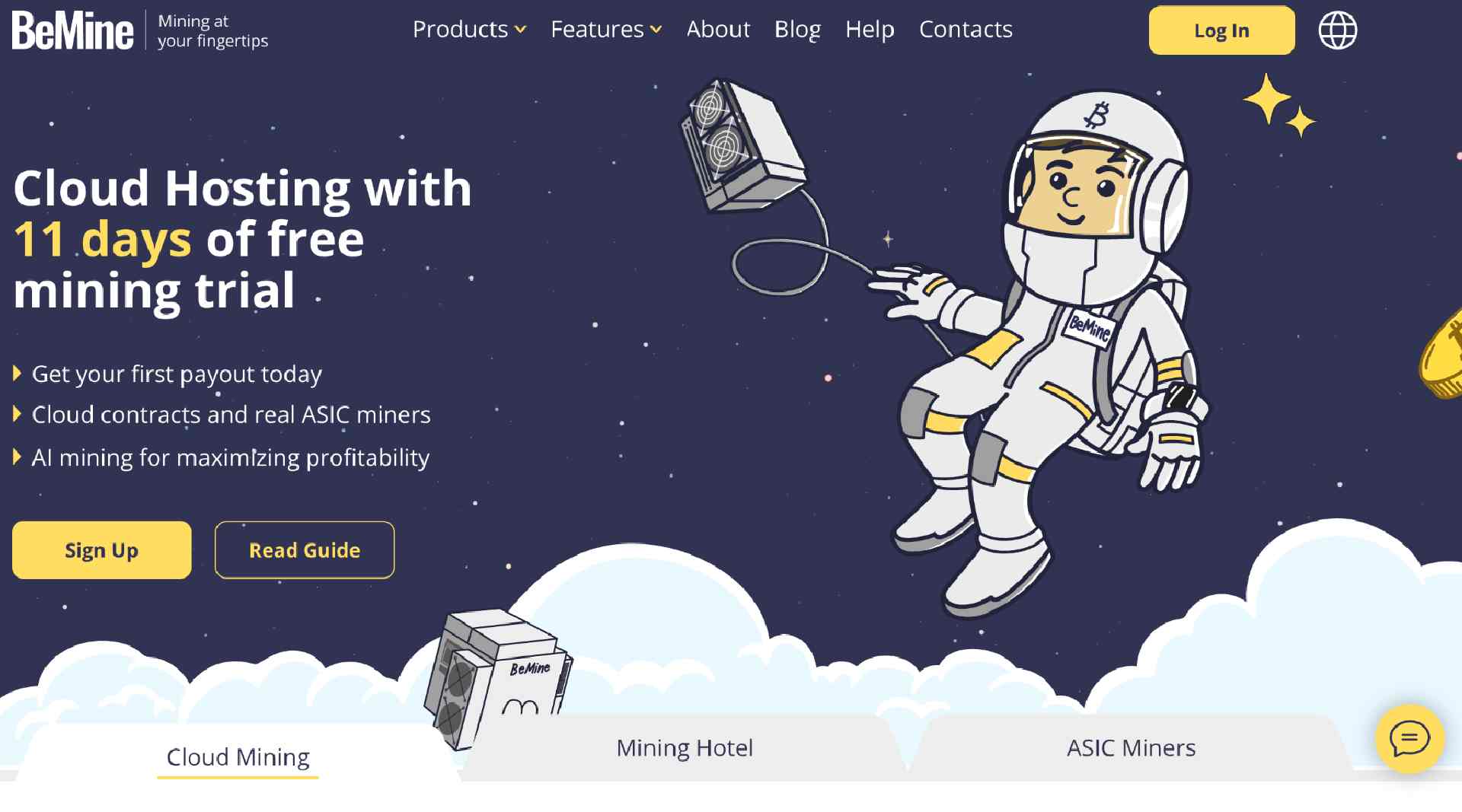
1. BeMine (2018)
Best for: Users who want exposure to real mining hardware through fractional ASIC ownership rather than standard fixed-term cloud contract
| Minimum Entry | Payout Frequency | Contract Duration | Withdrawal Threshold |
|---|---|---|---|
| Flexible, starting at around $100–$200 | Daily BTC payouts | Perpetual ASIC share ownership + 12–24-month mining packages | Minimum withdrawal from 0.0025 BTC |
Pros & Cons of BeMine
| Pros |
|
| Fractional access to real ASIC hardware | The range of available hardware may be narrower than on some competing platforms |
| Upgrade and exchange options for hardware exposure | Entry cost and withdrawal threshold are not the lowest in the segment |
| Daily BTC payouts | The ownership model may require a bit more research than a simple fixed-term contract |
| Real-equipment-backed packages hosted in partner data centers — including large-scale infrastructure partners | |
| Active promotional and trial ecosystem, backed by responsive customer support | |
BeMine Overview
Since 2018, BeMine has built a model that stands apart from standard cloud mining contracts. Users can buy shares in real ASIC miners hosted in partner data centers — including large-scale facilities like BitRiver — without needing to manage a full machine. Users who purchase a full unit can also have it delivered.
Beyond shares, BeMine offers direct hardware purchases with worldwide delivery, as well as simpler mining packages for a more passive setup. It's an accessible entry point for beginners and a more hardware-grounded option for those who want something closer to real mining.
Current offer: New users can get a $30 bonus, plus access to an 11-day trial mining offer worth around $150 in Bitcoin, when registering through this link.
2. NiceHash (2014)
Best for: Users who want marketplace-style BTC mining instead of long-term contracts
| Minimum Entry | Payout Frequency | Contract Duration | Withdrawal Threshold |
| From 0.001 BTC per order | Varies by setup; payouts depend on the selected pool and are not centered on a simple BTC cloud mining model | No fixed contracts; marketplace-based orders can be canceled | From 0.0005 BTC for BTC withdrawals |
Pros & Cons of NiceHash
Pros | Cons |
Long-standing and highly recognizable brand in the mining market | Not a traditional hardware-ownership model |
No fixed contracts on the marketplace, with flexible order-based access | Payout timing can vary depending on whether users rely on external pools or different NiceHash product flows |
Low entry point for marketplace buyers, starting from 0.001 BTC per order | Better suited to short-term hashrate buyers than users seeking long-term exposure to specific equipment |
Supports fast, frequent payout mechanics within its ecosystem | The platform’s structure is more marketplace-driven and may feel less straightforward than classic cloud mining offers |
Completed its repayment program after the 2017 security breach | Profitability can depend heavily on marketplace conditions, selected algorithms, and product flow rather than a simple BTC mining model |
Founded in 2014, NiceHash is one of the best-known names in mining. It operates as a hashrate marketplace rather than a traditional cloud mining platform, and unlike more hardware-linked companies, it doesn't offer physical hardware ownership or equipment delivery.
3. ECOS (2017)
Best for: Users looking for long-term BTC cloud mining contracts
| Minimum Entry | Payout Frequency | Contract Duration | Withdrawal Threshold |
| Starting from around $150 | Daily BTC payouts | Typically 36 months | From 0.001 BTC |
Pros & Cons of ECOS
| Pros | Cons |
| Established Armenia-based mining brand with a long-running FEZ narrative | More contract-led than ownership-based, which may be less appealing to users seeking direct hardware exposure |
| Long-term BTC cloud mining contracts tied to hashrate | Long-term contracts may feel less flexible than shorter marketplace-style options |
| Built-in wallet and broader app ecosystem | Product terms and economics still require careful review before purchase |
| Mobile app and profitability tools make the platform easier to navigate | |
ECOS Overview
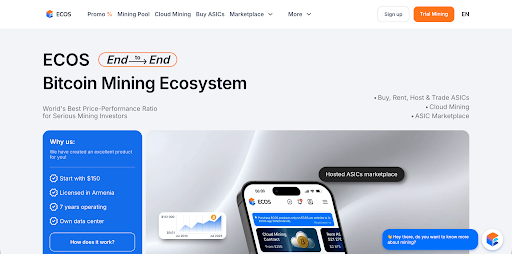
Founded in 2017, ECOS is one of the longer-running names in cloud mining, closely associated with its Armenia-based operations. Beyond mining contracts, it offers a broader app-based ecosystem including a wallet and other crypto tools.
4. Bitdeer (2018)

Best for: Users who want flexible BTC hashrate plans
| Minimum Entry | Payout Frequency | Contract Duration |
|
Varies by plan (availability can be limited) | Daily pool-based payouts | Flexible plan terms, from short-term to long-term | Set by mining pool |
Pros & Cons of Bitdeer
| Pros | Cons |
| Public, SEC-reporting company with a large-scale mining profile | Electricity fees and net returns can require more active monitoring |
| Wide range of BTC hashrate plans, including short-term options | Payout timing and thresholds depend on the selected pool setup |
| Mining rewards are paid directly by the connected pool | Product economics can be harder to compare than simpler cloud mining offers |
| Daily payout structure is available on current BTC plans | Not an ownership-based mining model |
| Plan availability can be limited, with some BTC offers frequently marked as sold out | |
Bitdeer Overview
Bitdeer is one of the more structured cloud mining platforms, combining large-scale infrastructure with preset BTC hashrate plans across different time horizons. Users choose from fixed plans with varying contract lengths, hashrate levels, and electricity fees — making it better suited for comparing plan economics than gaining direct hardware exposure.
5. Genesis Mining (2013) — Legacy Mention
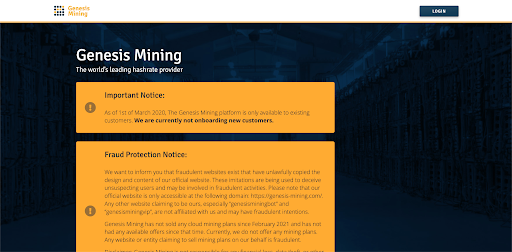
Best for: Historical context and legacy brand comparison; not currently available to new users
| Minimum Entry | Payout Frequency | Contract Duration | Withdrawal Threshold |
| Not available for new users | N/A | N/A | N/A |
Pros & Cons of Genesis Mining
| Pros | Cons |
| One of the oldest cloud mining brands | Not open to new users |
| Still widely recognized in the market | Not currently selling mining power |
| Scam and impersonation risks around the brand name | |
Genesis Mining Overview
Genesis Mining is one of the oldest cloud mining brands and was once one of the best-known names in the industry. Today, though, it is no longer a practical option for new users, since the platform has for years limited access to existing customers only.
Best Cloud Mining Platforms 2026 Comparison Table
Cloud Mining Platforms | Minimum Entry | Payout Frequency | Contract Duration | Withdrawal Threshold |
| 1. BeMine (2018) | Flexible, starting at around $100–$200 | Daily BTC payouts | Perpetual ASIC share ownership + 12–24-month mining packages | Minimum withdrawal from 0.0025 BTC |
| 2. NiceHash (2014) | From 0.001 BTC per order | Varies by setup; payouts depend on the selected pool and are not centered on a simple BTC cloud mining model | No fixed contracts; marketplace-based orders can be canceled | From 0.0005 BTC for BTC withdrawals |
| 3. ECOS (2017) | Starting from around $150 | Daily BTC payouts | Typically 36 months | From 0.001 BTC |
| 4. Bitdeer (2018) | Varies by plan (availability can be limited) | Daily pool-based payouts | Flexible plan terms, from short-term to long-term | Set by mining pool |
| 5. Genesis Mining (2013) | Not available for new users | N/A | N/A | N/A |
How we evaluated the platforms
We assessed longevity, market cycle performance, and 2026 relevance. We compared service structure, entry cost, payout frequency, withdrawal conditions, and fee transparency — to highlight platforms that remain relevant and meaningfully different.
Is cloud mining profitable in 2026?
Profitable but not guaranteed. Returns depend on BTC price, network difficulty, and contract terms. The 2024 halving cut rewards to 3.125 BTC, tightening margins. Profitability comes down to pricing, payout terms, and transparency. Treat it realistically — not as passive income.
How to choose the best cloud mining site
Start with the mining model — contracts, hashrate plans, or real hardware. Compare entry cost, payout frequency, and fee clarity. Prioritize track record, since many platforms don't survive full market cycles. A good site should be easy to understand before you invest.
Risks of mining BTC online
The main risk is the platform itself. Returns can fall if Bitcoin drops, difficulty rises, or fees are hidden. Some platforms disguise weak economics behind marketing. Always check track record, payout rules, and fee transparency before investing.