RWAs are booming. DeFi-Native Exposure Is Taking Shape on TON

The RWA Boom and Growth of Tokenized Assets
Diversification is no longer just “more tokens”
DeFi solved something legacy systems never fully delivered. Anyone can hold assets directly, move capital instantly, and execute strategies without permission. Yet crypto investors still face a portfolio problem: diversification across tokens, protocols, and strategies often leaves them exposed to the same driver — crypto liquidity.
That’s why real-world assets (RWAs) became the next major conversation — not as a buzzword, but as a portfolio primitive. They provide exposure to credit, commodities, and equities driven by different fundamentals than crypto assets. The catch is that many RWAs still come with the structures DeFi users tried to leave behind: heavy intermediation, custodians, jurisdictional limits, and permissioned access.
The story is shifting. RWAs are not just arriving on-chain — they’re beginning to integrate with DeFi in ways that feel native to self-custody, on-chain execution, and composability.
RWAs are an emerging asset class and the numbers show it
A few years ago, RWAs on public blockchains were mostly experimental. Today, the market is large enough to measure and track like a real asset class.
The RWA.xyz dashboard for tokenized real-world assets, currently shows around $21B in on-chain RWAs with 620,073 total asset holders and over 10-fold growth over the last 2 years (Figure 1). That same dashboard also shows how big the broader tokenized conversation has become when you include stablecoins with $297.68B in value, held across 220.12M holders.
Figure 1: RWA value
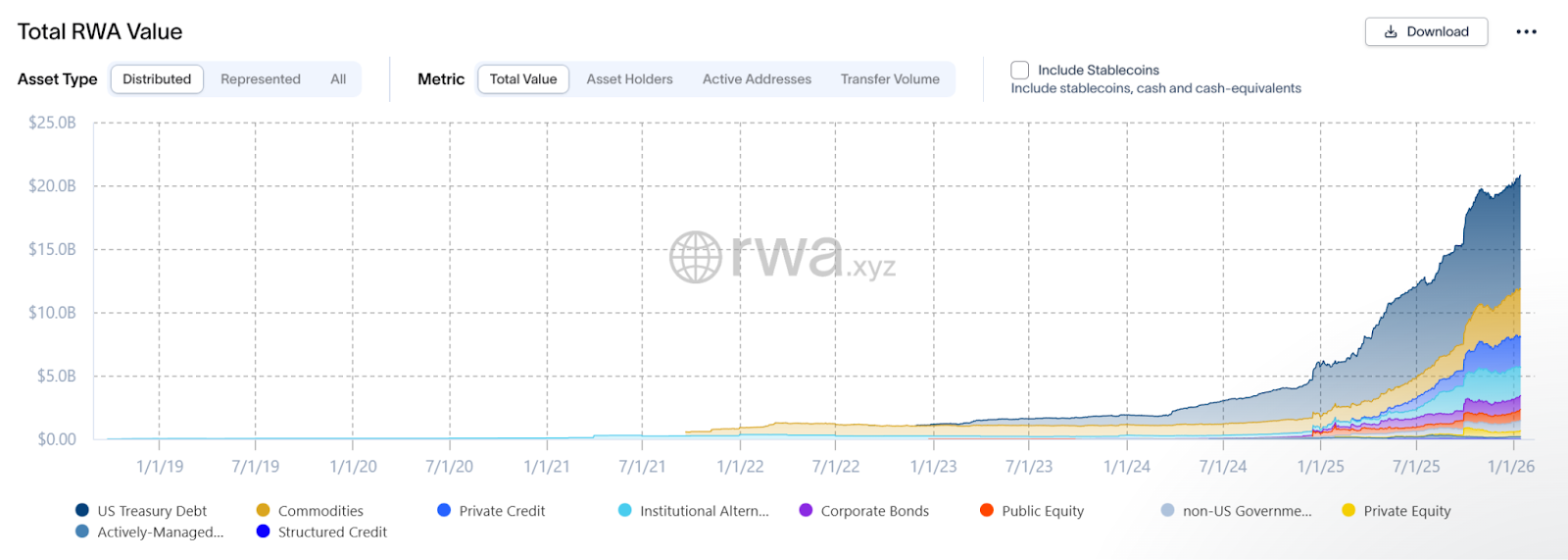
Within RWAs, one segment became a clear flagship in the last year. Tokenized U.S. Treasuries now hold about $9B across 62 products and 58,979 holders, up from $3.8B a year ago — showing investors are willing to hold yield-bearing off-chain exposure in token form at scale.
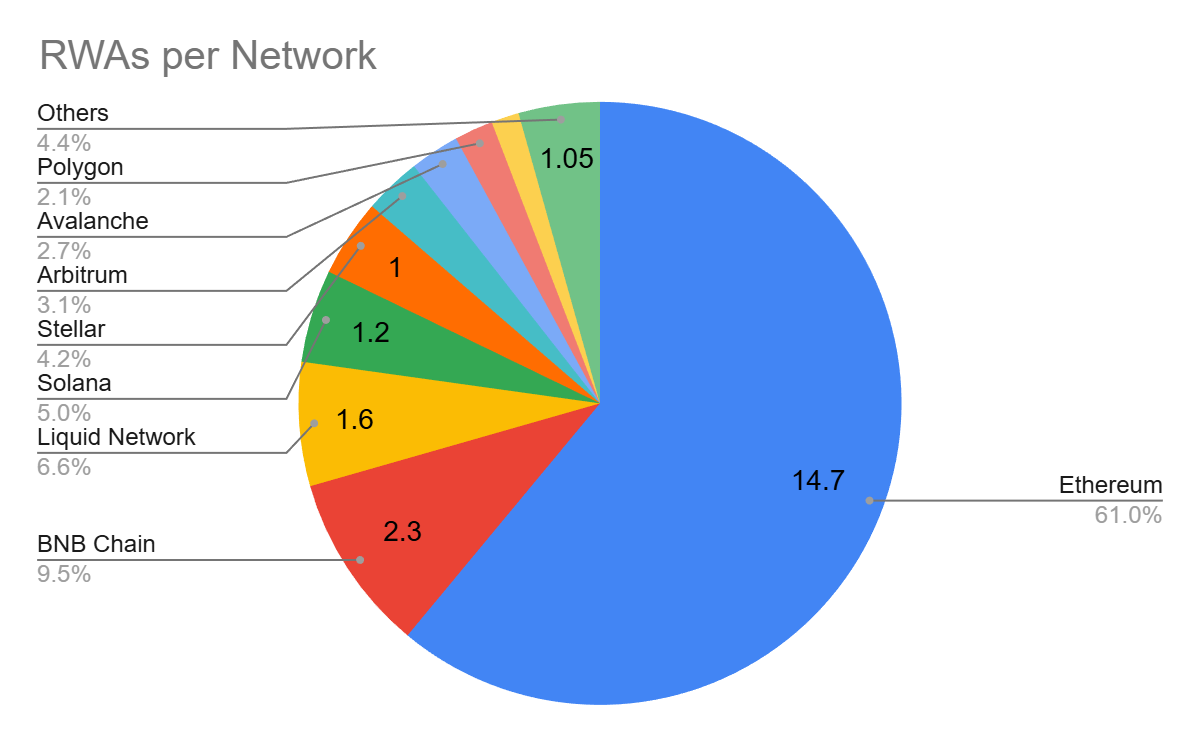
There’s also a second signal hidden in plain sight: where RWAs live. RWA.xyz’s network breakdown shows Ethereum still dominates distributed RWAs, with roughly $12.8B in value and about 61% market share in the distributed category (Figure 2). Many still assume RWAs are mainly an Ethereum story. But the asset class is now large enough that distribution matters as much as issuance. The winners won’t just tokenize assets first — they’ll make RWAs usable in the ecosystems where users already operate.
Figure 2: RWAs per network
Beyond today’s on-chain totals, macro expectations are large even by institutional standards. McKinsey estimates that tokenized market capitalization across asset classes could reach around $2 trillion by 2030 in its base case (excluding cryptocurrencies and stablecoins), with scenario ranges spanning roughly $1T to $4T. Other forecasts have been even more aggressive. BCG has published projections framing tokenization as a multi‑trillion‑dollar opportunity, including a widely cited estimate of $16T by 2030 for tokenization of illiquid assets.
Projections aren’t guarantees, but the trajectory is clear: RWAs have moved from narrative to a measurable market.
The uncomfortable truth: much of RWA is still centralized by design
If RWAs are growing, why aren’t more DeFi users using them? Because many RWA models often recreate TradFi’s dependency stack. The asset is off-chain. The custody is off-chain. The legal structure is off-chain. Access is frequently permissioned. And the rails, such as banks, broker-dealers, regulated distributors, still define who can participate and where.
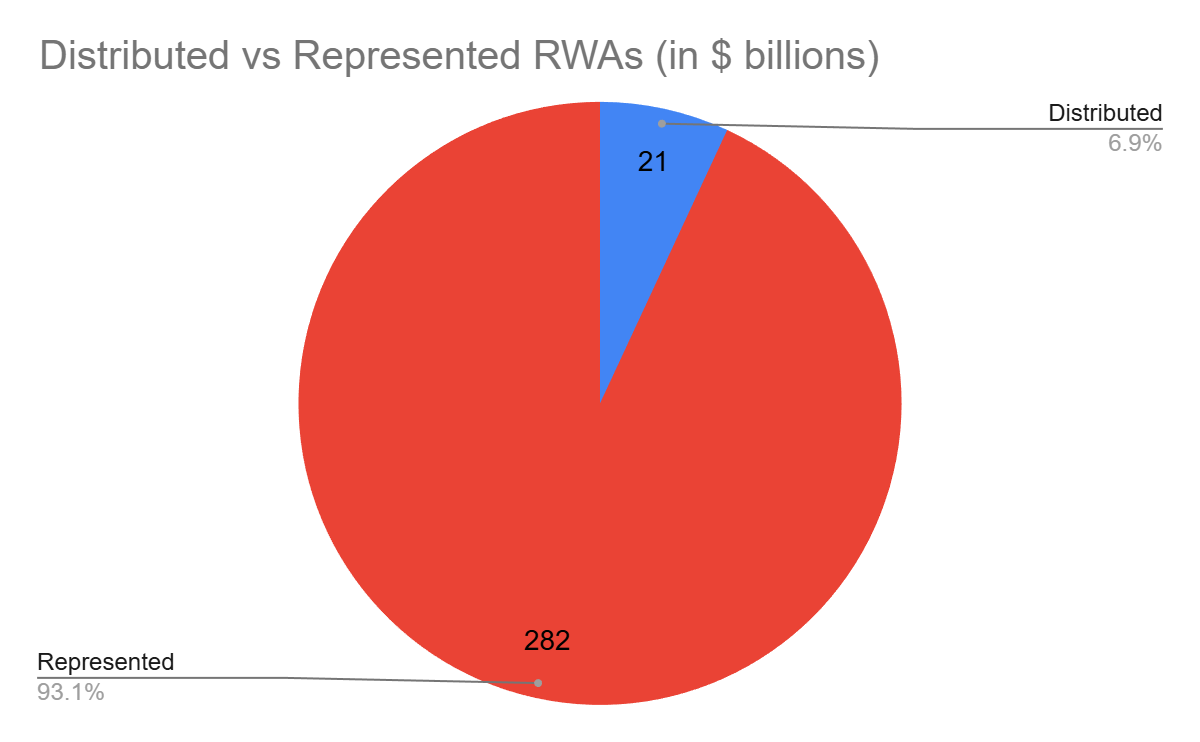
RWA.xyz captures this structurally with a distinction that’s more than semantics: Distributed versus Represented assets. Distributed assets can be moved to external wallets and transferred between wallets (even if eligibility controls exist). Represented assets cannot be moved out of the issuing platform or transferred between wallets, whether due to design choices or regulatory constraints. In that model, blockchain functions mainly as a recordkeeping and reconciliation layer rather than an open distribution channel.
The scale of represented RWAs is not small. RWA.xyz currently shows over $280B in represented asset value. This is an order of magnitude larger than distributed RWAs (Figure 3). That number captures the industry’s tension. Tokenization activity is large, but much of it is optimized for institutions and internal infrastructure rather than open DeFi markets.
Figure 3: Represented vs Distributed RWAs
Geography and regulation remain a practical bottleneck. Issuers often restrict distribution, require licensed intermediaries, and limit who can buy. For instance, Backed, a Swiss-based issuer of tokenized securities, states in its documentation that its products are not offered directly to the public but through licensed entities, with restrictions on U.S. persons and certain jurisdictions.
These constraints are the cost of issuing regulated financial exposure. But they shape the user experience. For a global DeFi user, traditional RWAs can feel less like open finance and more like a patchwork of gated access points.
So the critique isn’t that RWAs are fake. The critique is that many RWAs are not DeFi-native yet. They are tokenized instruments that still behave like traditional products in how they are accessed, custodied, and controlled.
The shift: on-chain RWA exposure via xStocks on TON
This is the gap xStocks on STON.fi targets — bringing regulated market exposure into a workflow familiar to DeFi users: wallet-native, self-custodied, and tradable on-chain.
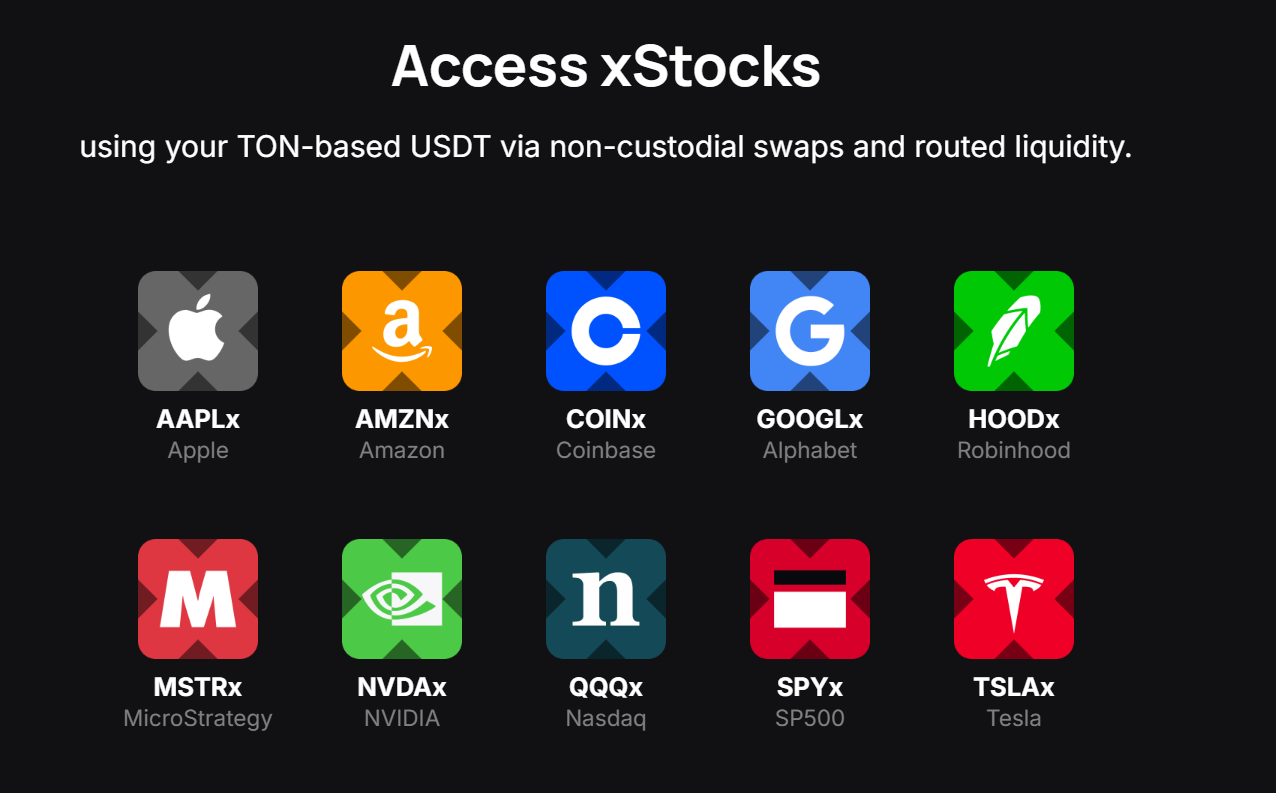
xStocks on STON.fi are tokenized representations of selected traditional market assets from the U.S. market, issued on TON by Backed Assets (JE) Limited and designed to track the value of the underlying asset, allowing eligible users to swap them within the TON ecosystem. Legally, xStocks are tokenized securities (tracker certificates), representing debt obligations of the issuer that track the value of publicly listed equities or ETFs. They do not confer shareholder or voting rights in the underlying assets. STON.fi’s launch roster includes recognizable names and indices such as AAPLx, NVDAx, TSLAx, and others (Figure 4).
Figure 4: xStocks assets
The core comes down to four DeFi-native advantages. First, self-custody remains the default. STON.fi emphasizes that users retain control of assets, and its role is infrastructure rather than brokerage. It does not issue, sell, or distribute xStocks and does not act as a broker, dealer, exchange, or investment adviser. That matters for DeFi users because custody is not a feature, but a baseline expectation.
Second, the product is structured around transparent issuance and backing. xStocks is a tokenized tracker certificates issued as freely transferable, on-chain securities, each tracking a publicly listed equity or ETF on a 1:1 basis and fully collateralized by the underlying asset. STON.fi’s Proof-of-reserves is being built in by the issuer and custodian. Hence, xStocks are backed by real assets at 1:1 ratio.
Third, execution is designed to feel like DeFi, not like a brokerage. xStocks are issued by Backed Finance and users can find and swap xStocks on STON.fi like any TON asset. The execution and pricing are handled by independent third-party resolvers through the Omniston protocol to reduce slippage and improve pricing. This is a very DeFi-native approach to a TradFi-native exposure. It improves market access not by creating another custodial silo, but by improving routing, liquidity, and execution on-chain.
Fourth, the “always-on” aspect is operational, not theoretical. xStocks are accessible to on-chain markets 24/7, with some venue and product limitations. “Always-on” doesn’t remove market structure realities — it simply means portfolio management and transfers don’t stop when traditional exchanges close.
This is the narrative shift. On-chain tokens that reference RWAs don’t have to mean TradFi wrapped in blockchain language. On TON, xStocks are framed as regulated, fully collateralized market exposure that can live in a self-custodied wallet, swap like a token, and integrate with the ecosystem’s DeFi tooling. However, it keeps the legal reality visible rather than pretends it doesn’t exist.
RWAs are getting real and now they’re getting usable
RWAs have already crossed the threshold from idea to market. The data shows scale, growth, and clear product-market fit in segments like tokenized treasuries, while also revealing the industry’s main limitation. Much of the tokenization remains represented, permissioned, and tied to institutional rails.
That’s why the next phase matters more than raw issuance numbers. The next phase is distribution and usability — whether RWAs can be held, traded, and managed where crypto users already operate without reverting to broker chains.
With xStocks integrated into STON.fi’s decentralized swap protocol, tokens that provide price exposure to RWAs take a step toward a more DeFi-native form. It is a familiar equity and ETF exposure, designed to be held in self-custody on TON, and is interacted with through protocol-native swap flows, while issuance and collateralization remain governed by regulated frameworks.
Portfolio liberation doesn’t mean ignoring constraints — it means expanding choice. RWAs are becoming a serious asset class, and eligible users now have more DeFi-native ways to access them.
Researched and written by Slavik Baranov, CEO of STON.fi Dev, an independent development company contributing to STON.fi protocols and interfaces. STON.fi is one of the leading AMM protocols on TON blockchain.
Disclosure:
xStocks are tokenized securities (tracker certificates). Access is restricted by jurisdiction. STON.fi does not issue, list, or provide access to trading of xStocks. Any interactions with xStocks occur via third-party providers and only in permitted jurisdictions. This column is for informational purposes only and does not constitute an offer or solicitation of securities.
Also read:









.webp)