Bedrock Price Prediction: Will BR Recover After Binance Airdrop?

Bedrock Price Prediction: BR Hits MEXC & Binance—What’s Next?
Bedrock (BR) just had one of the busiest 48 hours any small-cap DeFi token could ask for.
The Binance Alpha airdrop went live on May 11; MEXC opened BR/USDT spot trading the same day, and the chart immediately started telling a story that most traders recognize—a fast pump, then a structured pullback that is still playing out right now.
The Bedrock price prediction 2026 matters a lot more today than it did two weeks ago
Because this is no longer a quiet restaking protocol trading on one exchange.
It is now visible to millions of users across Binance's ecosystem and MEXC's 34 million user base.
Whether that visibility turns into sustained price action depends on a few things—and the chart gives us a pretty clear framework for what to watch.
BR is currently trading around $0.1388–$0.145 on KuCoin and Bybit.
Binance Alpha Airdrop: What Actually Happened and Why It Moved the Market
Binance Wallet's official announcement was straightforward — users with at least 241 Binance Alpha Points could claim 225 BR tokens on a first-come, first-served basis.
Claiming consumed 15 Alpha Points per wallet, and users had 24 hours to confirm on the Alpha Events page or forfeit the claim.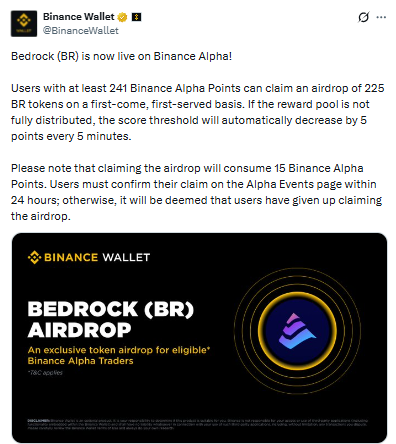
That structure created something very specific in the market: urgency. Traders rushed to qualify. Volume spiked.
The token, which had already been building momentum from its BTCFi narrative, saw a push toward the $0.206 resistance zone in early May.
Then the natural unwind began.
Airdrop participants who got 225 free BR tokens had no cost basis.
For them, $0.14, $0.15, or $0.16 is all profit. That kind of selling pressure does not discriminate — it hits regardless of how good the fundamentals are.
The result was a 32% drawdown from peak to current levels over the span of seven days.
This is not a collapse. It is a listing flush. And understanding that difference is central to any serious Bedrock price prediction 2026 analysis.
The Binance Alpha platform also functions as a screening mechanism. Projects listed there are not guaranteed a main Binance spot listing, but the pathway exists.
For BR, that potential upgrade is now one of the biggest price catalysts on the table for the rest of 2026.
MEXC Listing for BR: Spot and Futures, 150,000 USDT Prize Pool
MEXC confirmed BR/USDT spot trading on May 11, 2026, at 10:00 UTC—the same day as the Binance Alpha airdrop.
The exchange also launched BR perpetual futures with up to 50x leverage in both cross and isolated margin modes.
To celebrate the listing, MEXC ran an Airdrop+ campaign with a 150,000 USDT prize pool.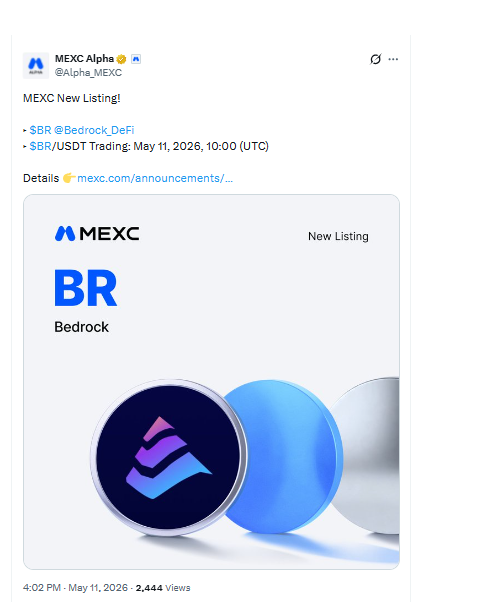
MEXC serves over 34 million users across 170+ countries. When a token like BR gets listed there alongside a futures market, it fundamentally changes who can access and trade it.
Retail traders in Asia, specifically India and Southeast Asia, now have a familiar regulated-ish platform to buy BR/USDT without routing through DEXes.
The futures listing is a double-edged sword, though. Leveraged shorts became available immediately, which means bearish traders could amplify selling pressure in the short term.
That is partly what contributed to the sharp pullback from $0.206. Once leverage enters the picture, moves in both directions get exaggerated.
For the Bedrock price prediction 2026, the MEXC listing adds both liquidity and volatility.
In the medium term — Q3 and Q4 2026 — that liquidity is a net positive. More participants means better price discovery and less susceptibility to thin-market manipulation.
Reading the Chart: Falling Wedge and What It Actually Means
The 4-hour TradingView-KuCoin chart tells the story clearly.
After the listing pump pushed BR to a peak near $0.2062, the token entered a falling wedge—two compressing blue trendlines that have been squeezing price action lower for about two weeks.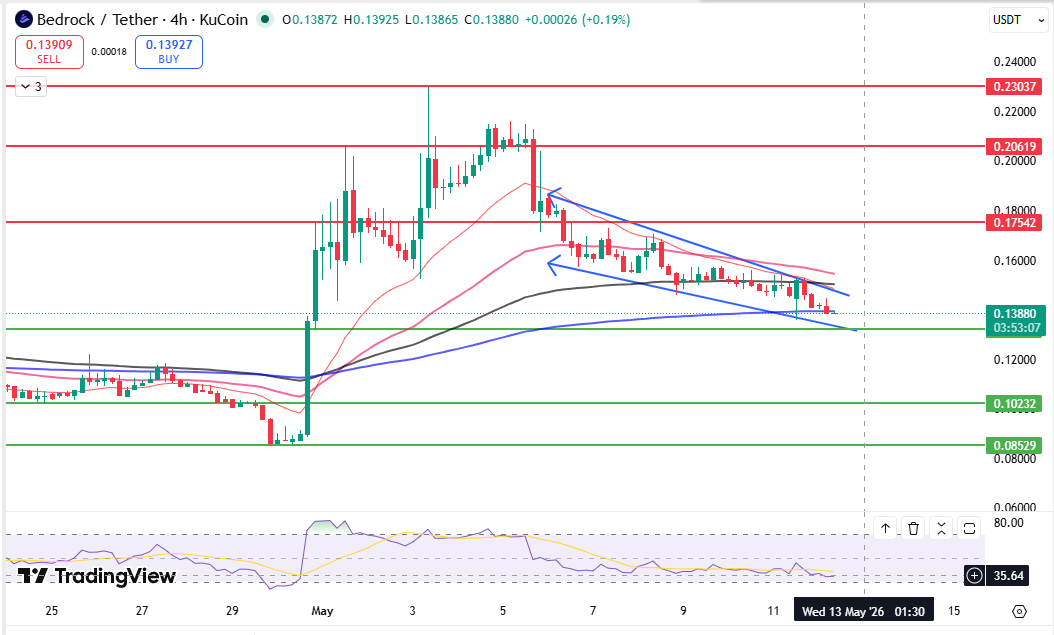
The moving averages on the chart — the pink short-term MA and the grey long-term MA — are both still above the current price.
That means the trend structure has not fully recovered from the listing flush. These MAs are acting as dynamic resistance.
The RSI on the 4-hour timeframe has been hovering in the 30–40 range. Technically approaching oversold, but not quite there yet.
Oversold RSI alone does not trigger a bounce, but it does reduce the probability of another sharp leg down from current levels.
Key Levels for Bedrock BR Price Prediction 2026:
Support:
-
$0.1388 — Current major support, lower channel boundary, high-volume horizontal zone. This is the battleground.
-
$0.1023—Next structural support if $0.1388 is loses on a daily close with volume confirmation
-
$0.0853 — Deep support, likely a multi-week accumulation zone if reached
Resistance:
-
$0.1754 — First meaningful overhead, previous consolidation, likely where short-term sellers re-emerge
-
$0.2062 — The post-listing high, major supply zone
-
$0.2304 — Upper-end resistance, only reachable with a strong macro catalyst or exchange upgrade
A confirmed daily close above $0.1754 with volume recovery in the $3M–$5M daily range would be the first signal that the listing flush is done and real buyers are accumulating.
Until that happens, the falling wedge is still in control.
Bedrock Protocol Fundamentals: Is There a Real Business Behind BR?
This is where the Bedrock price prediction 2026 gets more interesting than just chart levels.
Bedrock is a multi-chain liquid restaking protocol focused on BTCFi — the emerging space of putting Bitcoin to work in DeFi while keeping liquidity.
Its two flagship products, uniBTC and brBTC, allow users to stake BTC and earn yield without surrendering the asset.
The protocol crossed $1.2 billion in TVL by May 1, 2026, following a 90% price surge driven by strong adoption metrics.
The Babylon partnership was a key driver of that TVL growth. Babylon enables Bitcoin staking natively, and Bedrock's integration created a direct pipeline for BTC holders looking to earn DeFi yields.
By the end of March 2026, the protocol had secured over 6,200 BTC across all networks — a number that reflects real utility, not just speculative interest.
The veBR governance model—where BR tokens are locked 1:1 for non-transferable veBR—introduces a supply-tightening mechanic.
Longer lock periods give more voting power and higher yield boosts. If a significant portion of circulating BR gets locked for governance, available sell-side supply decreases.
That is the Curve Finance (CRV/veCRV) playbook, and it has a proven track record of affecting token price over time.
Total supply is 1 billion BR.
Currently, around 261 million BR are in circulation. There are 131 million tokens in a scheduled unlock that was approaching in March 2026.
That unlock is a risk — if a large tranche hits the market without corresponding demand, price pressure follows.
BR Token Price Prediction 2026: Scenario-Based Targets
Given the chart structure, listing catalysts, and fundamentals, here is how the Bedrock price prediction 2026 breaks down across three scenarios:
Bearish Scenario: $0.1388 support breaks. Selling pressure from token unlocks and airdrop overhang pushes BR toward $0.1023 and potentially $0.0853.
This plays out if broader crypto sentiment turns negative or the MEXC futures market sees sustained short pressure.
-
Q2 2026 range: $0.085–$0.110
-
EOY 2026 target: $0.095–$0.125
Base Case: The listing flush completes near current levels. $0.1388 holds. BR gradually reclaims $0.1754 through Q3 as the BTCFi narrative strengthens and veBR adoption reduces sell pressure.
-
Q3 2026 target: $0.155–$0.175
-
EOY 2026 target: $0.175–$0.206
Bullish Scenario: Binance upgrades BR to a main spot listing. TVL crosses $2B on uniBTC and brBTC. The veBR locking rate exceeds new emissions. BR tests $0.23 and potentially pushes toward $0.26 by year-end.
-
Q3 2026 target: $0.206–$0.230
-
EOY 2026 target: $0.230–$0.260
Most analysts tracking the Bedrock BR price prediction 2026 land in the base case range, with $0.175–$0.206 as the year-end consensus for moderate market conditions.
Bedrock Price Prediction 2026 — Monthly Targets
Analyst View on Bedrock BR
The dual listing on Binance Alpha and MEXC was a significant moment for BR — not just in terms of price, but in terms of protocol credibility.
Getting into Binance's ecosystem, even at the alpha stage, signals that the project cleared a meaningful compliance and quality bar.
The chart, however, reflects the reality of early-stage listings. Airdrop recipients selling free tokens, leveraged shorts building on MEXC futures, and momentum traders exiting after the pump — all of it creates noise in the first weeks.
The underlying question for the Bedrock price prediction 2026 is not what happens in May.
It is whether the BTCFi thesis holds and whether BR token captures a portion of that value.
The protocol has genuine infrastructure — Babylon integration, Chainlink security, cross-chain BTC restaking on Ethereum, Base, and Aptos.
The TVL numbers are real. The veBR locking mechanic, if adopted at scale, creates structural support. These are not empty narratives.
What traders should watch closely: the daily close behavior around $0.1388. If BR holds this level for 3–5 consecutive daily candles and volume stabilizes above $1.5M per day, that is the accumulation signal.
The $0.1754 reclaim confirms the trend shift. Without that, the falling wedge pattern remains in control through June.
Invalidation level for any bullish thesis: a weekly close below $0.1023 with volume. That scenario opens the door to $0.0853 and would require reassessment of the timeline.
Disclaimer: This article is published for informational and educational purposes only. Nothing in this content constitutes financial advice, investment recommendations, or a solicitation to buy or sell any cryptocurrency. The Bedrock BR price prediction 2026 analysis presented here is based on publicly available chart data, exchange announcements, and protocol metrics at the time of writing. Cryptocurrency markets are highly volatile. Past price performance does not guarantee future returns. Token prices can fall to zero. Always conduct your own research and consult a qualified financial advisor before making any investment decision. The publisher and authors of this article accept no liability for any financial losses arising from reliance on this content.