Bitcoin Price Prediction 2050 Next Generation Asset Value


Bitcoin Price Prediction 2050 Digital Gold Future Price
Bitcoin Price Prediction 2050 highlights a future where BTC is no longer just a cryptocurrency, but a next-generation global asset. As traditional financial systems evolve, Bitcoin is increasingly being viewed as a secure, decentralized store of value with long-term growth potential.
By 2050, factors like limited supply, rising global adoption, and technological integration could position Bitcoin as a core part of the financial ecosystem. From institutional portfolios to everyday transactions, BTC may play a much larger role than it does today.
What Makes Bitcoin Different From Every Other Asset?
Bitcoin is not a company. It has no CEO, no office, no quarterly earnings call. It is a protocol — a set of rules enforced by mathematics and a decentralized network of over 50,000 nodes globally. And yet it has grown from $0 in 2009 to a $1.6 trillion market cap asset in 16 years. That trajectory does not happen by accident.
The scarcity argument: There will only ever be 21 million Bitcoin. That number is not a corporate decision — it is hardcoded into the protocol. By 2040, over 99.8% of all Bitcoin will have been mined. New supply creation becomes essentially zero. Every halving event cuts the rate of new supply in half. The 2024 halving dropped the daily new supply from 900 BTC to 450 BTC. The 2028 halving will cut it to 225 BTC. Against growing institutional demand, this supply math is extraordinarily bullish.
• Bitcoin ATH: $109,114 reached in January 2026
• Current price (March 2026): ~$84,700 — down 22% from ATH
• Total supply cap: 21 million BTC — hardcoded, unchangeable
• Circulating supply: approximately 19.85 million BTC
• Spot ETF AUM: over $120 billion across all U.S. ETF products
• Staking/yield: no native yield — pure store-of-value asset
Bitcoin Price Prediction 2050: $10 Million Target Keeps Reappearing
The $10 million figure appears repeatedly across 2050 models because it comes from a consistent underlying calculation, not from coincidence. Global private wealth is estimated at $250 to $350 trillion. The global gold market cap is $18 trillion. Global fiat currency reserves held by central banks total approximately $14 trillion. If Bitcoin captures a combined 5% to 10% of these three asset classes by 2050, the implied market cap is $15 to $25 trillion — and at 21 million fixed supply, the implied price is $714,000 to $1.2 million. To reach $10 million, Bitcoin needs to capture more than 50% of global reserve assets. That is the calculation that drives every model landing near $10 million.
The $10 million Bitcoin by 2050 scenario is not about Bitcoin becoming a speculative asset. It is about Bitcoin replacing the role that gold and U.S. Treasuries currently play as the foundational neutral reserve assets of the global financial system. The math is straightforward. The probability is the debate.
What Makes 2050 Structurally Different From Every Previous Cycle
Bitcoin Price Prediction 2050: Bitcoin will have completed 10 halving events. Daily new supply will be approximately 3.5 BTC. To put that in context: three large institutional buy orders on a quiet Tuesday will exceed the entire day's new Bitcoin production. The asset becomes, for all practical purposes, completely supply-inelastic. Price becomes entirely a function of demand.
The generational holder effect: The current generation of young Bitcoin holders — those who bought between 2017 and 2026 — will be in their 50s and 60s by 2050. Many will have held Bitcoin through multiple cycles without selling. The behavioral shift from speculative trading to long-term wealth preservation is already visible in on-chain data, with the percentage of Bitcoin unmoved for 5-plus years consistently growing. By 2050, the effective liquid supply could be as low as 3 to 5 million BTC — creating supply conditions that make even modest demand growth extraordinarily price-impactful.
Bitcoin Price Prediction 2050 Case: $1.7 Million to $2.7 Million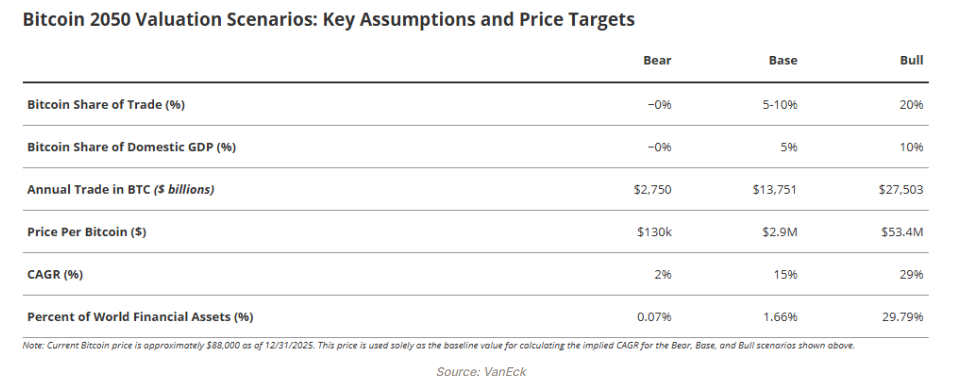
Bitcoin Price Prediction 2050 CoinCodex projects $1.757 million using algorithmic trend modeling without structural adoption assumptions. PricePrediction models $2.5 million. These represent the scenario where Bitcoin grows steadily but does not dominate global finance — more like a $25 to $35 trillion asset class, comparable to the combined global ETF and private equity markets today.
Even this conservative scenario represents a 20x return from today's $84,700 over 24 years — equivalent to an annualized return of approximately 13%. For comparison, the S&P 500 has historically returned 10% annually. Bitcoin's conservative 2050 scenario beats the stock market benchmark comfortably, without assuming it becomes the world's reserve currency.
Bitcoin Price Prediction 2050 VanEck Says Bitcoin could hit 3.4 million
Bitcoin Price Prediction 2050 VanEck, a New York-based asset management firm, has projected that Bitcoin could become a global reserve asset by 2050, potentially reaching a price of $3 million. The firm's long-term model suggests that Bitcoin could be held at around 2% by central banks and used in international trade settlements. VanEck emphasized that this target price, while seemingly extreme, represents an average annual growth rate of 16% over the coming decades, which they consider reasonable.
It is conceivable that Bitcoin Price Prediction 2050 could be used to settle 10% of the globe’s international trade and 5% of the world’s domestic trade. This scenario would result in central banks holding 2.5% of their assets in BTC. Using assumptions about global growth, investor BTC demand, and Bitcoin’s turnover, we apply a velocity of money equation to suggest a potential price of $2.9M per Bitcoin, translating to a total market cap of $61 trillion. Applying our existing framework for valuing Ethereum L2s, we estimate that Bitcoin L2s could collectively be worth $7.6T, approximately 12% of BTC’s total value.
Disclaimer: Bitcoin Price Prediction 2050 Cryptocurrency investments are highly volatile and involve significant risk. Prices can rise or fall rapidly, and you may lose part or all of your invested capital. The information provided is for educational and informational purposes only and should not be considered financial or investment advice.