Bitcoin's Warning Signs Are Stacking Up and the Next Move Could Hurt


Where Bitcoin Stands Right Now and What Losing $80K Actually Means
Bitcoin slipped under $80,000 this past week and did not ease its way down — it fell hard and fast. As of Monday morning, BTC trades at $76,869, a level that breaks a psychological floor traders had defended through most of Q1 2026.
The 52-week range tells the full story of how far this has come: Bitcoin peaked at $126,186 and has since retraced to lows near $60,187 before this latest stabilisation.
What makes this week's drop worth taking seriously is not the number alone. It is everything that arrived alongside it.
On May 13, US spot Bitcoin ETFs recorded a single-day outflow of $635.23 million — the largest since late January and a clear three-month high, according to SoSoValue data.
That broke a short stretch of positive flows and landed on the same day the Producer Price Index came in at 6%, well above market consensus, sharpening fears that the Federal Reserve will keep rates elevated far longer than the market had hoped.
As of 18 May 2026, Bitcoin broke below $77,000, and over $$3.68 million in long positions got liquidated in a single hour, with the majority of that — roughly $591.64 million — coming directly from flushed longs.
That kind of cascading wipeout does not happen in healthy markets.
The On-Chain Signal Analysts Are Watching Most Closely
Among all the metrics circulating this week, one is drawing the most serious attention from on-chain researchers: the average realised profit margin across Bitcoin holders has reached 17%.
To put that plainly — for the first time since October 2025, the average person holding Bitcoin is sitting on meaningful paper gains. And when that happens historically, they sell. That is not an opinion. It is the recurring pattern the blockchain data shows, cycle after cycle.
"The last time this exact reading appeared — 17% realised margin, Bitcoin simultaneously testing the 200-day moving average as overhead resistance — was March 2022. That moment marked the local top before a prolonged downtrend took hold for months."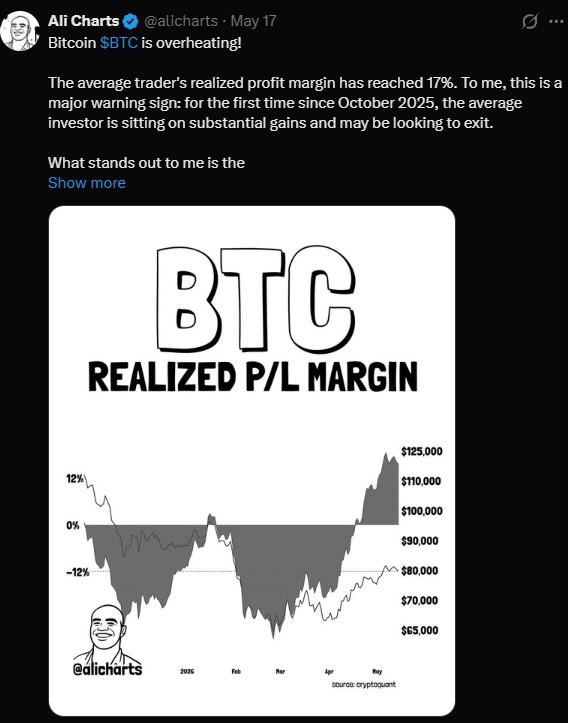
That same setup is back. Same margin level. Same moving average acting as a ceiling.
On-chain data from Glassnode also shows the market value to realised value (MVRV) ratio hovering near 1.1 — approaching historical undervaluation territory — while net unrealised profit and loss has slipped back into what analysts describe as a "Hope/Fear" regime.
Spot price sits well below the short-term holder cost basis of roughly $94,000 and under the True Market Mean near $80,100, which signals sustained pressure on anyone who bought in the last six months.
What the Chart Is Actually Saying
The structure has turned bearish. That is the clearest way to say it without dressing it up.
Bitcoin broke down from a rising channel it had held since January, got rejected sharply near $82,000, and then fell cleanly through the channel's lower boundary. That is a confirmed breakdown — not a test, not a wobble.
The 50-day moving average has now crossed below the price and is falling. RSI has drifted toward neutral, but the buying pressure behind it has visibly faded. Sellers quietly took control after weeks of failed bullish attempts.
Multiple analysts — including Rekt Capital and il Capo of Crypto — have independently overlaid the current 2025–2026 structure against the 2022–2025 cycle.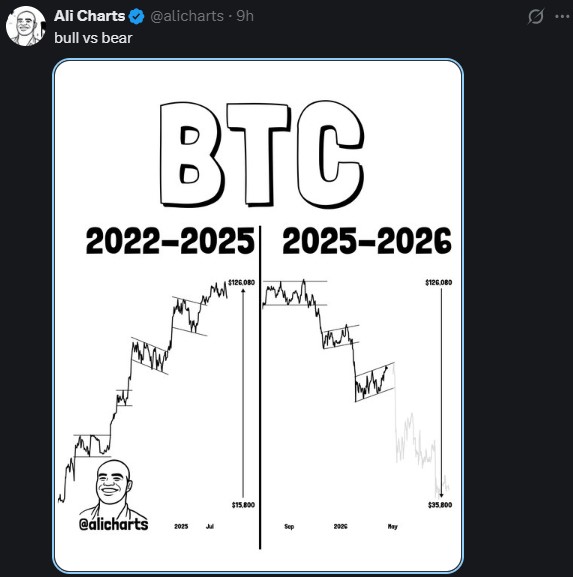
The resemblance is uncomfortable. Both show a peak near major highs followed by a gradual rollover that mirrors early 2022 almost beat for beat, right before the major crash that followed.
That does not guarantee a repeat. But it is not a chart pattern anyone should dismiss without a proper reason.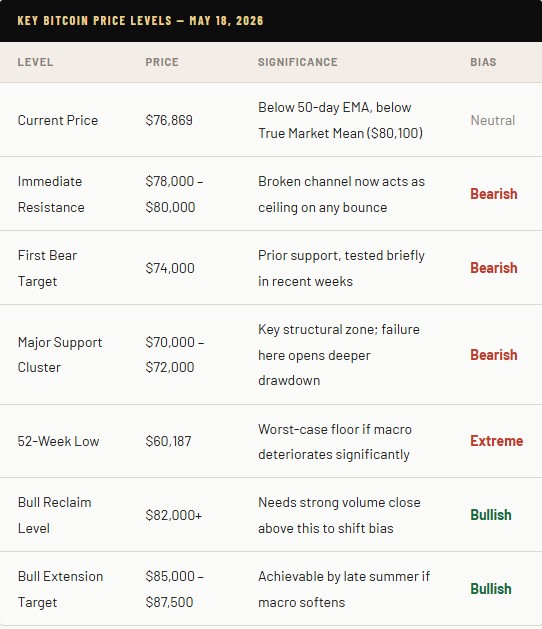
What Could Push Bitcoin Higher or Drag It Lower From Here
The bear case does not need anything dramatic to play out. Prolonged high interest rates, continued ETF outflows, and large holders maintaining selling pressure — if all three stay in place together, $70,000 comes into range faster than most current forecasts suggest.
The CPI reading for April came in at 3.8%, the highest since September 2023, which compounds the PPI shock and makes a Fed pivot look increasingly distant.
The bull case has a real structural foundation, and ignoring it is its own kind of bias. According to on-chain data tracked by Glassnode and BitcoinTreasuries.net, roughly 14.84 million BTC have not moved in over 155 days.
That is a significant share of the circulating supply held by long-term conviction holders who are not reacting to weekly candles.
On the derivatives side, total liquidations over the past 24 hours reached $181.86 million, with long positions accounting for the majority at $161.59 million, while short liquidations stood at $20.27 million.
This indicates that bullish traders faced significant losses as the market moved sharply against leveraged long positions.
A Federal Reserve pivot toward rate cuts, or a strong week of institutional inflows into spot ETFs, could flip sentiment in days.
Corporate buyers like Strategy, which now holds 818,869 BTC purchased at an average cost of $75,540 per coin, also provide a structural demand floor that is difficult to ignore.
Short-Term and Medium-Term Price View
In the short term, the data does not ask for optimism. The path of least resistance is lower. If $74,000 fails to hold, the $70,000–$72,000 zone becomes the next genuine test.
A bounce from that area accompanied by rising volume is the setup worth watching for signs of a base forming — not a rally call, but a first sign that sellers are exhausted.
Medium term, a recovery toward $82,000–$87,500 is a reasonable scenario by late summer if macro data softens and ETF flows return.
Changelly's model puts the average BTC price in May 2026 at around $81,557, with a maximum of $84,616.
For December 2026, projections climb toward $85,574 on average with an upper band near $89,740 — conditional on rate cut expectations improving.
The long-term thesis — scarcity, institutional adoption, a government Bitcoin reserve framework expected in mid-2026, and the Bitcoin Core v31.0 upgrade improving network efficiency — has not changed.
But "long term" is easy to say and hard to hold when a portfolio is down 15% in a fortnight. The near-term data is asking for caution, not conviction.
Bottom Line
Bitcoin is printing the same cluster of signals that appeared ahead of the 2022 crash: 17% realised profit margins, a broken rising channel, a sharp rejection at the 200-day moving average, ETF outflows hitting multi-month highs, and $591.65 million in liquidations in a 24-hour period. None of those things alone would be alarming. Together, they tell a clear directional story.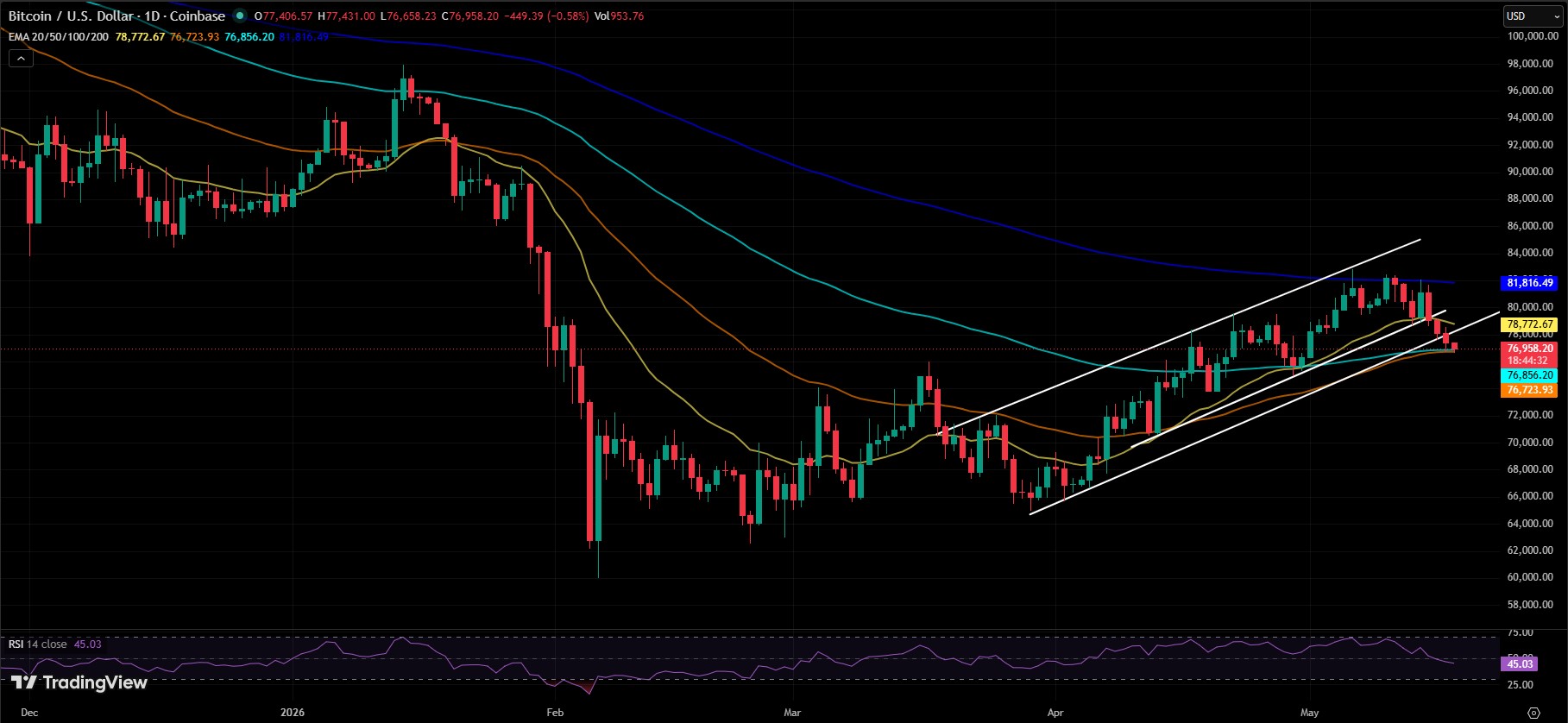
If $80,000 cannot be reclaimed and held with conviction, the $70,000–$72,000 zone becomes the next real test. Short-term traders need tight stops and smaller position sizes.
Long-term holders have history on their side — but history also shows that the next few weeks will decide which camp the summer belongs to.
Disclaimer: This article is for informational and educational purposes only and does not constitute financial, investment, or trading advice. Cryptocurrency markets are highly volatile. Past patterns do not guarantee future results. Always consult a licensed financial advisor before making investment decisions.
Also read:












.webp)