Bitcoin (BTC) Price Prediction for May 2026 — Bull Run or Breakdown?


Bitcoin Stuck at $79,000 — Can It Finally Break $80,000 in May?
Bitcoin has been knocking on $80,000 for two straight weeks now. Every time it gets close, it gets pushed back down. Right now, BTC is sitting around $78,000. April was actually a decent month — Bitcoin went up 12% — but that ceiling at $80,000 just won't budge.
So what happens next? Four things in May could finally decide whether Bitcoin breaks free or falls further — and they all hit within the first two weeks of the month.
What Is the Bitcoin Price Prediction for May 2026?
Most likely, BTC stays somewhere between $73,500 and $83,500 this month. The real test is the 200-day moving average sitting at $83,842. Bitcoin hasn't closed above that level since Jan 2026. If it does, things could get interesting fast; if it doesn't, expect more of the same sideways movement.
The first of those four catalysts arrives as early as May 5 — and it involves the company sitting on the biggest bet in the world.
Will Strategy's Q1 Earnings Report Affect Bitcoin Price?
Strategy reports earnings on May 5, and this one actually matters for Bitcoin. The company holds 818,334 BTC, and their average buying price is $75,537 per coin — barely below where it trades today.
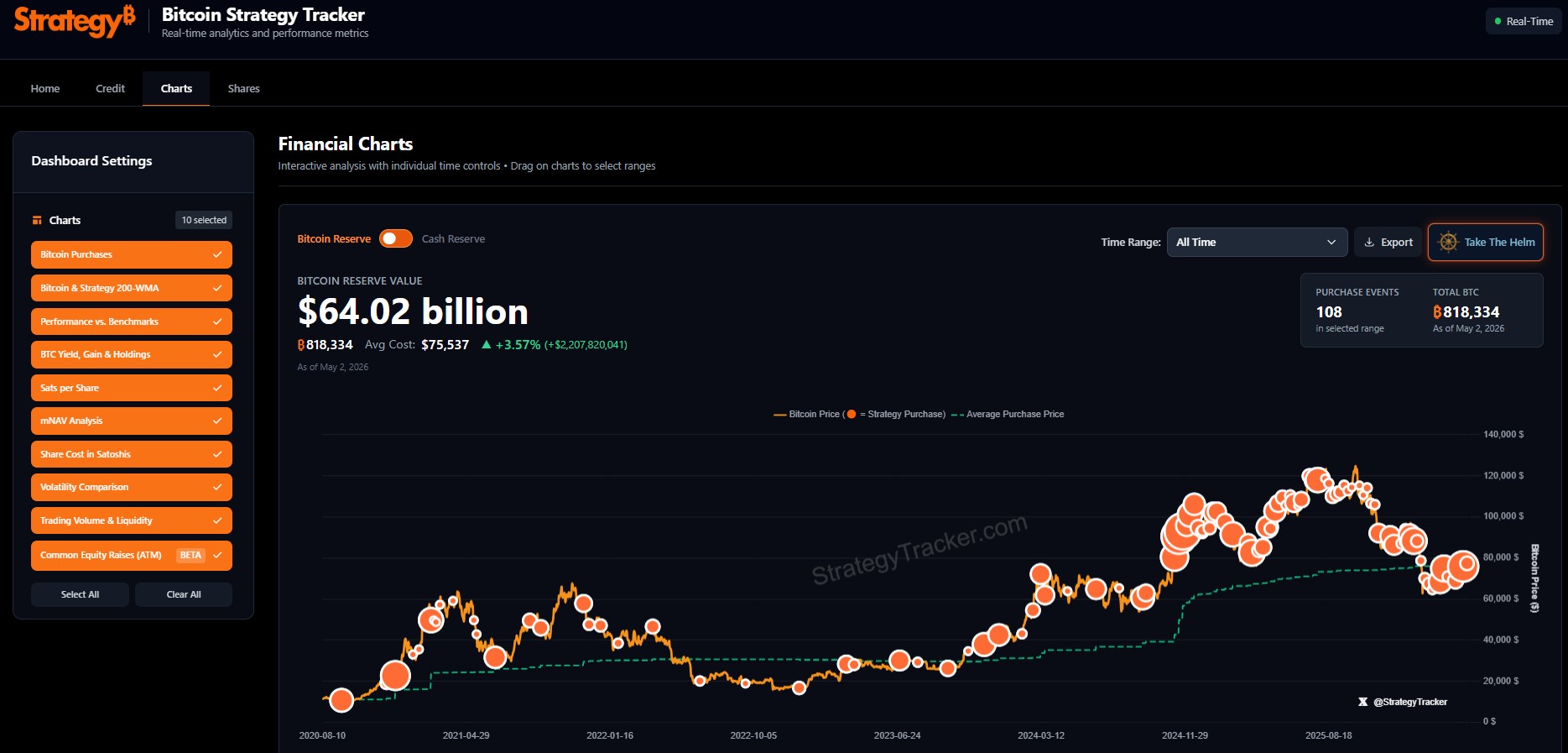
During Q1, BTC price crashed to $62,000. That means Strategy is sitting on roughly $14.46 billion in paper losses. The big question is whether Michael Saylor keeps buying or finally hits pause.
If he stops buying, the coin loses its most consistent buyer at the exact same time that ETF flows turn negative. That's not a great combo.
That brings us to the second catalyst — one that could reshape how the entire financial market thinks about rate cuts.
How Will Jerome Powell's Replacement Affect Bitcoin in May?
May 15 is Powell's last day as Fed Chair. Kevin Warsh is stepping in, already cleared by the Senate Banking Committee on April 29. The full Senate vote is expected the week of May 11.
Warsh won't chair his first Fed meeting until June, so no actual rate decisions happen in May. But what he says between now and then is what markets will react to.
He's been vocal about the 2022 inflation surge being the Fed's worst mistake in 40 years, and analysts at J.P. Morgan think he'll push for rate cuts faster than Powell ever did.
For the asset, a weaker dollar is the unlock. If Warsh's early statements spook dollar bulls, BTC gets a real shot at clearing $80,000.
But even if Warsh delivers the right tone, there's a third factor that could wipe out any gains overnight — the situation in Iran.
Could an Iran Ceasefire Push BTC price Higher?
This is the biggest wildcard of May. Iran sent a peace proposal to mediators in Pakistan on May 1, and oil markets reacted immediately — U.S. crude futures dropped nearly 5% on the news.
Two scenarios here. If the ceasefire sticks and oil falls back below $90, risk assets, including crypto, get room to rally. If the deal falls apart and Iran fully closes the Strait of Hormuz, Brent could spike toward $150, and that kind of macro shock historically drags Bitcoin down with everything else.
The war has quietly been hanging over BTC since late February. May could be the month it gets resolved.
How it ends will likely determine whether the fourth catalyst — ETF inflows — can hold up through the rest of the month.
Are Bitcoin ETF Inflows Coming Back in May?
As per Sosovalue, April was actually the best month for BTC ETF inflows all year — $2.62 billion came in over the first three weeks. A total of $1.97 billion inflow has been seen.
Then it stopped. Between April 27 and 29, roughly $490.63 million flowed back out across three sessions.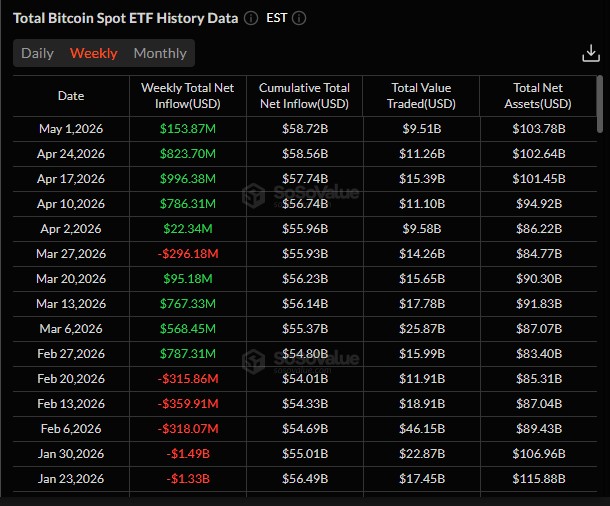
ETF flows have tracked BTC price pretty closely all year. When money comes in, the price goes up. When it leaves, the price drops. If inflows return in the first two weeks of May, that alone could be enough to push BTC above $80,000.
How High Can Bitcoin Go in May?
A clean daily close above $80,000 opens the door to $85,000 first, then $88,000. Beyond that, $100,000 becomes the next major target.
A few things back up the bull case. Wallets holding 1,000 BTC or more have bought 270,000 BTC in the last 30 days — the biggest single-month accumulation since 2013.
On top of that, the amount of BTC sitting on exchanges just hit a 7-year low, last seen in December 2017, right before BTC first crossed $20,000.
Short sellers are also heavily exposed right now. If the asset pushes above $80,000, those short positions get liquidated, which forces buyers into the market and can accelerate the move upward fast.
That said, the downside risk is just as real — and it's worth understanding exactly where the asset could fall if things go wrong.
How Low Can Bitcoin Drop in May?
The downside risk is real, too. Between $80,000 and $66,000, there's basically no major support — traders call this an "air pocket." If the coin falls back to $75,000 and breaks below it, the next stop is $73,500, which lines up with the 50-day moving average.
Below that, $70,000 and then $66,000 come into play. February's low was $62,500.
For Bitcoin to fall that far, multiple things would need to go wrong at once — the Iran ceasefire collapses, oil spikes back to $130, and ETF outflows continue. Any one of those alone puts pressure on the $75,000 level.
All three together could push BTC toward $66,000–$70,000. Which direction it goes comes down to how the first two weeks of May play out.
Bottom Line For BTC in May
The first two weeks of May are when this gets decided. Earnings from Strategy, early signals from the new Fed Chair, the Iran situation, and ETF flow data will all land before mid-month.
If Bitcoin can close a full week above $82,228, it will likely break out of the range it's been stuck in since February. If it can't, $75,000 becomes the floor to watch — and the air pocket below it becomes a very real risk.
This article is for informational purposes only and does not constitute financial advice. Always do your own research before making any investment decisions.









.jpg)