Divam Paliwal
 23-03-2026

The Ethereum price prediction for 2027 is essentially a bet on one question: does the 2024 Bitcoin halving cycle produce a delayed second leg that carries ETH to new all-time highs? If the answer is yes, 2027 is the year ETH breaks $5,000, possibly $7,500 to $10,000. If the answer is no — if this cycle has already peaked — then 2027 is a consolidation year with ETH grinding between $3,000 and $5,000 without breaking new ground. The halving cycle argument is the dominant framework for 2027 predictions. Bitcoin halved in April 2024. The previous two halving cycles peaked roughly 18 to 20 months after the halving date. That puts the theoretical cycle top in October 2025 to December 2025 — which actually aligns with ETH's $4,951 ATH in August 2025. If the cycle already peaked, 2027 is recovery from correction. If there is a second leg coming, 2027 is the explosive phase.
Ethereum is the world's second-largest cryptocurrency by market cap, but calling it just a cryptocurrency misses the point. It is a programmable blockchain — a global settlement layer where decentralized applications run, where stablecoins like USDT and USDC settle, where $50 billion in real-world assets are tokenized, and where the majority of DeFi protocols live.
Why ETH has value: Every time someone uses Ethereum — paying gas fees, executing a smart contract, minting an NFT, settling an institutional trade — ETH is consumed. Post-Merge, a portion of every transaction fee is permanently burned. This means the ETH supply shrinks when the network is busy. And the network is increasingly busy: staking pools, Layer-2 rollups, and institutional DeFi are all using the base layer as settlement. That is a demand meeting shrinking supply.
• ETH ATH: $4,951.66 reached on August 24, 2025
• Current price (March 2026): ~$2,124 — down 57% from ATH
• Circulating supply: ~120.69 million ETH
• Market cap: ~$260 billion, ranked 2nd globally
• Staking APY: approximately 3.5% annually for validators
Pectra and Fusaka Upgrades : Ethereum completed the Pectra upgrade, which improved staking UX and EIP-7702 account abstraction. 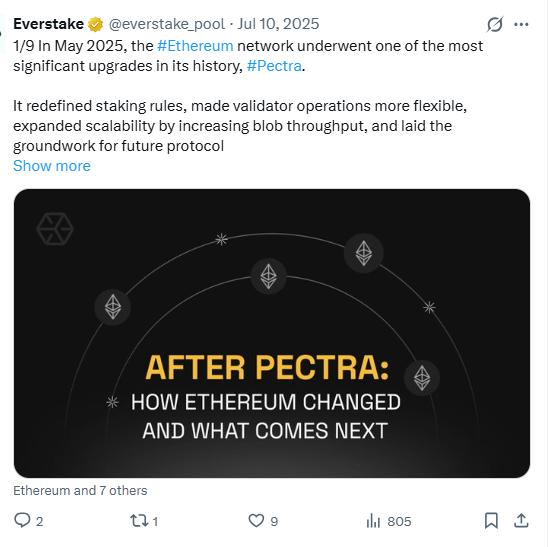 The Fusaka upgrade, targeting H2 2026, introduces PeerDAS — a data availability sampling system that dramatically cuts Layer-2 fees. When Layer-2 gets cheaper, usage grows. More L2 usage means more ETH base-layer demand. That is the flywheel.
Glamsterdam and Hegota Upgrades in Pipeline (Bullish): Two more upgrades — Glamsterdam and Hegota — are scheduled for 2026. Both focus on long-term network sustainability and gas fee optimization. These are not hype upgrades. They are infrastructure improvements. But infrastructure improvements drive adoption, and adoption drives ETH demand over 12 to 24 month horizons.
ETH ETF Inflows Growing : U.S. spot Ethereum ETFs, approved in 2024, have seen growing institutional inflows in early 2026.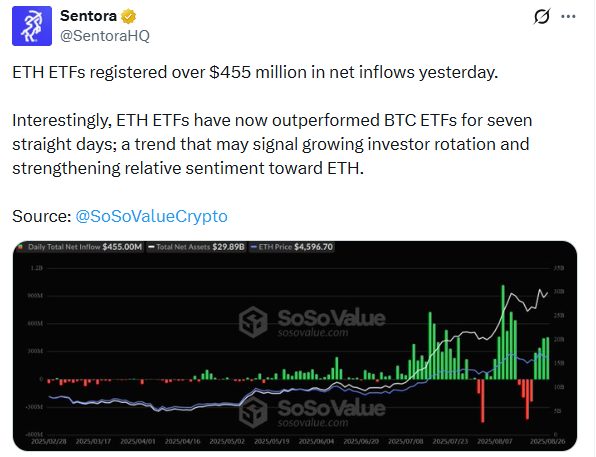
BlackRock BUIDL and Fidelity both expanded ETH exposure. Total ETH ETF AUM crossed $10 billion in February 2026. Institutional capital now has a regulated, compliant way to get ETH exposure — and it is using it.
RWA Tokenization Leadership (Bullish): Ethereum holds approximately 65% of the real-world asset tokenization market. BlackRock BUIDL ($2B+), Franklin Templeton, Ondo Finance, and Securitize all use Ethereum as the primary settlement layer. This is not speculative usage — it is institutional infrastructure adoption.
Macro and Geopolitical Headwinds (Bearish): U.S.-led geopolitical tensions in early 2026 triggered a $128 billion crypto market cap wipeout. ETH dropped 15% in 48 hours in late February. The Federal Reserve rate trajectory remains uncertain. Any further macro shock could push ETH toward the $1,800 floor.
Year / Period | Min Price | Avg Price | Max Price |
2026 (Base) | $2,013 | $4,447 | $6,352 |
2027 Conservative | $2,533 | $3,389 | $4,068 |
2027 Base Case | $5,614 | $6,028 | $8,570 |
2027 Bullish | $10,000 | $14,142 | $21,213 |
Changelly's 2027 minimum of $2,533 is the most cautious model — essentially projecting that ETH trades sideways from current levels for two years. CoinCodex lands at $3,389 average. LiteFinance targets $5,614 to $7,063. CoinForama projects $3,969 to $8,570. CoinPedia's aggressive model hits $14,142 average with a max of $21,213, based on ETH establishing new ATHs and continuing higher.
Conclusion :
Ethereum’s 2027 outlook depends on whether the current cycle extends or has already peaked. If a second bullish leg comes, strong drivers like ETF inflows, Layer-2 expansion, network upgrades (Pectra, Fusaka), and ETH’s deflationary model could push prices toward $7,500–$10,000+.However, if the cycle topped in 2025, 2027 may be a consolidation phase, with ETH ranging between $3,000–$5,000. Despite short-term uncertainty, Ethereum’s dominance in DeFi, staking, and real-world asset tokenization keeps its long-term fundamentals strong.
Disclaimer:
This content is for informational and educational purposes only and should not be considered financial or investment advice. Cryptocurrency markets are highly volatile and unpredictable.

Divam Paliwal is a dedicated Research Analyst with more than six years of experience in financial markets and cryptocurrency research. He specializes in market analysis, price trend evaluation, and blockchain industry insights. Over the years, Divam has developed strong expertise in interpreting market data, identifying emerging trends, and delivering research-driven insights that help investors better understand the rapidly evolving crypto landscape. His work focuses on simplifying complex market movements and providing data-backed perspectives on digital assets, trading patterns, and industry developments.
Divam Paliwal is a dedicated Research Analyst with more than six years of experience in financial markets and cryptocurrency research. He specializes in market analysis, price trend evaluation, and blockchain industry insights. Over the years, Divam has developed strong expertise in interpreting market data, identifying emerging trends, and delivering research-driven insights that help investors better understand the rapidly evolving crypto landscape. His work focuses on simplifying complex market movements and providing data-backed perspectives on digital assets, trading patterns, and industry developments.



Owned by:-
DCG Tech FZCO, UAE
Delivery Partner:-
Gabbar MediaTech Pvt Ltd.
Copyright © 2026 Coin Gabbar. All Rights Reserved.