Mozone AI Listing May 16: 5 Days Left — Will $MZONE Crash Like $DSNT?


Will the Mozone AI Listing Crash? $MZONE vs DeepSnitch Verdict
Five days.
The Mozone AI listing is confirmed for May 16, 2026 on PancakeSwap — and the crypto community is watching closely.
Not just because it is an AI token listing, but because the last time a similar project launched on a DEX, it crashed 99% within hours.
DeepSnitch AI raised $2.87 million. Had real tools. Lost nearly everything on listing day.
That memory is fresh.
So the question going into the MZONE launch date is simple — same story or different outcome?
The answer is not about hype.
It is about structure. And structure is where Mozone AI is doing something DeepSnitch did not.
What Is Mozone AI and Why Is Everyone Watching the MZONE Listing?
Mozone AI is a BEP-20 token on BNB Smart Chain with a total supply of 10 billion MZONE.
The MZONE PancakeSwap listing is set at $0.006 per token — a confirmed fixed price that gives the market a clear reference before trading begins.
But the part that actually changes the conversation is what happened on May 10. Just days before the MZONE BSC token launch, the project activated its AI Agent Plans inside the Mozone Wallet. 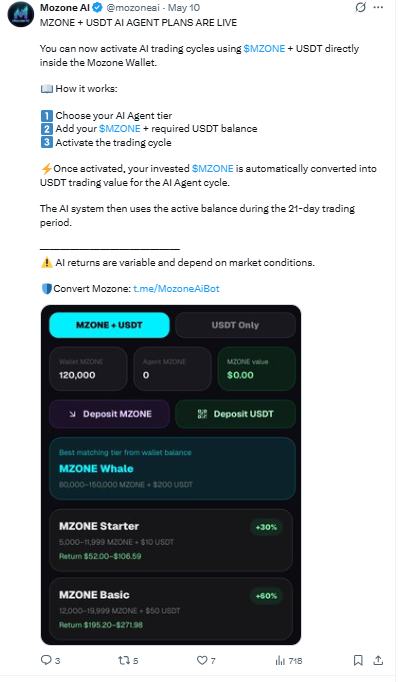
These are not roadmap promises — they are live, working, and already processing user funds.
Here is how it works: users deposit $MZONE plus USDT, select an AI Agent tier, and activate a 21-day automated trading cycle.
The AI system converts the MZONE balance into USDT trading value and runs the cycle automatically.
Returns are variable, but the tiers are structured and published:
This is real utility running five days before the Mozone AI launch news today.
DeepSnitch had tools too — but none of them were running automated revenue cycles for users before launch day even arrived.
The DeepSnitch Comparison — What Went Wrong There
DeepSnitch had a credible product and $2.87M raised. The crash came from mechanics, not the idea.
Thin DEX liquidity at TGE, no confirmed liquidity lock, and a large holder base with no reason to wait — that combination created a one-sided sell wall the moment trading opened.
Here is where the MZONE listing update looks structurally different:
Lower launch price means more room before sellers feel pressure. BSC gas fees mean smaller traders can actually participate.
And a two-year liquidity lock means the pool cannot be drained on day one — the specific mechanics that collapsed DeepSnitch are directly addressed here.
5 Reasons the MZONE Listing Could Play Out Differently
1. AI Agent utility is live before listing day: The trading cycles activated May 10 — not after launch. Users are already depositing $MZONE and USDT, running 21-day cycles.
When a token has active utility before it even hits an exchange, holders have a reason to stay instead of sell.
2. Two-year liquidity lock protects the floor: The single biggest structural difference from DeepSnitch.
Liquidity cannot be removed for two years. Even if early holders sell tokens, the pool absorbs it without collapsing the price.
3. Fixed launch price at $0.006 sets clear expectations: No ambiguity at TGE. Buyers know exactly what they are walking into.
$0.006 is an anchor the market can trade around — unlike DeepSnitch where TGE price was an estimate that never held.
4. Telegram airdrop spreads the holder base: Airdrop recipients across thousands of wallets reduces concentration risk.
No single large holder can move the price the way concentrated presale wallets did during the DeepSnitch listing.
5. BSC keeps it accessible for small buyers: ETH gas effectively excluded small buyers during DeepSnitch. BSC fees are cents.
More wallets means broader organic demand from day one — and that is what thin-liquidity DEX launch need most.
MZONE Price Prediction 2026: Bull, Base, Bear
No trading history exists for $MZONE yet. Price discovery starts May 16. Three scenarios based on structure, not hope:
Bear Case — $0.003 to $0.005 Airdrop recipients dump immediately. Volume dries up fast. Price falls below the $0.006 launch level within 48 hours. Happens if community sell pressure outweighs new buyer interest in the first week. Invalidation: price stays below $0.003 for more than 7 days post-listing.
Base Case — $0.008 to $0.018 Liquidity lock holds the floor. AI Agent utility keeps holders engaged. Light CEX interest in Q3. Price trades in a modest range — 2x to 3x for early airdrop participants through mid-2026.
Bull Case — $0.03 to $0.06 AI trading cycle adoption grows fast. Demand builds from users needing $MZONE to activate higher tiers. A CEX listing drops in Q3. Price reaches 5x to 10x from listing level before year end.
Expert View
Coingabbar analysts watching the Mozone AI listing date point to one detail most coverage is missing: the AI trading cycles went live on May 10 — six days before the MZONE listing.
That sequence matters. Projects that activate real utility before exchange listing create a holder base with an active reason not to sell.
The 21-day trading cycle lock-in is not a vesting schedule — it is product engagement that mechanically delays selling. Combined with the two-year liquidity lock, the setup going into May 16 addresses both failure modes that destroyed DeepSnitch.
Whether the Mozone AI price prediction materializes depends on post-listing adoption, but the structural groundwork is the cleanest seen in a BSC AI token launch at this price range this cycle.
Disclaimer: This article is for informational purposes only and does not constitute financial advice. Cryptocurrency DEX listings carry extreme risk including total loss of capital. AI Agent return figures are from the project's published tiers — actual returns vary by market conditions and are not guaranteed. Always conduct independent research before investing. Do not invest more than you can afford to lose.