MSVP Price Prediction After BingX Listing: What Comes Next?


Why is MSVP’s price down today? What the Chart Predicts Next
MSVP surprised traders with a huge move after its BingX listing, but the excitement quickly turned into uncertainty. The token first surged to $0.1483, then sharply dropped nearly 38% to around $0.069.
Now investors are asking one big question: Is this a temporary correction or the beginning of a deeper crash?
The listing created hype across the crypto community, and many traders expected immediate exchange expansions like Bitget or Binance. That speculation fueled aggressive buying, pushing the price into a parabolic rally.
However, the rally became overheated — and markets rarely move up forever without cooling down.
Why MSVP Price Dropped After the Rally
The MSV Protocol chart shows a classic blow-off top pattern. This happens when a token rises too fast within a short period and late buyers enter near the peak.
After hitting the $0.12–$0.15 zone, sellers entered aggressively. Large red candles appeared, which signals distribution and panic selling. Early investors likely took profits while new traders exited at losses.
At the same time, the broader crypto market weakened slightly. Since the token had already pumped strongly over the past 30 days, it reacted more violently than other coins.
Right now, the price has returned to an important historical support zone near $0.065–$0.060.
Key Support and Resistance Levels
Support and resistance zones are crucial for the MSVP price prediction because they show where buyers and sellers are reacting. The immediate support lies near $0.065, while $0.060 is the most important level. If this support breaks, the price may fall toward $0.050 and possibly $0.040 during heavy selling.
On the upside, recovery faces hurdles at $0.085 and $0.095. A move above $0.10 would signal a trend reversal, and strength above $0.12 could restart bullish momentum. 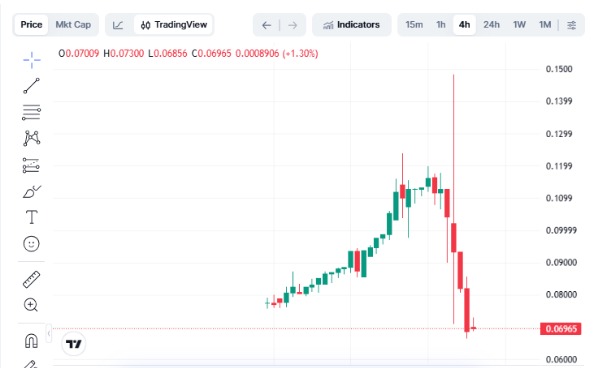
Source: CoinMarkretCap
Holding the $0.060 area may allow the token to stabilize and form accumulation.
Short-Term MSVP Price Prediction
After the sharp rally and drop, the token may trade sideways in the coming weeks as the market cools down. If buyers defend support, the price could rebound toward $0.085–$0.095. However, a clear break below $0.060 could send the token to $0.050 or even $0.040. This phase usually reflects accumulation, where strong investors buy and weak holders exit.
Can MSVP Start a New Uptrend?
A real recovery requires MSVP to reclaim $0.10 and form higher highs and higher lows. This level now acts as psychological resistance because many traders may sell near it. If the price turns $0.10 into support, it would confirm the correction is ending and a new rally could begin.
Exchange Listing Possibility
A listing on Binance, Bitget, or other major exchanges could increase liquidity and attract new investors, potentially supporting the price. However, listings depend on trading volume, community growth, and project development, so traders should not rely only on rumors.
Long-Term Outlook
With a total supply of 200 billion tokens, MSVP needs strong adoption to sustain higher prices. If adoption grows and listings expand, the price may hold above $0.10. But if interest fades, the token could gradually move below $0.05. The reaction around $0.060 support will likely decide the medium-term trend.
Disclaimer:
This content is for informational and educational purposes only and not financial advice. Cryptocurrency investments are highly volatile. Always do your own research (DYOR) before investing.
Also read: