Pacifica Price Prediction 2026: PACIFICA Token Match HYPE Gains?


Pacifica Price Prediction 2026 Massive HYPE Gains
Pacifica price prediction 2026 is quickly becoming a trending topic as investors compare the PACIFICA token's growth potential with massive gainers like HYPE. With rising searches for Pacifica crypto forecast 2026, PACIFICA price target, Pacifica token analysis, PACIFICA bull case and bear case, and Pacifica vs HYPE performance, traders are eager to know whether this emerging altcoin can deliver similar explosive returns.
Quick Take: What Is Pacifica and What Does This Forecast Cover
Pacifica Price is a kind of exchange that lets people trade futures on the Solana blockchain. It has become the exchange of its kind on Solana, with the most trading happening every day. Pacifica was started in January 2025 by Constance Wang, who used to be in charge of operations at FTX, and some other experienced people from companies like Binance and Coinbase. The people who started Pacifica are paying for everything themselves; they do not have any investors giving them money.
The Pacifica token is not available yet as of April 2026. This is a guess about what the price of the Pacifica token might be before and after it is officially released, which is called the Token Generation Event. We are comparing it to what happened with the Hyperliquid HYPE token. All the numbers we are talking about are guesses. The date for the Token Generation Event has not been officially announced.
Current Platform Status: Pacifica Price in April 2026
Pacifica started its mainnet in June 2025. It did not take long for Pacifica to become the Solana perp DEX by daily volume. Pacifica surpassed Jupiter in three months. By January 2026, Pacifica had crossed $100 billion in trading volume. You could track this milestone live on DeFiLlama.
As of April 2026, data from CoinGecko shows that Pacifica generates over $1 billion in 24-hour trading volume. Pacifica also has an interest of about $69 million across 59 trading pairs. The active pair on Pacifica is BTC/USDC. This pair has over $664 million in volume.
With all the success of Pacifica, the PACIFICA token has not been launched yet. Pacifica has a points program that gives 500,000 points to traders every Thursday. This program started on September 4 2025. As of March 2026, there is no date for the token launch. This makes Pacifica one of the anticipated token launches in the perpetual DEX space. Pacifica is following the success of Hyperliquid HYPE.
Pacifica vs Hyperliquid: Why the Comparison Matters for Pacifica Price
Here are the main reasons why PACIFICA token prices matter at launch
Zero VC Dilution Structure: With no investor allocations, any token distribution will flow entirely to active platform users and the team. This maximizes community token value at launch, similar to the Hyperliquid model that produced historic airdrop returns.
$100 Billion Cumulative Volume Base: 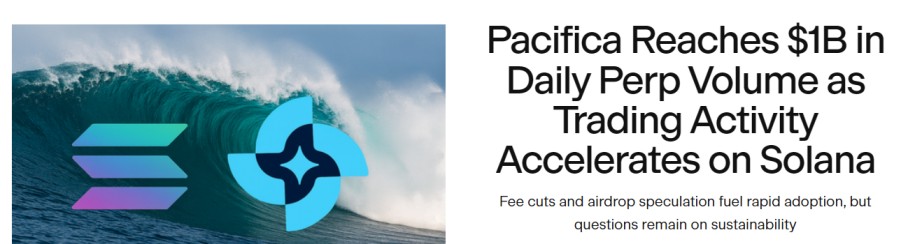 Real, verifiable trading volume of over $100 billion provides a credible fundamental basis for token valuation. Compare this to protocols that list tokens with minimal real usage.
Pacifica Price Solana Perp DEX Status: Pacifica overtook Jupiter, the dominant Solana DEX, within three months of launch.  Holding this position at TGE would support a premium valuation multiple versus competing perp DEX tokens.
Fully Diluted Valuation Estimates: Community models estimate potential token values near $1.09 per token, assuming a 25% airdrop ratio and a $10 billion fully diluted valuation. However, these are community projections, not official figures.
AI Trading Tools Integration: Pacifica integrates AI-powered smart tools for risk analysis and trade suggestions — a differentiating feature that could attract institutional and advanced retail traders post-TGE.
Strong Founding Team: Led by Constance Wang (ex-FTX COO), with engineers from Binance, Coinbase, Jane Street, OpenAI, and DeepMind—the team has the credibility and execution track record to attract institutional attention at token launch.
Solana Ecosystem Growth: With Solana maintaining $1 billion-plus daily DEX volumes in 2026, Pacifica operates in one of the highest-activity on-chain environments, supporting sustained revenue and token demand.
Pacifica Price Technical Overview: Discovery After TGE
Since PACIFICA has not yet launched, traditional price chart analysis does not apply. Instead, price discovery at TGE will be driven by airdrop recipient behavior, secondary market listings, and the ratio of circulating supply to fully diluted valuation. Based on the Hyperliquid HYPE model, where HYPE launched at approximately $3 and reached a peak above $28 within weeks, community analysts have constructed PACIFICA valuation scenarios using Pacifica volume and user metrics as benchmarks.
Key resistance levels to watch post-TGE will be the initial listing price on decentralized exchanges, where early airdrop recipients may take profits. For context, early HYPE sellers on day one missed substantial gains as the token appreciated by over 800% in its first month. Whether PACIFICA follows a similar trajectory depends on the depth of the initial listing order books, exchange partnership announcements, and how the no-VC structure is communicated to retail and institutional buyers.
Pacifica Price Token Price Prediction 2026
Estimated price scenarios based on Hyperliquid comparables, platform volume data, and community FDV models. The date is unconfirmed as of April 2026:
Scenario / Period | Low Estimate | Average Estimate | High Estimate | Key Assumption |
TGE Launch Day | $0.30 | $0.80 | $1.20 | Airdrop recipients partially sell |
Post-TGE Month 1 | $0.50 | $1.09 | $2.50 | Exchange listings, airdrop narrative |
Mid 2026 (Q2-Q3) | $0.40 | $1.50 | $4.00 | CEX listings, HYPE comparison |
End of 2026 | $0.60 | $2.00 | $6.00 | Bull market + sustained volume |
2027 Long-Term View | $1.00 | $3.50 | $10.00 | Protocol fee revenue, staking |
Important: The PACIFICA token has not launched. All figures are community-model estimates. The $10 billion FDV assumption used in community estimates ($1.09/token) is not an official valuation. A high scenario requires sustained hyperliquid-level adoption.
Scenario Analysis: Bull, Base, and Bear Cases for PACIFICA
Bull Case (Target: $4.00–$6.00 by End 2026)
The bull case requires PACIFICA to launch with a strong Hyperliquid-comparison narrative, secure immediate listings on Binance or Coinbase, and maintain its no-VC distribution story throughout the launch. If Pacifica sustains its $1 billion-plus daily volume through TGE and beyond, protocol fee revenue would provide a fundamental basis for a $4 billion to $6 billion FDV. The bull case further assumes Solana continues its 2026 growth trajectory and no major protocol exploits occur.
Pacifica Price Base Case (Target: $1.00–$2.00 by End 2026)
The base case assumes PACIFICA launches successfully, the community airdrop narrative drives initial buying, and the token stabilizes in the $1 to $2 range after post-launch volatility. Pacifica maintains its top Solana perp DEX position, attracts mid-tier exchange listings, and token staking mechanics reduce effective circulating supply over time.
Pacifica Price Bear Case (Target: Below $0.50)
The bear case reflects risks common to high-anticipation token launches. Airdrop recipients farming points with no long-term conviction could sell aggressively at TGE, collapsing price before organic buyers step in. A broader crypto market downturn, a major protocol exploit, or competitive displacement by a better-funded rival (such as Lighter or a Hyperliquid expansion to Solana) would all suppress post-TGE price recovery.
Expert View on Pacifica Price Token Outlook
CoinGabbar analysis suggests Pacifica represents the most credible remaining pre-TGE opportunity in the perp DEX sector as of April 2026. The combination of over $100 billion in verifiable cumulative volume, zero venture capital dilution, and a founding team with elite institutional credentials creates a structurally superior setup compared to most token launches in the current cycle. The Hyperliquid HYPE comparison is analytically reasonable—not because outcomes are guaranteed to replicate, but because the structural conditions are genuinely similar. The critical risk factor is timing: as more traders become aware of the airdrop opportunity, point farming competition intensifies, which may dilute individual airdrop allocations. This analysis considers platform volume data, team credentials, comparable perp DEX token performance, tokenomics structure, and Solana ecosystem health.
Risks and Uncertainties for Pacifica PACIFICA Token
TGE Delay Risk: No official TGE date has been announced as of April 2026. An indefinite delay would reduce airdrop momentum and allow competing perp DEX tokens to capture market share.
Pacifica Price Airdrop Sell Pressure: Large volumes of airdrop recipients receiving tokens on a zero-cost basis have strong incentives to sell at any positive price, creating heavy initial selling pressure at TGE.
Pacifica Price Point Farming Dilution: As awareness of the airdrop grows, more traders are farming points, potentially diluting allocations for existing participants and reducing per-wallet airdrop value.
Smart Contract and Protocol Risk: Pacifica operates on Solana with AI-integrated tools. Any smart contract exploit, oracle manipulation, or AI tool malfunction could cause significant financial losses and reputational damage that would suppress the token price.
Competitive Risk: Hyperliquid, Lighter, and other perp DEX platforms with larger war chests may expand to Solana or improve their offerings, threatening Pacifica's dominance before or after TGE.
Regulatory Exposure: Perpetual futures DEX platforms operate in a regulatory gray zone in many The most critical factors are the ratio of community versus team token allocation at TGE, exchange listings quality (especially Binance and Coinbase), sustained daily trading volume above $500 million, protocol fee revenue shared with token stakers, and overall Solana ecosystem health at the time of launch.
Pacifica Price Disclaimer: This Pacifica Price is for informational purposes only and does not constitute financial advice. Cryptocurrency markets are highly volatile. The PACIFICA token has not yet launched, and all price estimates are purely speculative projections based on comparable projects and platform data.