Celestia TIA Modular Blockchain 2026: Complete Guide

Celestia TIA Modular Blockchain 2026 Guide for Rollups and Staking
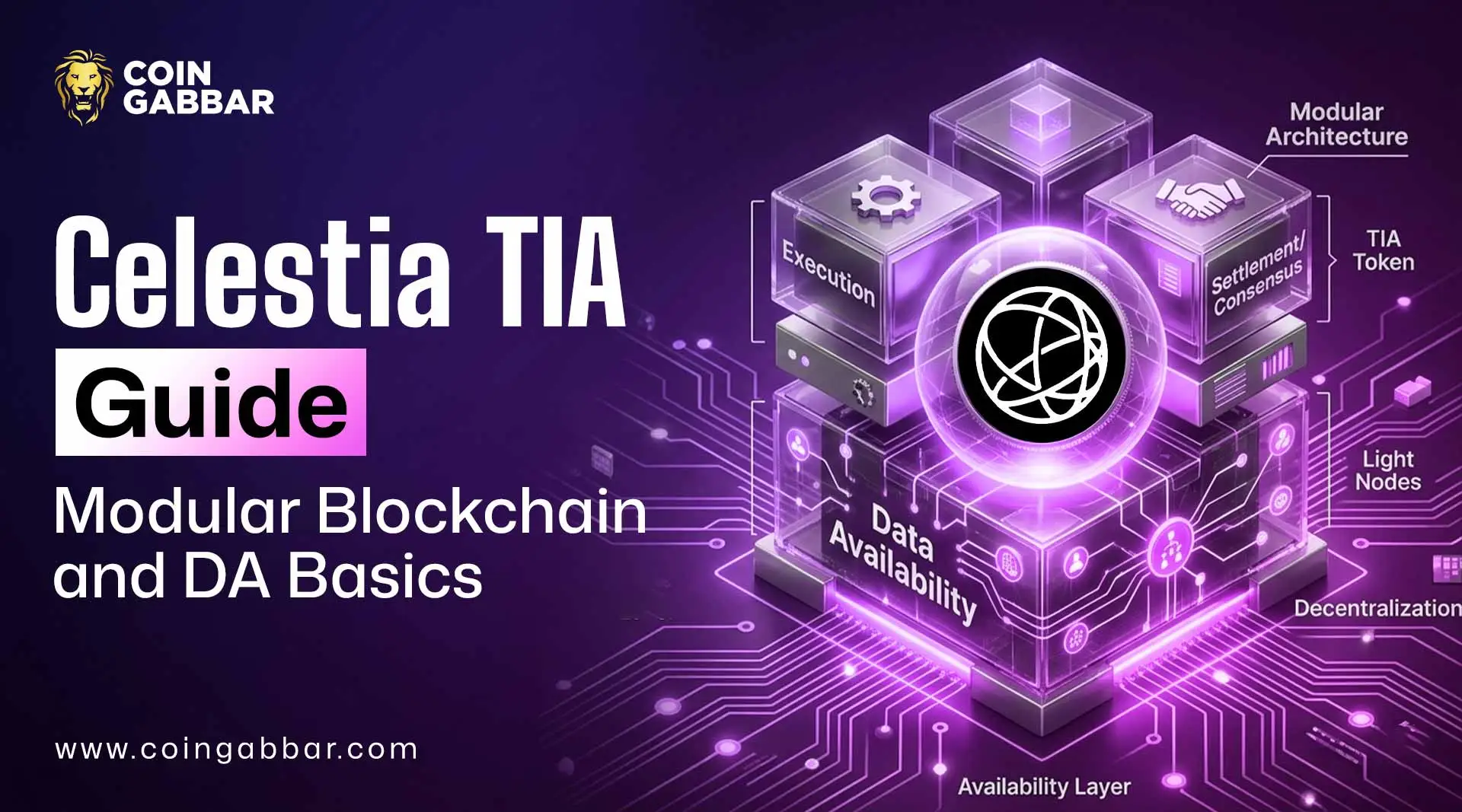
What if a blockchain stopped doing every job itself? That is the idea behind Celestia. The Celestia TIA modular blockchain 2026 model matters because Celestia focuses on ordering data and making it available. Execution and settlement can sit on other layers.
That sounds technical at first. It is actually a simple shift. Instead of one chain doing consensus, execution, and data at once, Celestia handles the data layer. Rollups or app-chains can then build execution above it. This is why many builders call Celestia a modular blockchain, not a monolithic one.
Why Celestia TIA Modular Blockchain 2026 Matters?
Data availability, or DA, answers one basic question. Can the block data be downloaded by the network? If the answer is no, users cannot verify balances, challenge bad state updates, or rebuild the chain safely. That problem matters a lot for rollups.
Celestia’s answer is Data Availability Sampling, or DAS. Light nodes do not need to download full blocks. They sample small, random pieces of block data instead. If enough valid samples come back, the network gets strong confidence that the full block exists and can be reconstructed. Celestia also uses Namespaced Merkle Trees, which let each app fetch only its own data instead of the whole chain’s data.
That is the heart of the Celestia TIA modular blockchain 2026 story. Celestia TIA tries to scale blockspace by separating duties. It orders blobs and keeps them available. Other layers can focus on execution, settlement, or app logic.
What TIA Actually Does?
TIA is not just a trading token. It has real network jobs. Rollup teams use Celestia TIA to pay for blobspace through PayForBlobs transactions. Some chains can also use TIA as their gas token while they bootstrap. That can help teams launch faster without creating a token on day one.
TIA also secures the network. Celestia uses proof-of-stake, built on the Cosmos SDK. Users can delegate TIA to validators and earn a share of staking rewards. TIA staking also gives the community a governance role over key network parameters, while Celestia’s community pool receives 2% of block rewards.
There is also a token supply angle. Celestia launched with 1 billion TIA at genesis. Its docs say the inflation rate dropped to about 2.5% after the November 2025 v6 upgrade. That rate now decreases by 6.7% each year until it reaches a 1.5% floor. For readers building a thesis around the Celestia TIA modular blockchain 2026 theme, that token design matters.
How TIA Staking Works In Practice?
Staking sounds easy. You delegate to a validator, then collect rewards. That basic flow is true on Celestia too. Still, you should know the fine print before you stake.
First, rewards are not fully automatic in every case. Celestia’s staking docs say that after CIP-30, changing your position does not auto-claim rewards anymore. You now accrue rewards until you call the reward withdrawal message yourself. That is a small detail, though it matters for active stakers.
Second, validator risk becomes your risk. If a validator gets slashed, delegators lose the same percentage of delegated funds. Celestia says downtime can jail a validator if it stays offline for more than 25% of a rolling 5,000-block window. Double-signing is worse. It triggers a 2% slash, permanent removal from the validator set, and a 21-day unbonding period for delegators.
So, the Celestia TIA modular blockchain 2026 investment case is not only about price. It is also about validator choice, reward handling, and governance participation. Beginners should treat staking like infrastructure exposure, not free yield.
Celestia Vs Ethereum Blobs Vs EigenDA?
This is where the topic gets interesting.
If you compare the Celestia TIA modular blockchain 2026 model with Ethereum blobs, the first big difference is location. Ethereum blobs are part of Ethereum’s roadmap through EIP-4844. Rollups can attach cheaper blob data to Ethereum blocks. That data is not accessible to the EVM, and Ethereum deletes it after about 18 days. Ethereum only guarantees that blob data for that fixed window.
Celestia TIA works differently. It is a separate proof-of-stake chain built for DA. It uses DAS and Namespaced Merkle Trees so light nodes can verify data without full downloads, while apps fetch only their own namespace data. In plain English, Ethereum blobs give rollups Ethereum-native temporary data space. Celestia gives builders a dedicated DA layer with its own validator set and token.
EigenDA sits in another lane. EigenDA’s docs describe it as a data availability protocol built on EigenLayer, not as a blockchain. It aims for very high throughput and low cost. Its own security FAQ also says that an L1 smart contract cannot directly verify network-level data availability for alt-DA systems, because that requires offchain networking. That does not make EigenDA weak by default. It does mean the trust and bridge design differ from Ethereum-native blobs.
So which one fits best?
Ethereum blobs fit teams that want Ethereum-native DA and settlement. Blob data stays cheap, but only for a short window.
Celestia TIA fits builders who want modular design, app-specific blockspace, and a standalone DA chain.
EigenDA fits teams chasing very high throughput in an alt-DA design tied to EigenLayer.
The Main Risks You Should Not Ignore
Every Celestia TIA guide should say this clearly. Data availability is not the same as permanent storage. Celestia’s docs say light nodes now sample within a 7-day window. Older blobs get pruned by default on light nodes. Archival nodes may keep history, though rollups and apps remain responsible for storing their own historical data.
That is a real risk for builders. If your rollup needs long history, you need an archival plan. Free public archival access may not last forever. Celestia’s own docs suggest using archival providers, shared snapshots, or future namespace pinning tools.
The second risk is staking exposure. Bad validator behavior can hit your delegated TIA. The third risk is token economics. Supply unlocks, inflation, and governance decisions can affect market behavior even if the technology stays strong.
Final Take
The Celestia TIA modular blockchain 2026 thesis is simple. Split the blockchain into jobs. Let Celestia handle data availability. Let rollups and app-chains handle execution their own way. That design gives builders more freedom, though it also shifts more responsibility onto them.
For beginners, here is the short version. Celestia is not trying to be another all-in-one chain. It is trying to become the data layer many chains can use. If modular design keeps growing in 2026, Celestia stays important. If builders prefer Ethereum’s native blob path, Ethereum may keep the simpler story.
Disclaimer: This article is for education only. It is not financial, investment, or legal advice. Crypto assets and staking carry market, technical, and custody risk.
Also read: