What Is Crypto Governance – How DAOs Make On-Chain Decisions

How DAOs Enable On-Chain Governance Without Control
Someone Has to Make the Decisions
Every protocol has rules. Someone decides the fees. Someone decides which chains to support. Someone decides how to spend the treasury.
In traditional finance, that's a board of directors. In crypto, it's you ,if you hold the governance token.
That's the core idea behind crypto governance. Token holders on changes to a protocol. The code executes the result. No CEO signs off. No legal team reviews it.
What are DAOs, Actually?
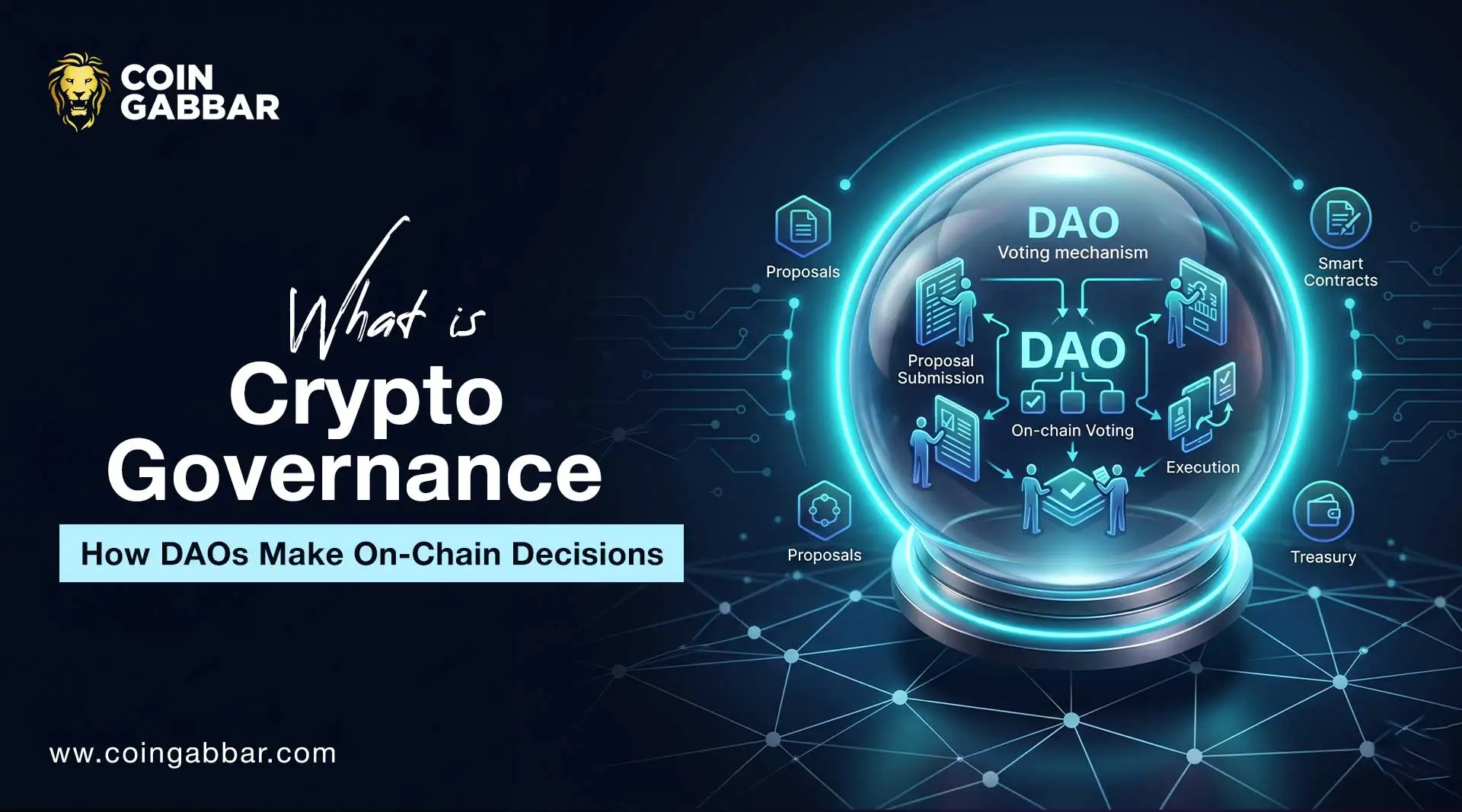
DAOs stands for Decentralized Autonomous Organization. It’s a group in which decisions are made by the members of the community and there is no involvement of any centralized governance or middlemen. Rules are written in smart contracts as a code.
Think of it like a company where every shareholder gets a direct it on every decision. No board filters it. No management delays it.
MakerDAOs governs the DAI stablecoin this way. Uniswap's community votes on protocol fees. Compound holders decide interest rate models.
On-Chain vs Off-Chain Voting:
There are 2 types of voting: On and Off voting.
On-chain voting means your vote is a real transaction. It costs gas. It's permanent. Once it passes, the smart contract executes automatically.
Off-chain voting happens on platforms like Snapshot or Discord. You sign a message with your wallet with no gas fee. It's cheaper and faster. But someone still has to manually execute the result on-chain afterward.
Most DAOs use both. Snapshot handles temperature checks and early discussion. On-chain voting finalises the binding decision.
The Proposal Lifecycle: From Idea to Execution
A proposal doesn't jump straight to a vote. It follows a clear path.
Here's how most DAOs structure it:
-
Temperature check — Everything starts with a simple idea, where a single member shares his thoughts like “should we fund this” or “should we change this”.
-
Forum discussion — If the members like the idea, it becomes more detailed
-
Formal proposal — Now comes the important part “voting”, where all the eligible members cast their vote on the blockchain, by choosing “yes”or “no” (sometimes there are more options available).
-
Voting period — there is a voting period (usually 3 to 7 days) for token holders to vote
-
Timelock —After a proposal passes through voting, nothing happens suddenly, there is usually a waiting time known as timelock.
-
Execution —After the waiting period (timelock) smart contract automatically performs the action that was approved.
Quorum: The Minimum Needed to Pass Anything
A vote means nothing if nobody shows up.
Quorum is the minimum number of votes required for a proposal to be valid. If participation falls below that threshold, fails — even if everyone who voted said yes.
Uniswap's quorum requires 40 million UNI votes. That's roughly 4% of total supply. It sounds low. In practice, it's hard to reach because most token holders don't vote.
Quorum exists to prevent a tiny minority from making decisions for everyone. It's a basic protection but it only works if people actually participate.
The Voter Apathy Problem Is Real
Here's the uncomfortable truth about most DAOs.
Most token holders never vote. Ever. Compound regularly sees fewer than 10% of eligible tokens participate in any given it. Uniswap has struggled to hit quorum on major proposals multiple times.
Why? A few reasons:
-
Voting on Ethereum costs gas, so small holders skip it
-
Most people buy governance tokens to speculate, not govern
-
Proposals are technical and hard to evaluate quickly
-
Many holders delegate their votes and then forget
This creates a real problem. A small, active group ends up controlling protocols that claim to be decentralised.
Vote Delegation: Giving Your Vote to Someone Else
You don't have to vote yourself. You can delegate.
Delegation means assigning your power to another wallet. That person votes on your behalf. You keep your tokens. You can take your votes back any time.
Compound and Uniswap both support delegation natively. Some protocols have professional delegates people who publish their governance philosophy publicly and actively participate in proposals.
It's not a perfect system. Your delegate might vote against your interests. But it's better than your votes sitting idle forever.
The veToken Model: Locking for Power
Some protocols reward long-term commitment with more power. This is the veToken model, "ve" stands for vote-escrowed.
Curve Finance pioneered it with veCRV. In this, you lock your CRV tokens for (4 years). The longer you lock, the more veCRV you receive and more veCRV means more power and more fee rewards.
This model aligns incentives. Long-term holders get more say. Short-term speculators get less. It reduces the risk of someone buying tokens, selfishly, then dumping.
Balancer, Frax, and Yearn all adopted similar models after Curve proved it worked.
Governance Attacks: When Voting Gets Weaponised
Governance sounds safe. It isn't always.
A governance attack happens when someone acquires enough tokens to pass a malicious proposal. They don't hack the code. They use the voting system itself as the attack vector.
The Beanstalk exploit in April 2022 is the clearest example. An attacker took a flash loan , a loan borrowed and repaid in a single transaction , to gain majority power temporarily. They passed a proposal that drained $182 million from the protocol's treasury. All within one transaction.
The vote was technically valid. The protocol executed it. That's the terrifying part.
Real DAOs Decisions That Actually Mattered
Governance isn't theoretical. Real decisions have shaped real outcomes.
MakerDAO voted to add USDC as collateral for DAI in March 2020. That one vote kept DAI stable during a market crash. It also made MakerDAOs more centralised — a trade-off the community debated for months.
Uniswap governance voted on whether to turn on a 0.05% protocol fee in 2022. The vote failed. Millions in potential revenue stayed with LPs instead. One governance decision changed who earned the money.
These aren't small calls. They're the decisions that shape a protocol's future.
Key Takeaways Before You Participate
You now understand how DAOs actually work — not just the idealistic version.
Here's what to remember:
-
On-chain votes are binding and automatic; off-chain votes still need manual execution
-
Quorum thresholds exist to prevent tiny groups from deciding everything
-
Voter apathy is the biggest real-world failure of DAO governance today
-
Delegation lets you assign your votes without giving up your tokens
-
veTokens reward long-term holders with more voting power
-
Governance attacks are real — Beanstalk lost $182 million through a valid vote
-
Bribery markets exist and influence major protocol decisions openly
If you hold a governance token, you have real power. Most people ignore it. The ones who don't end up controlling protocols worth billions.
That's crypto governance in plain language. Now you know how the decisions actually get made.
Conclusion
Crypto governance may sound simple at first. Vote with tokens and shape the protocol. But the reality is more complex than you think. People might think every member has equal voting power but that's not the case.
Disclaimer
This blog is for educational purposes only and should not be considered as financial advice. Crypto and crypto governance involves risk.
Always do your own research and study before investing your money.
Also read: