PYUSD vs USDT: Fees, Custody and On-Chain Velocity in 2026

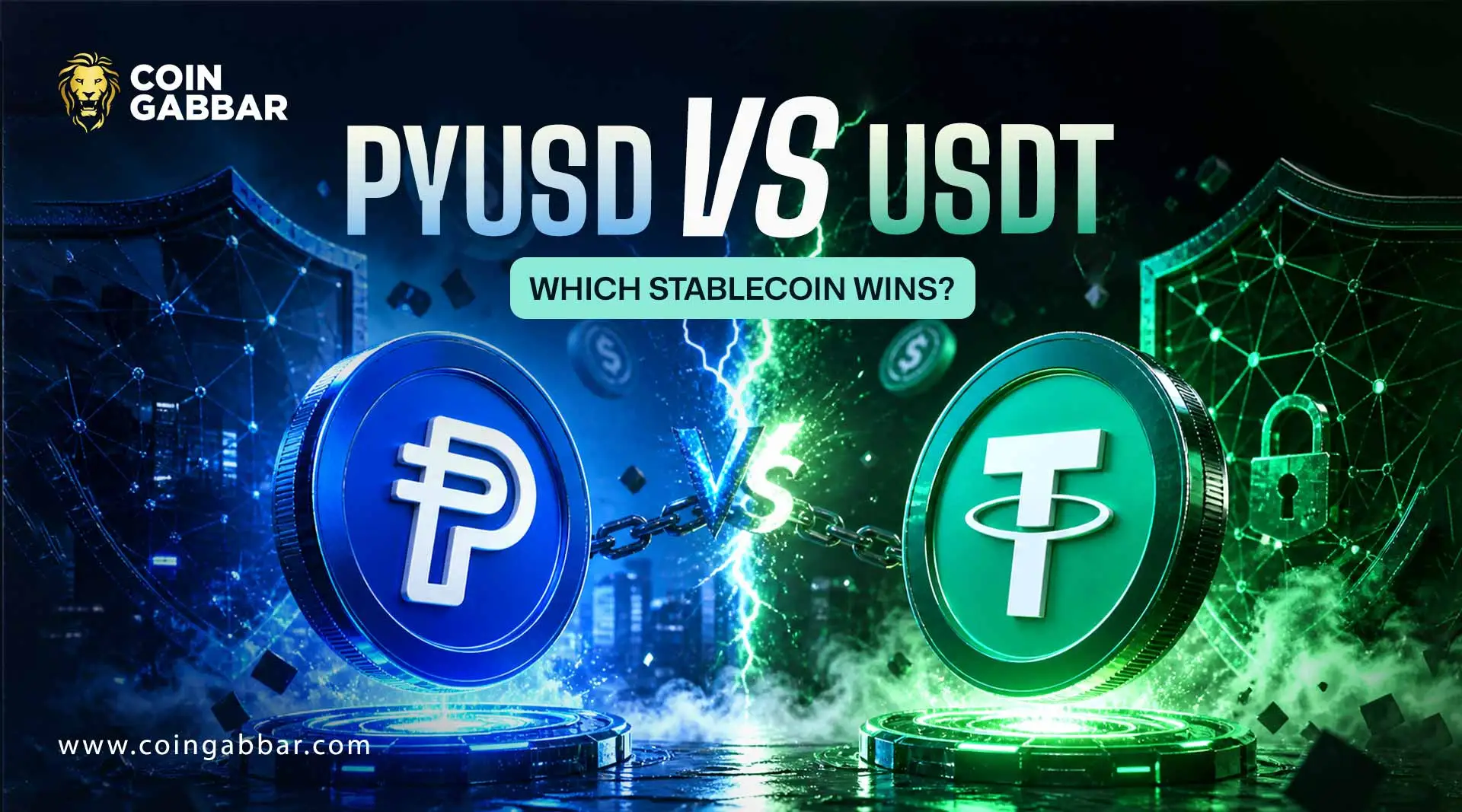
PYUSD vs USDT: Which Stablecoin Offers Better Fees and Control Today?
Stablecoins have quietly become the backbone of the crypto economy. As of May 2026, the total stablecoin market cap has crossed $317 billion, and two names sit at very different ends of that story.
USDT (Tether) has been the dominant stablecoin since 2014, with a market cap of around $189.5 billion and daily trading volume consistently above $100 billion. PYUSD (PayPal USD) is the newer challenger backed by one of the world's most recognizable financial brands, with a market cap near $3.4 billion that surged 680% year-over-year.
But which one is actually better to use in 2026? This PYUSD vs USDT comparison breaks it down across three things that matter most to real users: fees, custody, and on-chain velocity.
What Are PYUSD and USDT?
Before comparing them, let's understand what each one actually is.
PYUSD: PayPal's Stablecoin
PYUSD was launched by PayPal in August 2023 and is issued by Paxos Trust Company, a regulated financial institution. It's available on Ethereum and Solana, and it's fully backed 1:1 by USD deposits and US Treasury assets.
PayPal's official PYUSD page (paypal.com/pyusd) describes it as designed for everyday payments — sending money to friends, paying merchants, and bridging traditional finance with crypto. It's already integrated into PayPal and Venmo, giving it instant distribution to over 400 million accounts.
USDT: Tether's Market Leader
USDT, issued by Tether Limited (tether.to), launched in 2014 and has maintained its position as the world's largest stablecoin for over a decade. It runs natively on 10 major blockchains, including Ethereum, TRON, and Solana, with bridged availability across 80+ additional networks. Tether publishes daily reserve reports and quarterly attestations — every USDT is backed by US Treasury Bills, cash equivalents, and other assets.
In short:
PYUSD: Fintech-first, built for payments and consumer access
USDT: Trading-first, built for global liquidity and market infrastructure
Fees Comparison: PYUSD vs USDT
This is where the networks you use matter just as much as the tokens themselves.
PYUSD Fees
Inside PayPal/Venmo: Sending PYUSD between PayPal accounts is free no transaction fee for peer-to-peer transfers within the ecosystem
On Ethereum: Standard Ethereum gas fees apply, which can range from $0.50 to several dollars depending on network congestion
On Solana: Fees drop to fractions of a cent Solana transactions typically cost less than $0.001
Conversion fees: PayPal charges a spread when converting PYUSD to fiat, which varies by transaction size
USDT Fees
On TRON (TRC-20): Near-zero fees roughly $0.001 per transaction, which is why TRON hosts over $80 billion in USDT and processes about 1.15 million daily transactions
On Ethereum (ERC-20): Gas fees apply similarly to PYUSD on Ethereum — can be high during peak periods
On Solana: Sub-cent fees, similar to PYUSD
Cross-exchange transfers: Often free when sending USDT between wallets on the same network
Verdict on stablecoin fees comparison: Both tokens are cheap on low-fee networks. The key difference is flexibility — USDT gives you 10 native chains to choose from, letting you almost always route through the cheapest option. PYUSD is primarily limited to Ethereum and Solana.
Custody: Who Controls Your Funds?
Custody is about who holds your money and how much control you actually have over it.
PYUSD Custody
When you hold PYUSD inside the PayPal or Venmo app, PayPal holds your funds on your behalf. This is custodial, meaning you don't hold the private keys. PayPal can freeze accounts, restrict withdrawals, or comply with government orders to block funds.
The PYUSD smart contract also includes built-in features, such as supply control, pause mechanisms, and an asset protection role that allow Paxos to freeze or blacklist specific wallets under lawful orders, as noted in Bitget's PYUSD analysis.
You can withdraw PYUSD to a self-custody wallet (like MetaMask or Phantom), but the default experience is custodial.
USDT Custody
USDT is more flexible. You can hold it:
On a centralized exchange (custodial the exchange holds your keys)
In a self-custody wallet like MetaMask, Trust Wallet, or Ledger (you hold your keys)
In DeFi protocols directly
Tether also retains the ability to freeze USDT at the contract level — it has done so historically for addresses linked to theft or sanctioned entities. So while self-custody gives you more day-to-day control, ultimate freeze authority still rests with Tether USDT.
Verdict on USDT vs PYUSD custody:
PYUSD = easier for beginners, more centralized by default
USDT = more flexibility, more responsibility — genuinely self-custodial when held in your own wallet
On-Chain Velocity: Real Usage in 2026
On-chain velocity measures how actively a stablecoin is actually being moved and used on blockchains. High velocity = real demand. Low velocity = mostly sitting still.
PYUSD Velocity
PYUSD's on-chain activity is growing fast but from a small base. Its supply grew 16.66% in the past 30 days compared to USDT's 1.02% — a sign of accelerating adoption. Notable milestones:
Became the second-largest stablecoin on Kamino (Solana's top lending protocol) with over $500M in deposits
Integrated into YouTube creator payouts and Visa's remittance rails in 2025
Daily trading volume averages around $76–$104 million
For a coin under three years old, that's meaningful traction. But compared to USDT, it's still early.
USDT Velocity
USDT's on-chain velocity is in a different league:
$136 billion+ in 24-hour trading volume — consistently one of the highest of any crypto asset
Processed roughly $13.3 trillion in transactions in 2025 — a significant share of the $33 trillion total stablecoin flows that year
TRON alone processes about $23.9 billion in USDT transfers per day with 1.15 million active daily addresses
Used actively in DeFi, trading pairs, remittances, and as a de facto dollar substitute in high-inflation economies
Verdict on USDT usage vs PYUSD adoption: USDT wins comprehensively on velocity. It is the most actively used stablecoin on-chain, by a wide margin. PYUSD is growing but is still primarily driven by its PayPal ecosystem rather than open on-chain activity.
PYUSD vs USDT: Key Differences at a Glance
Feature | PYUSD | USDT |
Issuer | PayPal / Paxos | Tether Limited |
Launch Year | 2023 | 2014 |
Market Cap | ~$3.4B | ~$189.5B |
24H Volume | ~$100M | ~$60B–100B |
Native Blockchains | Ethereum, Solana | 10+ (ETH, TRON, SOL, etc.) |
Fees (Cheapest) | Solana (~$0.001) | TRON (~$0.001) |
Default Custody | Custodial (PayPal) | Flexible (Exchange/Wallet) |
On-Chain Velocity | Growing | Extremely High |
Freeze Mechanism | Yes (Paxos) | Yes (Tether) |
Best Use Case | Payments, PayPal Ecosystem | Trading, DeFi, Global Transfers |
Risks and Transparency
Neither stablecoin is risk-free.
PYUSD risks:
Centralized by design — PayPal controls access within its app
Smart contract includes freeze and blacklist functions
Supply concentration in a small number of wallets
USDT risks:
Tether has faced long-running questions about reserve transparency, though it now publishes quarterly attestations
US senators recently opened an investigation into Tether's activities (May 2026)
Tether can freeze wallets — it has done so in the past, primarily for sanctioned addresses
Both stablecoins operate within centralized frameworks at the issuer level. The best stablecoin 2026 for you depends on how much you value ease of use versus control, and which risk profile you're more comfortable with.
Which One Should You Use?
Here's a simple decision framework:
You're new to crypto or mainly use PayPal/Venmo → PYUSD is the easier starting point
You trade actively on exchanges → USDT has the deepest liquidity and the most trading pairs
You send money internationally → USDT on TRON is one of the cheapest options globally
You want DeFi exposure → Both work on Solana and Ethereum, but USDT has far more protocol integrations
You care most about payments and fintech → PYUSD's growing Visa/YouTube integrations make it compelling
Final Thoughts
The PYUSD vs USDT comparison isn't really about which one is better — it's about which one fits your needs in 2026.
USDT remains the dominant force in global crypto infrastructure. Its liquidity, network reach, and on-chain velocity are unmatched. If you're trading, settling, or moving money across borders at scale, USDT is still the default choice for most of the market.
PYUSD is a genuine contender for the payments space. Backed by PayPal's distribution and growing fast on Solana, it's the better option for users who live inside the PayPal ecosystem or want a stablecoin backed by a regulated, familiar institution.
Use this stablecoin comparison guide to match the right tool to what you're actually trying to do — and always hold only what you're comfortable with in any single platform.
Disclaimer: This content is for informational purposes only and not financial advice. Always do your own research before making any crypto-related decisions.