Banco Braza Real Stablecoin BBRL Debuts on Polygon Network

Impact of the Banco Braza Real Stablecoin on Latin American FX
In a major step for digital money in Latin America, Banco Braza has finished a big move to the blockchain. The Banco Braza Real stablecoin launch officially brings the $BBRL token to the Polygon network. This is not just a test; it is a real bank putting a national currency on a public network. Banco Braza is a leading foreign exchange bank in Brazil. By using this technology, they aim to solve real problems with global payments and money flow.
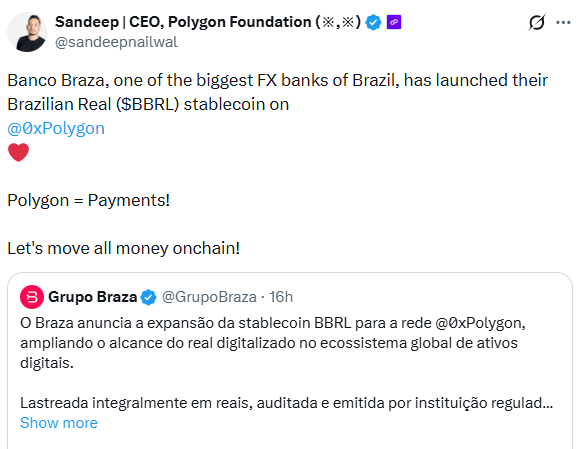 Source: X(formerly Twitter)
The BBRL token represents the Brazilian Real. It is fully backed by actual Reals held safely outside the blockchain. Because Banco Braza is regulated by the Central Bank of Brazil, the token stays within the country's formal financial rules. This oversight is very important for big businesses. It helps bridge the gap between old-school banking and new digital systems.
Technical Benefits of the Stablecoin Launch
The team chose Polygon for the Banco Braza stablecoin launch because it is fast and cheap to use. For people sending money across borders, using this network means payments can happen in seconds. This move lets the BBRL token work on more than one type of system. It makes it easier for businesses to handle international payments without relying only on traditional banks.
Why Banks Use Polygon
Polygon has become a top choice for payment systems in emerging markets. Experts note that tokens backed by local currencies are now basic building blocks for global trade. By moving money on-chain, Banco Braza can offer a better way to send remittances. This is a big shift away from slow and expensive banking channels.
Feature | Details of BBRL on Polygon |
Value | Fixed 1:1 with the Brazilian Real. |
Safety | Regulated by Brazil's Central Bank. |
Main Use | Fast payments and business transfers. |
Network | Polygon for lower fees. |
Status | Open to both companies and the public. |
Practical Use and Future Outlook
For the average person, BBRL on Polygon gives a new way to hold and move money digitally. You do not have to depend entirely on a traditional bank transfer. For companies, it creates a faster route for global payments. This rollout shows that banks are now using public blockchains instead of building their own private systems.
As more national currencies become digital, the work by bank shows how banking is changing. The goal is to connect the Brazilian Real with major global networks to modernize the industry. If this works well, it could change how international trade happens in Latin America by the end of 2026.
Your Money Your Life (YMYL) Disclaimer: This article is for informational purposes only. Stablecoins and digital assets involve technical and regulatory risks. Always consult a financial professional before participating in digital currency markets.









