Tether Market Cap Decline Raises Market Liquidity Questions


Tether Market Cap Decline Tracks USDT Stablecoin Movement
Tether market cap drop is getting attention now. New blockchain data shows a second monthly fall. In February, the value fell 0.8% to $183.61 billion. It keeps falling from about $187 billion in December 2025. January already showed weakness. The value was near $186 billion then. This shows a slow and steady downtrend.
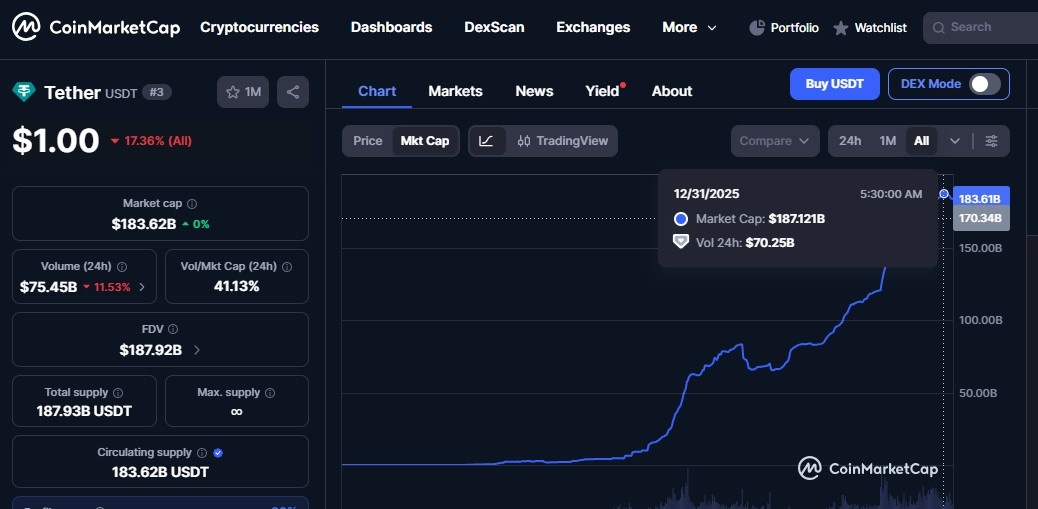
Source: CoinMarketCap Official
Stablecoins often reflect liquidity conditions across digital asset space. When supply shrinks, it can signal reduced trading activity, capital rotation, or cautious sentiment among participants. The latest numbers, therefore, highlight broader shifts rather than isolated movement.
Comparison With Past Shock: Terra Collapse 2022
Why Stablecoin Supply Is Falling Now
Many factors seem to be behind the recent Tether market cap decline. Analysts say there is less speculative trading now. Money is also flowing in more slowly after strong growth in past quarters.
At the same time, Bitcoin trading near $65,000 shows weaker momentum than before. When big assets slow down or move sideways, trading volume often drops. This can reduce the need for stable liquidity.
Possible reasons for capital rotation include:
Profit-taking after earlier rallies
Lower use of leverage on trading platforms
Another point is macro policy expectations. Some experts say uncertainty around possible Trump policies, such as regulation, fiscal plans, and global trade, may affect risk appetite. Even without direct impact, such news can shape markets mood and investor decisions.
In these conditions, investors may move funds into cash or traditional assets for a short time instead of keeping large stablecoin balances on exchanges.
Market Signals and Stablecoin Competition
The ongoing Tether Market Cap Decline may point to slower liquidity growth, not a major weakness. Stablecoin supply often grows in strong risk periods and slows during Tether markets pauses.
At the same time, USDC has seen a small recovery. It has reached about $75 billion after January lows. Still, its trend is mostly flat this year. This shows slow movement across major dollar-pegged assets.
This pattern shows the sector may be in a pause, not a sharp drop. When stabletoken growth slows, it can mean traders are being careful. They may be waiting for big events, clear rules, or markets triggers.
Traders track these metrics closely. Stabletoken supply acts like “dry powder.” When it grows, it shows new liquidity may enter. When it falls, it can mean lower trading demand.
Conclusion:
The current Tether market cap drop shows weaker liquidity after the earlier growth. With Bitcoin moving sideways, policy uncertainty affecting sentiment, and stablecoin growth slowing, the market seems to be in a careful phase, not a crisis.
This content is for informational purposes only and not financial advice. Cryptocurrency investments carry risk. Always do your own research and consult a qualified financial advisor before making investment decisions.








