US Crypto Clarity Act Update: Will the Big Bill Pass in 2026?


Crypto Clarity Act Nears Deadline: What If It Fails to Pass in 2026?
One of the biggest digital asset bills in U.S. history is facing a major time crunch. Known as the Crypto Clarity Act (H.R. 3633), this law aims to create clear rules for digital assets. While the policy itself has gained a lot of support lately, a crowded Senate calendar is putting the whole plan at risk.

Source: X Official (@cryptorover)
If the bill does not move forward this week, it might not pass at all in 2026. The Senate Banking Committee is now on watch to see if they will schedule a markup, the essential next step to turn the bill into law.
The Crypto Clarity Act Timeline: Why April Matters
The Clarity Act timeline has hit a massive roadblock. For the bill to reach a final vote, it must pass through the Senate Banking Committee first. Lawmakers originally circled the weeks of April 13 and April 20 as the must-act dates.
As of April 21, 2026, the committee has not yet scheduled a vote. Without a markup in April, the path to a Senate floor vote in May disappears. This is a huge problem because, after May, Congress shifts its focus to the midterm elections. Once election season starts, major new laws rarely get passed.
Why the Crypto Clarity Act Update Shows Mixed Results
From a policy standpoint, the Crypto Clarity Act update actually looks good. A few months ago, big players like Coinbase opposed the bill. Now, Coinbase has flipped its stance and publicly supports it. Even the White House released a report showing that stablecoins are not a threat to traditional banks.
However, three main issues are still causing a Crypto Clarity Act delay:
Stablecoin Rewards: Banks and cryptocurrency firms are fighting over whether stablecoins can pay interest or yield.
DeFi Protections: Law enforcement agencies are worried about safe harbor rules for decentralized finance (DeFi) developers.
Internal Politics: Republicans on the committee are still trying to align their views on the final text.
Crypto Clarity Act Polymarket Odds and Future Outlook
Investors are clearly nervous about the Crypto Clarity Act date being pushed back. On Polymarket predictions, the odds of the bill passing in 2026 have dropped. Earlier this year, people gave it an 80% chance of success. Today, those odds have fallen to just 49%.
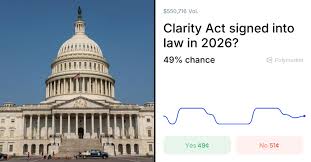
Source: Polymarket Official
Senator Thom Tillis, a key negotiator, suggested the markup might slide into May. While this keeps the bill alive, it makes the window for success very narrow. If the bill slips past mid-May, many analysts believe it will die in its current form and won't be revisited until 2027 or later.
What Happens If the Bill Doesn’t Pass?
If the Crypto Clarity Act fails to pass, the U.S. faces several major risks that could stall the industry for years. Here is the short breakdown of what happens next:
Loss of Global Leadership: Capital and developers are expected to leave the U.S. for regions with clearer rules, like the EU (with its MiCA rules), Singapore, and the UAE.
More Lawsuits, Fewer Rules: Without a federal law, the war between the SEC and CFTC will continue. This means, rules are decided by expensive, multi-year lawsuits rather than clear, pre-defined laws.
Stalled Institutional Investment: Banks and hedge funds will likely stay on the sidelines due to regulatory uncertainty.
Senator Lummis has even warned that if we miss this 2026 window, the midterm elections and changing political priorities could delay another real attempt at a crypto market structure bill until 2030.
This would leave the U.S. domestic market isolated in its own bubble while the rest of the world moves ahead with blockchain infrastructure.
What to Watch for This Week
The Clarity Act news for the rest of this week will focus on Senator Tim Scott. If he announces a surprise meeting by Friday, the bill has a fighting chance. If the week ends without a schedule, the US crypto regulation landscape will remain uncertain for a long time.
Note: The article is for informational purposes only; it does not provide any financial or legal advice.






