Massive Drift Protocol Exploit Drains 285 Million Dollars


Impact of the Drift Protocol Exploit on the Solana Ecosystem
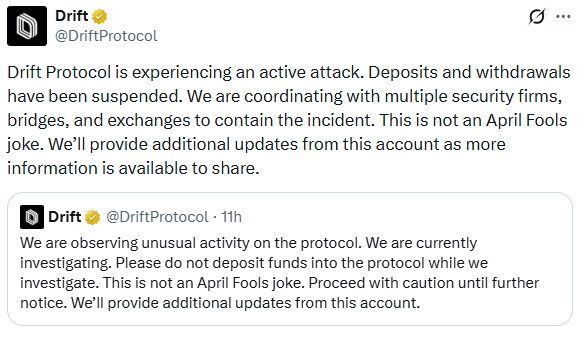
How did a normal trading day become one of Solana DeFi’s biggest security shocks of 2026? The Drift Protocol exploit unfolded on April 1, 2026, when the protocol first warned users on X about unusual activity, then confirmed an active attack, suspended deposits and withdrawals, and stressed that the incident was not an April Fools joke. Because This exchange is a major Solana venue for perpetual futures, the breach quickly became a market-wide risk event, not just a network problem.
 Source: X(formerly Twitter)
Drift Protocol exploit forces emergency shutdown
Drift’s public messaging moved in two clear steps. First, the team said it was investigating unusual activity and told users not to deposit funds. Later, it confirmed the platform was under active attack and said it was working with security firms, bridges, and exchanges to contain the damage. That shift mattered because it told traders the issue had moved beyond routine monitoring into an emergency response. Founded in 2021, The exchange operates on Solana and offers perpetual trading, spot trading, borrowing, and lending.
Drift Protocol exploit drains vaults and key assets
The money moved fast. The first major transfer happened around 11:06 a.m. ET, when roughly 41 million JLP tokens worth about 155 million left a DEX vault for the HkGz4K address. Later transfers across multiple assets pushed the total above 250 million, while PeckShield’s estimate reached 285 million. The suspicious address had been funded with 1 SOL the week before and may have received a small test transfer from the vault earlier. Security researchers said the attack may have come from leaked or compromised admin keys, pointing to human access failure rather than a simple trading bug. The exchange had about 550 million in total value locked before the incident, and Recorded Future noted that the network had linked to code audits from 2023 and 2024 on its website.
Drift Protocol exploit slams DRIFT and confidence
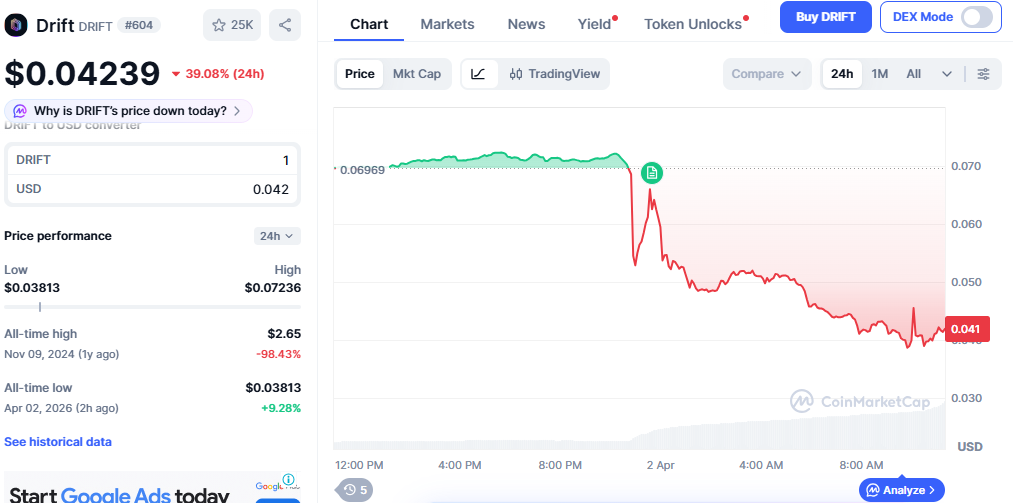
The market reaction was immediate. DRIFT fell nearly 28% on the day to around 0.049 dollars, while CoinMarketCap showed the token touching a new all-time low near 0.03813 dollars on April 2 and remaining more than 98% below its November 2024 high of 2.60 dollars. The pressure spread beyond the token itself: Users trying to access the exchange through its wallet would see a warning, and DeFi Development Corp said it had zero direct or indirect exposure to the ecosystem. At the time of writing, The token is trading near $0.04239.
 Source: CoinMarketCap Token Price
Expert analysis
This incident looks more like an access-control breakdown than a normal smart contract flaw. That distinction matters because key custody, admin permissions, and response speed now sit at the center of DeFi risk. Crypto theft topped 3.4 billion dollars in 2025, with the Bybit breach alone accounting for 1.5 billion dollars. For the wider market, the Drift Protocol exploit is a reminder that DeFi demand can return faster than security discipline.
Future Outlook and Protocol Security
The scale of the Drift Protocol exploit serves as a stark reminder of the risks inherent in "admin-gate" decentralized finance. While the network had undergone multiple audits in previous years, no amount of code auditing can protect against the loss of a private key. Moving forward, the Solana community will likely demand more robust multi-signature requirements and decentralized governance to prevent a single point of failure from causing such massive financial damage.
YMYL Disclaimer: This article is for informational purposes only and does not constitute financial, legal, cybersecurity, or investment advice. Crypto markets and DeFi protocols carry significant risk.
Also read:






