What Are Fed Skinny Master Accounts and Why Crypto Firms Want Them


Fed Proposes Skinny Master Accounts for Crypto and Fintech Firms
Could crypto firms finally plug directly into the US payment system?
That question moved significantly closer to a real answer on May 20, 2026. The US Federal Reserve issued a formal request for comment and proposed rulemaking for Fed Skinny Master Accounts—a limited version of the central bank accounts that would allow eligible crypto and fintech firms to access the Fed's payment rails for clearing and settlement purposes.
Crypto journalist Eleanor Terrett broke the story on X, citing the Federal Reserve's official statement. Wu Blockchain confirmed the report within hours.
This is one of the most consequential regulatory developments for the industry in 2026—and it arrives on the same day President Trump signed an executive order directing the Fed, SEC, CFTC, and OCC to review rules that restrict firms from accessing Federal Reserve payment infrastructure.
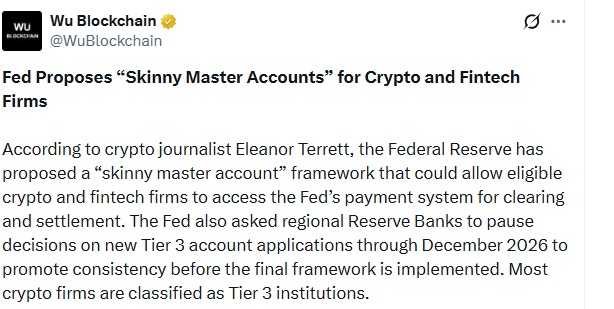
Source: X Account
What Are Fed Skinny Master Accounts and Why Crypto Firms Want Them
A Fed master account is the legal gateway to the central bank's balance sheet and payment rails—historically reserved exclusively for federally supervised depository institutions like commercial banks.
The "skinny" version would allow eligible institutions to clear and settle payments through the Federal Reserve system—but without access to intraday credit, the discount window, or interest on balances held at a Reserve Bank.
In simple terms, crypto and fintech firms get the payment access they need without getting the full benefits of being traditional banks. The proposal is aimed at institutions with newer business models, including some fintech and crypto-related firms, that want access to Federal Reserve payment services without receiving the full range of benefits available to traditional banks.
For firms, this access is significant. Right now, most must route payments through intermediary correspondent banks—adding cost, time, and counterparty risk to every transaction. Direct access eliminates that middleman entirely.
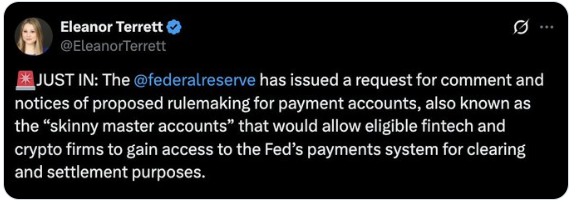
What the Fed Proposed on May 20 — Key Details Confirmed
The Fed opened a 60-day comment period on the new proposal, which is described as "substantially similar to the prototype" outlined in a December 2025 request for information that ran for an initial 45-day comment period.
The Fed also asked regional Reserve Banks to pause decisions on new Tier 3 account applications through December 2026 to promote consistency before the final framework is implemented. Most crypto firms are classified as Tier 3 institutions.
The pause matters. It means it currently in the application pipeline face a wait until the final skinny master account framework is published and implemented—expected by Q4 2026 per Federal Reserve Governor Christopher Waller's earlier timeline.
Trump's executive order, titled "Integrating Financial Technology Innovation Into Regulatory Frameworks," also directed the Fed to clarify whether the 12 regional Federal Reserve banks have independent legal authority to approve or deny master account applications without direction from the Board of Governors in Washington. That clarification carries real weight — if regional banks can act independently, it could potentially work directly with sympathetic Fed branches.
Kraken Already Has One—What That Means for the Industry
The skinny master account concept is not purely theoretical.
On March 4, 2026, the Federal Reserve Bank of Kansas City approved a limited-purpose master account for Kraken Financial — the Wyoming-chartered banking arm of Kraken — marking the first time in history a cryptocurrency firm gained direct access to the central bank's core payment system.
Ripple, Anchorage Digital, and money-transfer firm Wise are among other companies that have also been pursuing master account access.
The Kraken approval proved the mechanism works. The Fed's May 20 proposal takes that proof of concept and builds a formal framework around it—one that could open the same access to hundreds of eligible crypto and fintech firms.
Analysts note that platforms focused on tokenized treasuries, securities, and settlement infrastructure could "benefit disproportionately" if the review leads to easier links between fintech firms and payment infrastructure — marking the beginning of "crypto inside the rails" rather than "crypto outside the system."
The 60-day comment period is now open. The final framework is expected before the end of 2026.
Conclusion
The Fed skinny master accounts proposal is the clearest signal yet that crypto is moving from outside the US payment system to inside it. Kraken proved it works in March. The formalized the framework in May. Trump signed an executive order the same day. The 60-day comment window is the next chapter — and how traditional banking responds could shape what the final rules actually look like when Q4 2026 arrives.
YMYL Disclaimer
This article is for informational and news reporting purposes only. It does not constitute financial, legal, or investment advice








