India Crypto Tax Hits ₹700 Cr in 2 Years: Now Eyes 1% TDS Cut?


India Crypto Tax Jumps 62% in FY24: Will Parliament Slash 1% TDS FY25?
Let’s be honest—when most Indian cryptocurrency users heard “30% charge plus 1% TDS”, they thought trading was doomed. But here we are, just two years later, and India crypto tax collections have already crossed ₹700 crore.
As a cryptocurrency analyst watching India crypto news, I find this data both impressive and alarming. Impressive, because it shows real investor participation. Alarming, because this might only be part of the actual story.
Crypto Tax in India Explodes: ₹700 Cr Collected in Just 2 Years
India’s crypto tax revenue has crossed ₹700 crore in just two years—and the pace is accelerating. In a written reply to the Lok Sabha on July 21, 2025, the Finance Ministry confirmed that over ₹706.52 crore was collected from Virtual Digital Asset (VDA) transactions under Section 115BBH of the Income Tax Act.
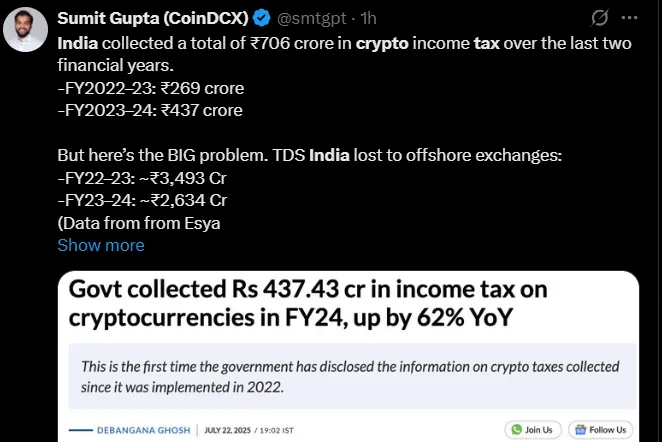
Source: Sumit Gupta CoinDCX
This milestone shows how deeply its has penetrated the entire economy, despite tough duty rules like 30% on profits and 1% India TDS Tax on every transaction.
Year-on-Year Surge: What’s Behind the 62% Jump?
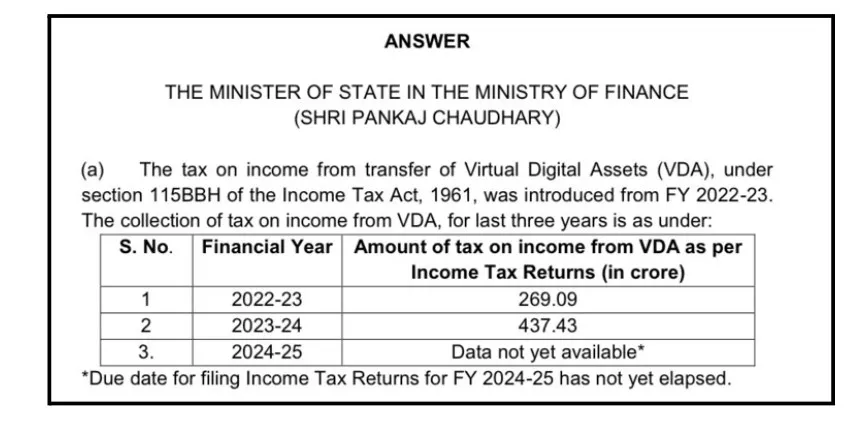
On 21 July 2025, the Finance Ministry officially confirmed through a Lok Sabha reply that:
-
₹269.09 Cr was collected in FY 2022–23
-
₹437.43 Cr was collected in FY 2023–24
That’s a 62% year-on-year jump—a massive rise in duty filings under the VDA charge collection system introduced in 2022.
It’s clear now: Investors didn’t exit the space… they just adjusted to the new tariff regime.
AI Is Watching: Crores Collected, But Hidden Cryptocurrency Income Could Be Much Bigger
While ₹700 crore is a big number, many analysts argue it’s just the tip of the iceberg. A huge part of the activity still happens through:
-
P2P transfers
-
Foreign exchanges
-
Non-custodial wallets
According to the Pankaj Chaudhary statement, the government has started using AI/ML tools and data analytics to track tariff evasion in the cryptocurrency news India space.
And still, experts say that countries cryptocurrency tariff evasion crackdown has barely begun. Many investors are still using: P2P trading, Global exchanges, Non-custodial wallets, which often fly under the tariff radar.
What’s Next for Country's Cryptocurrency Tax Landscape?
There’s a bigger shift in motion. The government is now considering a real-time matching system—where data from Virtual Asset Service Providers (VASPs), TDS filings, and user ITRs can be instantly cross-verified. If implemented well, this could stop duty evasion before it happens.
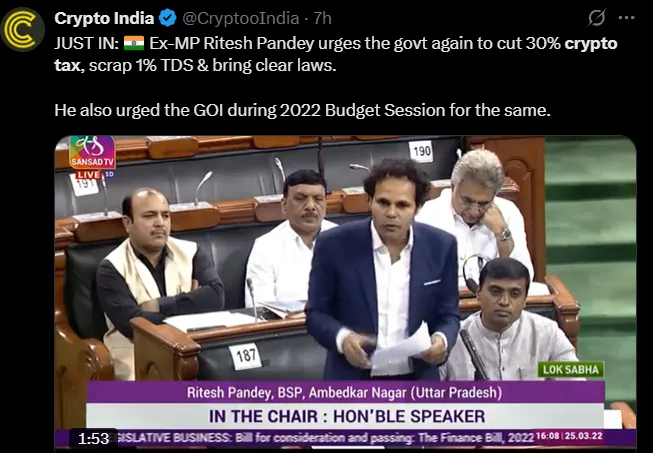
Source: Crypto India X Account
Former MP Ritesh Pandey recently raised this again in Parliament, calling for fair regulation 2025. He also called the currency a “yuva asset class,” urging the government to cut the 30% tax, scrap the 1% TDS deduction, and bring in fair, clear regulations to support the country's Web3 innovators.
As someone who’s observed the global space, India’s current crypto regime is far harsher than most countries.
Conclusion: ₹700 Cr Is Just the Beginning—The Real Crackdown Is Yet to Come
Yes, ₹700 crore in India crypto tax sounds like a big win for regulators. But from where I see it, this is only the visible part. The real industry economy is bigger, faster, and more complex than current rules can fully capture.
With AI surveillance rising, global regulatory pressure increasing, and country's adoption climbing, this story is far from over.
For every user out there—whether you’re a trader, investor, or builder—the message is clear: report right, plan smart, and watch this space closely.

10 months ago
A good article to read. The writer has effectively managed the data to make the article engaging. In my opinion, this is an excellent article.