Is PayPal Quietly Routing PYUSD Transactions Through Solana?

What Sparked the PayPal–Solana Default Network Claims? Let’s Decode
The claim that PayPal has made Solana its default blockchain for PYUSD, a 1:1 U.S. dollar-backed stablecoin, transfers gaining mass and rapid attention on social media channels. As PayPal itself didn’t make any formal announcement regarding this upgrade, many users define it as a secret shift.
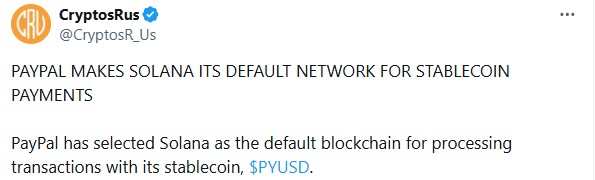
Source: X Official
While the narrative is spreading fast across crypto communities, it is important to separate what is confirmed from what is being inferred.
What Have Been Confirmed So Far
PayPal did first launch its U.S. dollar backed stablecoin, PYUSD, in 2023 on Ethereum. Later, in May 2024, Paypal expanded the coin’s access to Solana, under which users can choose between the networks according to their suitability. Here SOL network's addition was about expanding options, not replacing Ethereum.
However, recent claims suggest Paypal has now made Sol the default blockchain, which means that when users send or receive PYUSD, transactions will automatically route through SOL network unless users switch to other networks manually.
In reality, this assumption is based on interface behaviour rather than a direct statement from the e-payment platform itself.
How the “Default Network” Narrative is Spreading
The idea gained momentum after a post from a verified account on X claimed that PayPal had "quietly" made Sol its default network. The post included a screenshot of PayPal’s blockchain selection screen, where Solana appears listed first, followed by Ethereum, Arbitrum, and Stellar.
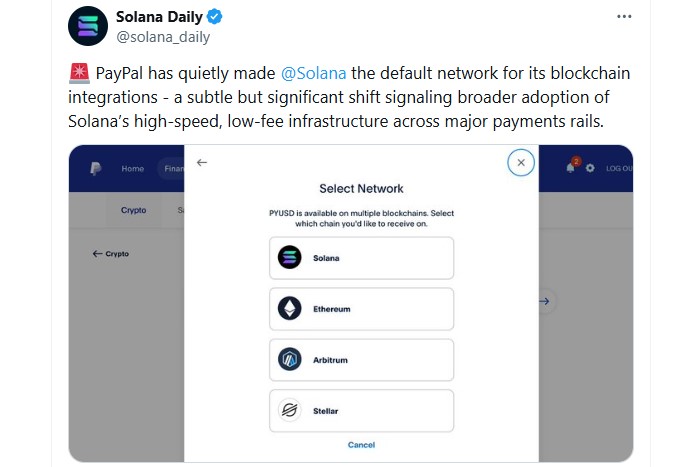
Source: Official X Account
Many users interpreted this ordering as proof that Solana is now the default routing option. As the news gained attention, the claim spread rapidly across many social media platforms, framed as a subtle but meaningful infrastructure shift.
Ethereum Vs Solana: Context Behind the Assumptions
Ethereum remains the dominant platform by total stablecoin value with $158.37 billion Mcap, supported by deep liquidity, strong security assumptions, and continued institutional preference. However, congestion and higher fees can slow down payments, making it less suitable for frequent payments.
Solana, meanwhile, has emerged as the leading network for fast and low-cost stablecoin transfers. Payments on SOL network typically settle in about 400 milliseconds, and it costs near-zero fees that suit everyday payments, trading, and high-volume activity.
These advantages help explain why many assume Sol would be the preferred as main chain, but critics argue over their trading volumes and cap, saying Solana is far below Ethereum and could not win over it.
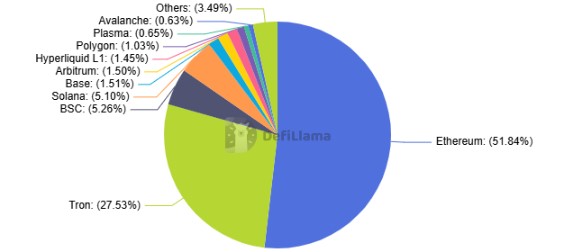
Source: DefiLlama
Final Verdict
At this stage, the claim for SOL network integration for PYUSD is unverified, and shows how quickly crypto narratives can form based on partial evidence.
The narrative is being driven by social media signals, UI observations, and community interpretation, not by an official announcement explicitly confirming a primary change.
Until PayPal formallly confirms such a shift, the “default network” claim should be treated as speculation amplified by social media, rather than established fact.
Note: The article is for informational purposes only. It does not constitute any legal or financial advice or claims.









