Layer Zero Unveils Zero: A Blockchain for Wall Street’s Big Challenges

Explore why Layer Zero, Zero Blockchain Gains Wall Street Support
In a major development that has captured global attention, Layer Zero, the crypto interoperability firm, officially announced it is launching a brand-new blockchain called Zero, targeted at solving some of the biggest barriers holding back Wall Street’s adoption of blockchain technology.
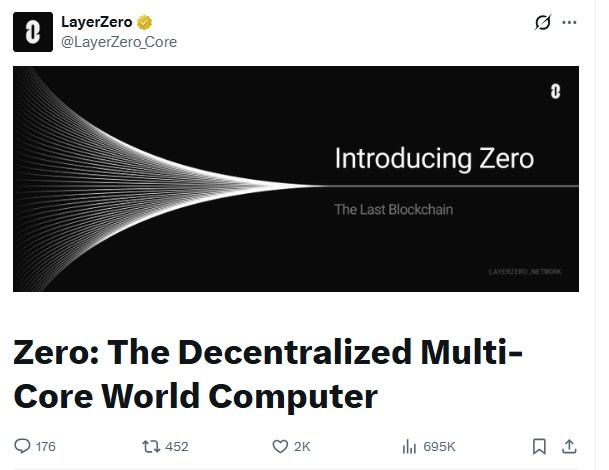
Source: X official
The new Zero blockchain is being built to tackle the two core issues that large financial institutions often cite: poor scalability, slow transaction speed, limited throughput, and lack of privacy for sensitive financial data. It aims to solve these by using advanced execution and zero-knowledge proof technology that allows many transactions to be processed quickly with greater data privacy than traditional public chains.
Major Financial Names Back Zero
Big finance firms are now stepping in as investors, advisors, or partners in the project, driving strong confidence in the idea:
Citadel Securities — The global market-making leader has made a strategic investment by purchasing the project’s token, though Citadel hasn’t revealed how much it paid.
Intercontinental Exchange (ICE) — The parent company of the New York Stock Exchange is working with Layer Zero as a partner to explore how they could support large-scale digital trading and clearing.
Cathie Wood and ARK Invest — Renowned investment firm ARK and founder Cathie Wood are participating with both advisory roles and economic backing.
Tether — The issuer of the widely-used USD stablecoin has confirmed its participation and investment in the project as well.
These institutions are drawn to Zero because they believe traditional markets could benefit massively from the distributed network efficiencies — such as faster settlement, real-time auditability, and tokenisation of securities that could run around the clock, rather than only during typical market hours.
Layer Zero Token (ZRO) Price Reaction
It's own token, ZRO, has seen notable market movement following the news. According to data from CoinMarketCap, the price of ZRO jumped sharply from about $1.66 to roughly $2.4 in the last 24 hours, marking a surge of around +24.43 % amid growing interest after the launch announcement.
Is Zero Just Another Blockchain or Something New?
A common question is whether Layer Zero is simply adding another blockchain to a crowded space or if it truly stands out. The answer seems to lean toward real differentiation: It is not just another public layer-1 network aimed at retail users — it’s designed from the ground up to meet institutional-grade requirements such as massive transaction capacity (millions per second) and strong privacy protections that are not the focus of many other chains today.
Most existing distributed networks were built for public apps and decentralised finance, but struggle with heavy loads and confidential data handling — something that Wall Street has avoided until now. Zero’s tailored approach, backed by big players with financial market expertise, suggests it could be more than a regular blockchain launch.
Why Blockchain Networks are Targeting Traditional Finance
In recent years, blockchain projects and major institutions have both pushed for closer integration between decentralised technology and traditional systems. The reasons include:
Faster settlement — Blockchain can finalise transactions in seconds versus days in traditional clearing systems.
Tokenisation of assets — Turning real-world assets like bonds or stocks into digital tokens can reduce cost and improve liquidity.
24/7 markets — Digital infrastructures do not have the same time limits as regular market hours.
Reduced intermediaries — By settling directly on a distributed ledger, middleman costs and delays can be cut.
These benefits matter not only to traders and firms but also to investors, as increased efficiency, transparency, and access often attract more capital and strengthen market participation over time. Institutions want a distributed network that works with real markets, not just crypto ecosystems.
Conclusion:
Layer Zero’s launch of the new blockchain, backed by Citadel, ICE, ARK, and Tether, marks a significant push toward bringing traditional finance and decentralised technology closer, signalling a new phase where distributed network infrastructure could serve global markets more broadly than ever before.
YMYL Description: This article is for informational purposes only and does not constitute financial or investment advice. Cryptocurrency investments carry risk.








