Why Middle East War Drives Commodities Higher, And Crypto Down?


Middle East War Escalating: Sentiments Moving From BTC To Gold and Oil
The Middle East war has entered its third day after the joint U.S.-Israeli strikes reportedly killed senior Iranian leadership figures, including Ali Khamenei. Iran responded with missile and drone attacks targeting Israeli cities and U.S. interests in the region.
The fast-moving conflict between the United States, Israel, and Iran pressurizes global markets and has triggered sharp reactions in oil, gold, equities, and crypto markets.
As tensions rise, investors are bracing for deeper economic shocks if the situation escalates further. However, the reaction of the geopolitical tension is differ in commodity and digital assets, where commodities have shown more open investment over crypto markets.
Here the question arises: If crypto is mainly about being free from any central controls and transparent then why are physical assets surging but digital assets not?
Middle East War Drives Oil and Gold Prices Higher
Major commodities are having their best value rallies in these tense situations.
Leading the space, oil has noted the highest levels. Brent crude briefly jumped to around $80 per barrel before settling near $78–$79, up nearly 8%. U.S. WTI crude also climbed above $72 (+8%).

Source: Trading Economics
The conflict has disrupted activity around the Strait of Hormuz, a key global oil shipping route. As a result, energy markets reacted quickly. Analysts warn oil could move toward $90 or even $100 if the Middle East war expands.
Precious metals also surged as investors reached for safe haven assets. Gold gained 2.31% in this weekly period, currently valued around $5,399–5,400, possibly crossing its January 2026, ATH of $5,589, setting a new record. Silver, enjoying highest year-on-year gains (200%), is measuring +2% at $95.5 price. Copper, Lithium, Platinum are also in green trading fields.
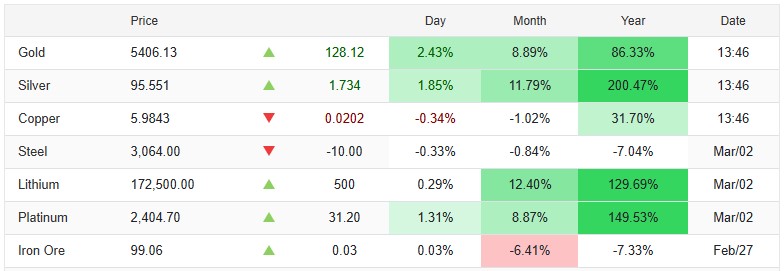
Along with this, the U.S. Dollar Index (DXY) is trading around 98.00–98.32, up roughly 0.71%, marking five-week highs. Meanwhile, the U.S. Treasury yields reflect a flight to safety, with the 10-year yield steady near 3.96–3.97% after briefly touching 3.93%.
This reflects the safe-haven demand that strengthens amid geopolitical tensions, especially U.S.-Israel strikes on Iran and disruptions near the Strait.
Crypto Markets Testing Resilience, But Why?
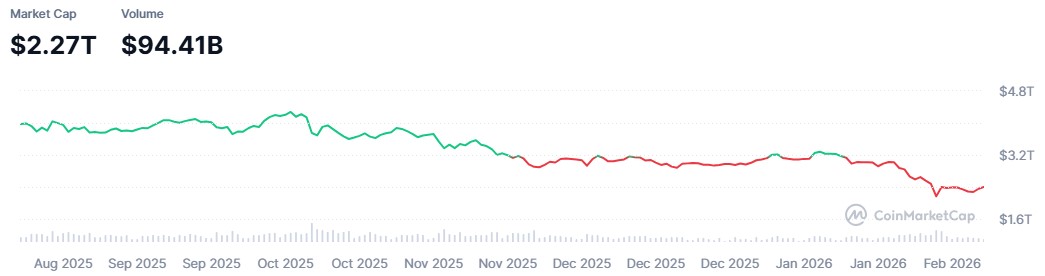
The Middle East war has shaken digital assets, which are already suffering from the October 2025 crash. Since the tensions first escalated in Mid-January, the crypto market has lost more than 12% of its total cap, from $3.28T to $2.27T as of today.
Source: CoinMarketCap Data
Bitcoin initially dropped to the $63,000–$65,000 range during early panic selling. It later rebounded toward $66,000–$67,000, showing partial resilience but still behaving like a high-risk asset. Ethereum traded near $1,950–$1,970, while major altcoins such as Solana and XRP also declined.
Historically, investors viewed crypto as a hedge during geopolitical stress, and situations like this blessed crypto-space, especially Bitcoin, with uptrends. In 2020, during the COVID, Bitcoin rebounded 300%.
However, in recent times, BTC has acted more like a technology stock, falling alongside equities during risk-off moments before stabilizing. Following the golden asset’s behaviour, the majority of cryptocurrencies are now becoming heavily volatile.
If crypto was once seen as a hedge during crises, what changed now?
The change in pattern is significantly related to the adulteration of its original concepts, like decentralizations, immunity, transparency, and rising risks of crypto-related frauds and crimes.
A few mining pools control 50%+ of Bitcoin’s hash rate, and centralized exchanges dominate trading volume.
Fraud has surged: $17 billion was stolen in crypto scams in 2025, illicit flows reached $158 billion (up 145% YoY), broke users' trust and account.
Platforms perform “Hard Fork” programs to get back the stolen funds through hacking, or exploits, which affects the irreversible feature crypto-space, splitting blockchains into parts.
Launching of more centralized tokens in the marketplace, activities from crypto-holding governments (Bhutan sold Bitcoin during panic), also affect the sentiments.
What’s For Next?
Right now, investors remain cautious. Oil and gold are benefiting from uncertainty, while crypto and equities face short-term pressure.
The direction of the Middle East war will likely determine whether markets stabilize or experience deeper volatility in the coming weeks. Until clearer diplomatic signals emerge, traders across commodities, stocks, and digital assets are likely to stay on high alert.
Also read:









