Quantum Threats Highlight Urgent Crypto Security Measures

How Quantum Computers Could Challenge Crypto Security in Near Future
Ethereum co-founder Vitalik Buterin has warned that quantum computers could pose a serious risk to crypto security as early as 2028. According to him, current crypto encryption methods may not survive rapid advances in atomic-level technology, forcing blockchains to upgrade sooner than expected.
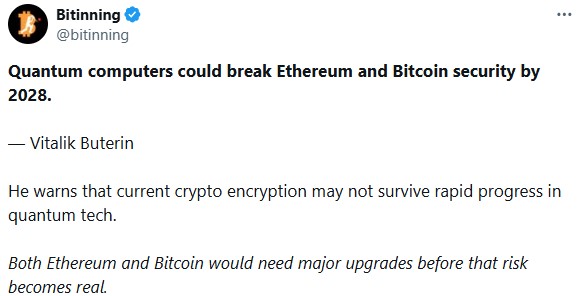
Source: Bitinning Official
Buterin estimates there is around a 20% chance that quantum computers could break today’s cryptography before 2030, though the median timeline is closer to 2040. Still, he believes the crypto industry must prepare early rather than react later.
How Quantum Computers Could Break Bitcoin and Ethereum
Most digital assets use a famous type of encrypting method known as Elliptic Curve Digital Signature Algorithm (ECDSA) to secure wallets and approve transactions on-chain. In ECDSA, wallet owners authorize the transaction through digital signature while a special math formula prevents hackers from guessing private keys (user’s password) from public keys.
However, a powerful subatomic computer technology could break these security levels using Shor’s algorithm which defines how private keys are calculated from public keys, but needs advanced technologies. This will lead attackers to forge transactions and steal funds.
Since public keys are generated only after the spending, cryptocurrency addresses are safe until they are used. But, once exposed, those addresses could become vulnerable if quantum computers reach sufficient scale. Some studies suggest a large portion of existing Bitcoin could be at risk if no upgrades happen.
Experts also note that Grover’s algorithm could weaken hashing systems like SHA-256, though this threat is slower and less severe than breaking digital signatures.
How the Crypto Industry Is Responding
Ethereum, understanding the upcoming needs, is already taking faster action on defense. The team behind is working on post-quantum cryptography modules, exploring options like hash-based and lattice-based digital signatures. As sudden shifts could cause major disruptions due to the size of the network, account abstraction and gradual migrations could support the balanced shift.
On the other side, Bitcoin, the face of cryptocurrency’s existence, faces a tougher path. Its conservative design and need of approval from a wide community make upgrades slower and relatively difficult. However, unspent coins remain relatively safe for now.
Some other blockchains, like Quantum Resistant Ledger (QRL) and IOTA, have already integrated quantum-resistant signatures into their infrastructures, while crypto wallets like BMIC also provide the same quantum-resistant services.
Why This Becomes Important Now
While quantum technologies that could break crypto encryption are not yet launched, it doesn’t mean that the threat is not real. Looking at the rapid innovations and advancing infrastructures, the powerful computers are not so far away.
Taking measures with time will help, while any late actions could lead to major losses for both platforms and users, as Vitalik Buterin also suggests – upgrading early may be the safest path forward.










