Schwab Crypto brings spot Bitcoin and Ether trading


How Schwab Crypto Simplifies Digital Asset Investing for Everyone
What happens when one of the biggest brokerages in the United States opens direct digital asset trading to everyday investors? Schwab Crypto is the firm’s answer. In an April 16 announcement published through its press room and Business Wire, the company said retail clients will soon be able to trade Bitcoin and Ethereum inside the same platform they already use for stocks, funds, banking, and research. The timing is notable because Bitcoin was trading near $74,799 and Ether near $2,329 as the news reached the market, showing the launch arrived during a still-active institutional asset cycle.
 Source: X(formerly Twitter)
Schwab Crypto rollout starts with Bitcoin and Ether
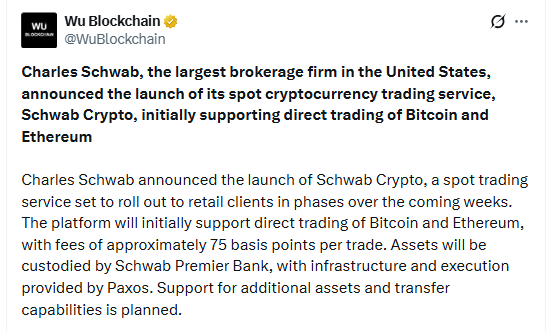
Schwab Crypto will begin with spot access to Bitcoin and Ethereum, the two largest digital assets by market value. The firm said the phased rollout will start in the coming weeks and will bundle trading with research, education, and 24 hour client support. Users will be able to view virtual assets beside traditional holdings across its web platform, mobile app, and thinkorswim. The company also said it plans to add more virtual assets and later support both deposits and withdrawals.
Schwab Crypto adds custody, pricing and scale
The launch is built around a separate Charles Schwab Crypto account linked to a brokerage account. The firm’s bank unit will safeguard client assets and keep records, while Paxos will provide the execution layer and sub-custody through its regulated infrastructure. The company set the trading fee at 75 basis points on the dollar value of each trade. The firm also said its clients already hold about 20 percent of spot digital asset exchange traded products, which suggests demand for this market was already strong inside the company ecosystem before this direct trading option arrived.
Schwab Crypto enters the US retail trading race
Scale is the part that makes this launch different. The brokerage reported record first quarter activity on the same day, including 39.1 million brokerage accounts, $11.77 trillion in client assets, and 9.9 million daily average trades. That gives Schwab Crypto a built-in audience that few digital asset platforms can match. Access will still be limited at the start, since these accounts are not initially available in New York, Louisiana, US territories, or international markets. Meanwhile, the company’s shares closed at $92.62 on April 16, down about 7.6 percent on the day, even as it posted record quarterly profit.
Schwab Crypto future outlook for market access
The deeper signal is not just that the company added another product. It is that digital assets keep moving into standard brokerage plumbing. Its own 2025 survey of 460 current and intended digital asset investors found that low transparent pricing, trusted brands, and asset security were the three biggest decision factors. That fits this launch closely. If the service expands beyond Bitcoin and Ethereum and adds transfers without friction, it could help make regulated digital asset access feel more routine for mainstream investors, even though volatility and loss risk remain unchanged.
In story terms, this launch feels less like a sudden leap and more like a door quietly opening in a familiar building. The company did not pitch a digital asset revolution. It offered a controlled, bank-linked path into Bitcoin and Ethereum. That is why markets will watch the rollout closely: not for hype, but for signs that this market is becoming normal infrastructure.
Your Money Your Life Disclaimer: This article is for informational purposes only and does not constitute investment, legal, or financial advice. Cryptocurrency involves high risk, including possible loss of principal, and readers should review official disclosures before making financial decisions.






