SEC Tokenized Securities Framework Redefines Blockchain Finance Rules

SEC Tokenized Securities Guidance Clarifies Issuer and Third Party Mod
The U.S. Securities and Exchange Commission has issued its most detailed guidance to date on SEC tokenized securities, drawing a clear regulatory boundary between blockchain innovation and long-standing federal securities law. The message is direct: placing a security on a crypto network does not change its legal status, investor protections, or compliance obligations.
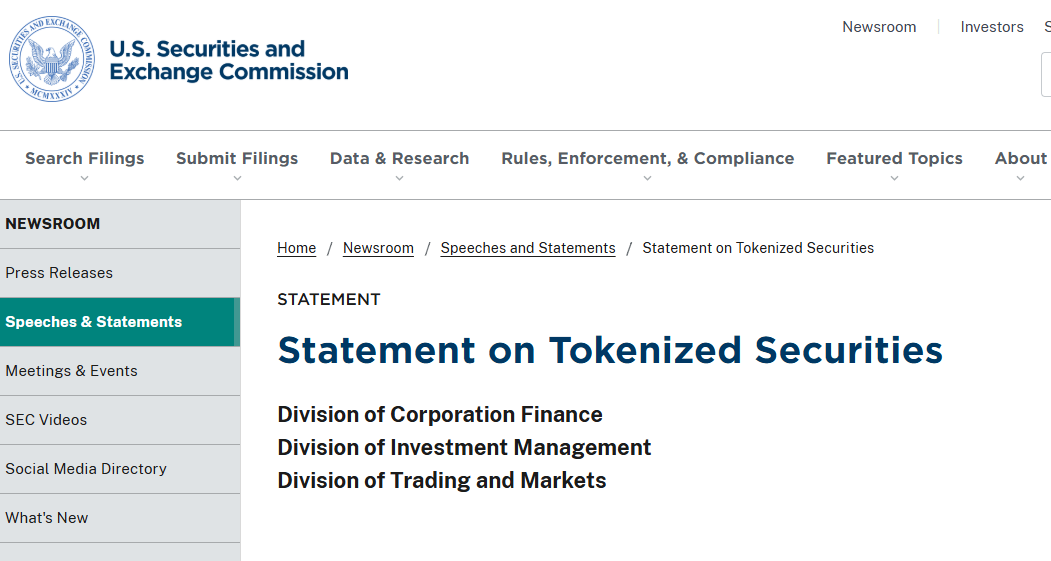 Source: US SEC
For issuers and exchanges racing to bring stocks and bonds on-chain, this guidance may now determine who launches successfully and who faces immediate regulatory risk.
In a joint staff statement released this week by the Divisions of Corporation Finance, Trading and Markets, and Investment Management, the SEC outlined how tokenized securities should be classified, issued, and regulated under existing law. The guidance arrives as major financial institutions accelerate tokenization pilots, following similar regulatory moves in the European Union, Singapore, and the United Kingdom between 2024 and 2025.
The Two Big Categories You Need to Know
The SEC has broken the world of digital securities into two distinct buckets. Understanding which one you fall into is the difference between a smooth launch and a legal nightmare:
Issuer-Sponsored Tokens: This is when a company (like a big tech firm or a bank) decides to issue its own shares directly on a blockchain. Here, the "on-chain" record is the official source of truth for who owns the stock.
Third-Party Tokens: This is where things get tricky. This happens when an outside company "wraps" another company's stock into a token. The SEC is keeping a much closer eye here because these tokens often don't give you the same rights, like voting or dividends.
How the Latest SEC Tokenized Securities Framework Affects Issuers
For companies looking to innovate, the SEC tokenized securities framework provides a much-needed "How-To" guide. If you are an issuer, you can now offer your shares in both traditional and tokenized formats. You could have one class of investors holding paper-style digital records and another holding tokens on a blockchain and as long as the rights are the same, the SEC will treat them as the same class of stock.
The Technical "Checklist" for Compliance
To stay on the right side of the law, the SEC tokenized securities framework requires a high level of detail in how you keep your records. You can't just have a list of anonymous wallet addresses.
Wallet-to-Identity Mapping: You must be able to link an on-chain wallet (e.g., 0x123...) to a real human address and name off-chain.
Master Securityholder File: Your "Master File" must be auditable and reflect every transfer that happens on the blockchain in real-time.
Synthetic Risks: If you are a third party offering "linked" or "synthetic" tokens, you are likely dealing with security-based swaps. These have much stricter rules and usually can't be sold to regular retail investors without heavy-duty registration.
Expert Analysis: The Strategic Liquidity Pivot
The arrival of this framework serves as a green light for institutional participants who have previously hesitated due to regulatory ambiguity. While the guidance sidesteps the debate regarding when a crypto-native token becomes a security, it provides a clear runway for the tokenization of real-world assets (RWA) such as Treasury bills and corporate bonds.
Future outlook indicates that the 2026 implementation deadline will likely trigger a wave of re-filings from existing projects seeking to align their structures with the custodial and synthetic definitions provided. As the New York Stock Exchange and other major trading venues prepare to launch blockchain-based equity platforms, this framework acts as the foundational manual for the next generation of U.S. capital markets.