Tether Gold Reserves Cross 140 Tons as Gold Price and Demand Surge


Tether Gold Reserves Power XAUt as Gold-Backed Stablecoin Leader
Tether has quietly made history in the global gold market. According to Bloomberg, the company now holds over 140 tons of the asset worth nearly $24 billion. This makes it the largest known private holder in the world outside of banks and governments. This shows how fast the company has grown from a crypto issuer into a serious financial power.
The scale of the Tether Gold Reserves is changing how people look at stablecoins. The asset is stored in highly secure Swiss bunkers, including nuclear-grade vaults built to protect national assets. These reserves support Tether’s gold-backed token XAU₮ and also strengthen its wider reserve structure that backs USDT.

Source: X (formerly Twitter)
Why Is Tether Buying So Much Gold?
CEO Paolo Ardoino believes the physical asset will play a key role in the future financial system. He has openly said Tether aims to become a “gold central bank” in a world where trust in fiat currencies continues to weaken.
Tether started buying gold aggressively in 2025, adding more than 70 tons in one year. At times, it purchased 1–2 tons every single week.
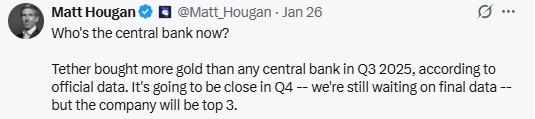
In Q4 2025 alone, they bought 27 tons. That made it the biggest XAUUSD buyer in the world, even larger than central banks.
Experts like Bitwise CIO Matt Hougan asked a simple question: “Who’s the central bank now?” The answer seems clear when looking at the size of reserves today.
Source: X (formerly Twitter)
How Gold Strengthens Tether’s Stability?
The yellow metal asset gives the organisation something most stablecoin issuers do not have: physical protection against financial shocks. While USDT is backed mainly by U.S. Treasuries, cash, and Bitcoin, the yellow metal asset adds a long-term safety layer. BDO audits have confirmed that firm’s reserves exceed the total USDT supply, which now stands above $187 billion.
This makes the firm less dependent on any single financial system. This diversification is important in times of inflation, rising debt, and global currency uncertainty.
XAU₮ Is Dominating the Gold-Backed Stablecoin Market
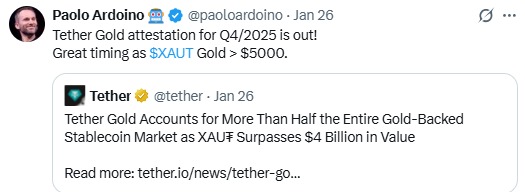
XAU₮, now represents more than 50% of the entire gold-backed stablecoin market. Its total value has crossed $4 billion, showing strong demand for digital assets that track real gold. Each XAU₮ token is backed by physical asset stored in Swiss vaults.
Source: X (formerly Twitter)
As gold prices recently crossed $5,000 per ounce, interest in XAUUSD-linked crypto assets has surged. Many investors prefer digital access to the asset rather than storing it physically.
Tether’s Revenue Power Supports Its Strategy
Tether earned $5.2 billion in revenue in 2025, which was 41.9% of the entire crypto industry’s revenue, according to CoinGecko. This strong cash flow allows them to keep expanding its holdings without harming liquidity. Profits from 2025 will continue funding future purchases.
This is why the accumulation not slowing down. They are becoming a core part of a firm's long-term financial identity.
USA₮ Adds a New Layer of Trust
The organisation has also launched USA₮ recently, a fully regulated dollar stablecoin for the U.S. market under the GENIUS Act framework. It is issued by Anchorage Digital Bank and backed by reserves custodied by Cantor Fitzgerald. USA₮ will be listed on platforms like Kraken, Bybit, OKX, Crypto.com, and MoonPay.
This shows the company is expanding both into regulated dollar assets and massive physical asset ownership at the same time.
Tether Is Becoming a New Type of Financial Giant
The reserves now sit at the crossroads of crypto and traditional finance. The company is no longer just a stablecoin issuer. It is becoming a hybrid financial institution holding massive gold, government debt, and digital assets together.
Disclaimer: This article is for informational purposes only and not a financial advice, kindly conduct your own research before investing.