Trove Token Crash Sparks Rug Pull Fears After 95% Post-TGE Dump

Trove Token Crash Exposes Presale Risks and KOL Shilling Practices
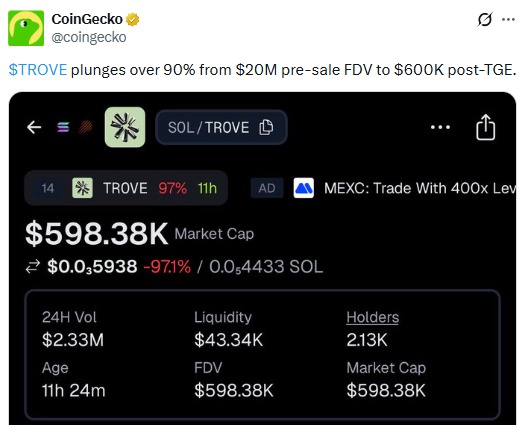
The crypto market witnessed another major shock as the Trove token crash wiped out millions of dollars in value within minutes of its launch. Trove Markets launched its $TROVE token on Solana on January 19, promising a $20 million fully diluted valuation. Instead, the token collapsed by more than 90%, falling to a market cap near $600,000. For many investors, this was not just a loss, it felt like a betrayal.
Source: X (formerly Twitter)
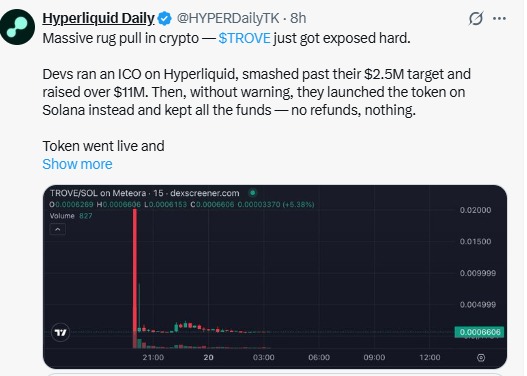
Before launch, Trove Markets had raised around $11.5 million in an ICO that originally targeted the Hyperliquid ecosystem. The project was heavily oversubscribed, far beyond its $2.5 million target. Expectations were high, and early buyers believed they were entering a strong new trading platform. But the outcome was the opposite, making the Trove token crash one of the biggest disasters of 2026 so far.
What Happened After the Token Launch?
The token launched with extremely low liquidity, around $50,000. This alone created danger. When early holders began selling, the price collapsed almost instantly. The FDV dropped from nearly $20 million to under $1 million in minutes.
Some investors shared heartbreaking stories. One trader said his $20,000 investment turned into just $600. This kind of damage is what makes the price crash feel more like a soft rug than a normal market dip.
The team later said they refunded about $2.1 million, while keeping around $9.4 million for “development.” This only increased anger in the community.
Chain Switch Added Fuel to the Fire
Originally, It was built around Hyperliquid. But just before the launch, the team suddenly moved the token to Solana. This last-minute chain switch shocked investors.
Source: X (formerly Twitter)
Many people thought that the hype was created through the ecosystem developed by Hyperliquid, but the idea that it launched on Solana for ease of exit broke the trust. The Trove rug pull situation taught a lesson on how quickly trust can vanish once approach changes without warning.
KOL Payments and Casino Fund Allegations
The matter went from bad to worse after blockchain investigator ZachXBT revealed evidence of transactions from the ICO wallets being sent to casino sites and bets on Polymarket. This raised serious red flags.
Nonetheless, there were also reports of several crypto influencers who were compensated to endorse the crypto ICO without disclosing it to the public. One major name, @waleswoosh, was accused of receiving $8,000 USDC. He later admitted payment issues and apologized for not being clear.
Undisclosed promotions are dangerous. During the crash, many traders realized they trusted voices that were secretly being paid.
Was It Planned or Just Chaos?
Many believe the price crash was not accidental.
Red flags included:
Oversubscription without clear refund rules
TGE Delays
Sudden chain migration
Low liquidity at launch
Influential marketing
Funds reportedly used for gambling
They all culminated to create a perfect storm.
Why Presales Are Dangerous?
The Trove market dump proves one thing clearly: presales are high risk. Flashy testnet numbers and big marketing campaigns cannot replace real products.
If a team controls large funds and offers weak transparency, investors carry the full risk.
A similar structure appeared in the $ASTER price crash case, where aggressive promotion, heavy influencer marketing, backed by personalities like CZ, and post-crash ‘rescue plans’ followed sharp price declines. In both cases, retail investors were left holding losses while narratives shifted to damage control.
Final Thoughts
The trove token crash is now being called 2026’s first major rug-style collapse. It reminds the crypto community that hype alone is never enough.
Always question:
Where is the money going?
Who is getting paid to promote?
Is liquidity safe?
In crypto, trust is everything. And once it breaks, recovery is almost impossible.