Trump WLFI Token Proposal: Why Staking Now Required for Voting Rights?

Trump WLFI Token Governance Shakeup: Community Voting Opens for 7 Days
Highlights:
World Liberty Financial proposes a staking requirement for voting.
Voting power to depend on staked WLFI amount and lock-up duration.
7-day community vote will decide the staking-based system rollout.
Why Is the Trump WLFI Token Update Creating Buzz?
The latest Trump WLFI Token Update has stirred fresh discussion in the decentralized finance (DeFi) sector. A new governance proposal presented by crypto project World Liberty Financial (WLFI), which is allegedly supported by the Trump family, can change the way token holders are involved in decision-making in a major way.
The proposal will require users to stake their unlocked tokens prior to being able to vote in governance. The proposal is in the community voting phase, and the decision period should last seven days. The relocation is meant to promote long term commitment and discourage short term speculations in the ecosystem.
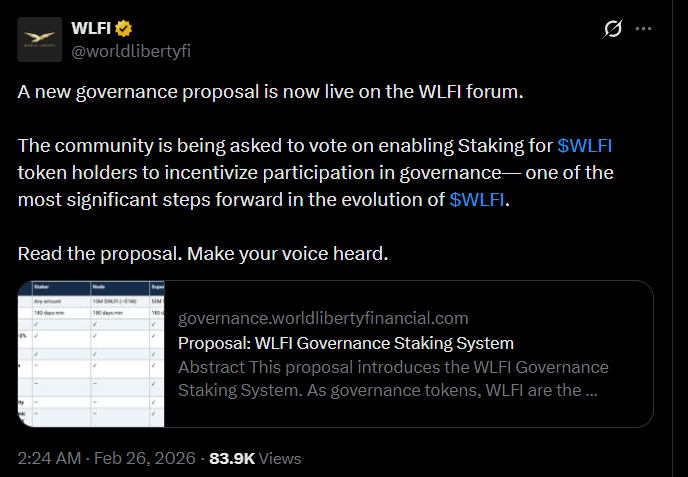
Source: Official X
What Does the New WLFI Governance Staking System Actually Propose?
The suggested Staking System implies a number of structural modifications in the functioning of the governance in World Liberty Financial.
Should You Cash in Tokens Before Voting?
According to the proposal, the holders of unlocked tokens are required to stake the tokens before they can be eligible to vote. The non-stakeholders who use their tokens will not be able to vote, and those who possess the tokens that have already been locked can vote. Key parameters include:
Lock-up of stakes of at least 180 days.
Power of governance that is founded on the size of the stake andthe lock-in period.
To avoid high voting concentration, non-linear square-root weighting.
Dynamically decreasing rights with a decrease in lock-up time.
It is designed in such a way that it allows long-term participants to make decisions, rather than short-term traders.
Can Staking WLFI Tokens Earn Rewards?
Yes. Active governance participants are also proposed to receive staking rewards.
The annual reward of about 2% APR is paid by the WLFI treasury to the stakers as a base. However, Rewards are conditional as token holders need to vote in at least two governance votes during their staking period to be eligible.
Other incentives will involve the benefits of users who deposit USD1 stablecoin on WLFI Markets that are run on Dolomite. These deposit incentives will not be given to the non-staking users.
What Are WLFI “Nodes” and “Super Nodes”?
The proposal also brings in levels of participation that are tiers and aimed at rewarding huge and dedicated contributors of the ecosystem.
Node Tier: Who Qualifies?
Nodes can be participants who have placed 10 million tokens (approximately $1 million at present prices). Node benefits include:
Availability of OTC conversion of stablecoins (USDT or USDC to USD1)
Direct contact with licensed market makers.
Other rewards for the volume of conversion.
Team-building benefits and management perks.
The idea is to shift arbitrage gains that institutional market makers have already acquired to serious ecosystem players.
Super Node Tier: What Additional Power Do they receive?
Super Nodes can be users who hold 50 million tokens (approximately $5 million). Super Nodes receive:
All Node privileges
Personal contact with the team to discuss partnership.
Possible further economic incentives for platform integrations.
In the proposal, however, it is clear that Super Node status does not imply a partnership deal; it is only priority access.
Why Is WLFI Introducing This Governance Change Now?
The offer comes with scrutiny of the project. Recently, the platform alleged that it was attacked in a coordinated manner, which raises the question of the stability of the ecosystem. World Liberty Financial attempts to:
Enhance active community engagement.
Match incentives to long-term token holders.
Minimize manipulation of governance by short-term traders.
Enhance confidence in the WLFI ecosystem.
Will the Community Support the Proposal?
The proposal must have a quorum of 1 billion eligible voting tokens and a simple majority to be passed. The community discussions on the governance forum suggest that the reaction is mixed; some users are concerned about the possibility of retroactive impact on current holders.
The voting will be open for seven days, and the team will implement it in three stages:
Governance staking launch
Node tier activation
Super Node partnership model.
With the Trump crypto news in progress, the ultimate vote may define whether the system of the platform will transform to become a stake-based system that will incentivize long-term ecosystem dedication.
Disclaimer: This is not financial advice. Please DYOR before investing. CoinGabbar is not responsible for any financial losses. Crypto assets are highly volatile, and you can lose your entire investment.






