U.S. Treasury Orders $344 Million USDT Freeze Linked to Iran

The Crypto Impact of the $344 Million USDT Freeze on the Tron Network
The U.S. Treasury has taken a sharp step against illicit finance. Officials under Donald Trump coordinated a $344 million USDT freeze. The move targets digital funds linked to Iranian government.

Source: CNN Politics
This action forms part of Operation Economic Fury. The campaign aims to break Tehran’s financial networks during rising global tension.
One question now stands out. Can governments control money on a system meant to be free?
What triggered the $344 million freeze?
On April 24, 2026, Tether confirmed it blocked two wallets on the Tron network. One held $212.9 million. The other stored $131.3 million.
U.S. officials linked both wallets to the Central Bank of Iran and local cryptocurrency firms. Authorities flagged the funds as tied to unlawful activity.
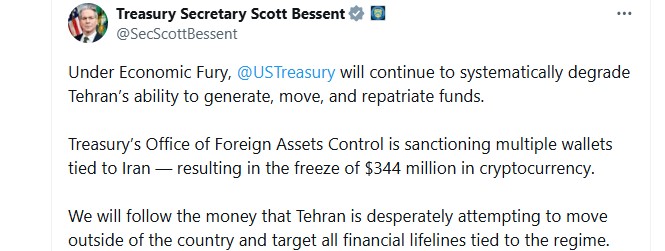
Treasury Secretary Scott Bessent shared the update online. He said the Office of Foreign Assets Control is sanctioning wallets tied to-Iran.
This ranks among the largest cryptocurrency enforcement moves ever recorded.
Why is Iran in focus now?
Iran has spent years building a crypto economy worth $7.8 billion, according to Chainalysis 2025 report. The Islamic Revolutionary Guard Corps reportedly moved over $3 billion through digital assets.
Why use cryptocurrency? It helps bypass banks and avoid sanctions. Many groups rely on Tether (USDT) for its dollar-like stability. But there’s a catch. Tether can freeze funds.
The company works with over 340 law agencies across 65 countries. It has frozen $4.4 billion so far. More than $2.1 billion ties to U.S. cases as per chainalysis data.
Can cryptocurrency still stay neutral?
Tensions remain high despite reports of a U.S.–Iran ceasefire. Oil prices reacted, with Brent crude falling to $97.56.
Iran has built a large crypto system over time. It mined Bitcoin to turn excess power into value. It even tested crypto toll payments near the Strait of Hormuz.
At the same time, U.S. tracking tools have improved. Blockchain analysis, or tracking public transaction data, can follow money step by step.
That transforms the landscape. Freezing funds can lock access instantly. Even complex transfers leave traces behind.
What does this mean for crypto’s future?
This $344 million freeze presents a potential change. Hiding funds on public blockchains is getting harder.
For Iran, the loss cuts into trade and funding channels. For the cryptocurrency world, it marks a shift toward tighter control.
You’re now seeing a new reality. Crypto isn’t beyond reach anymore.
Note: The article is for informational purposes only; it does not constitute financial or legal advice.









