White House Crypto Summit on Feb 2, Seeks CLARITY Act Approval


White House Crypto Summit: Bank Regulators Vs Crypto Firm Leaders
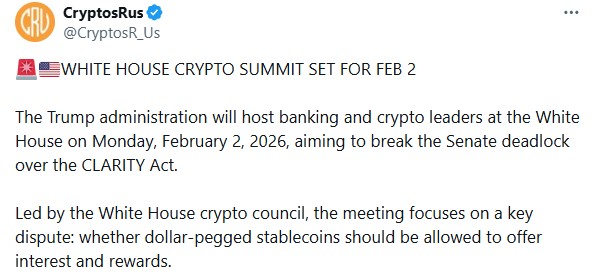
The White House Crypto Summit is scheduled for Monday, February 2, 2026, as the Trump administration moves to break the continuous deadlock over the CLARITY Act, the most comprehensive cryptocurrency regulation bill to advance in the United States so far.
Source: CryptosRus Official
Led by the White House crypto council, the meeting will bring together senior government officials, major banks, and leading digital asset companies in an effort to unlock progress on the stalled CLARITY Act.
While the cryptocurrency market structure bill has already cleared the House of Representatives and Senate Agriculture Committee by a narrow 12–11 votes, disagreements between digital asset giants and the traditional banking systems blocked the final approval.
What Is the CLARITY Act and Why It’s Stuck
The CLARITY Act is a proposed US crypto bill that aims to end regulatory confusion in digital currencies by defining whether it is a security or commodity, and which regulators, the SEC or CFTC, has authority over it.
Everything was smooth and crypto-platforms were also supporting the act, until it brought a surprising clause which restricts the crypto-firms to offer yields or rewards in stablecoin staking.
Cryptocurrency firms argue that yield-bearing stablecoins would speed up adoption, attract capital, and help the U.S. compete globally.
Banks, however, warn that allowing interest on stablecoins could pull deposits away from traditional accounts, especially from community and regional banks. This disagreement has become the main obstacle preventing the CLARITY Act from moving forward.
As the major players will be in front of each other, the White House Crypto Summit is expected to resolve the issue: should dollar-pegged stablecoins be allowed to offer interest to users or that privilege remain exclusively with banks?
Who Is Attending and What the Market Is Watching
Source: Coin Bureau
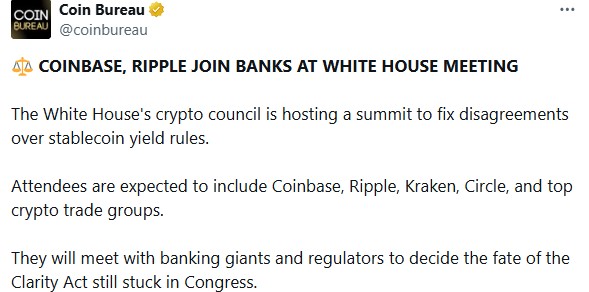
Expected attendees include major crypto-dealing companies and trade groups, including Coinbase, Circle, Ripple and Kraken, alongside top banking leaders and financial officials. Their discussions will focus on whether stablecoin yield rules can be adjusted in order to not disrupt traditional banking systems and widely accepted yield rewarding systems in cryptocurrency space.
Markets are watching closely because the outcome could post wide-effects as the U.S. is considered as one of the major digital asset markets with significant platforms and users. Analysts estimate that favourable stablecoin rules could unlock trillions in deposits, increasing crypto’s integration into mainstream finance and the number of participants.
However, failure to reach agreement could delay regulatory clarity, increasing uncertainty. At the same time if outcome will not come in favour of crypto-firms, their possible withdrawals can cause short term market volatility.
What Comes Next
If the White House Crypto Summit succeeds, it could clear the final roadblock for the CLARITY Act and set clear rules for stablecoins, exchanges, and regulators.
White House Crypto Czar David Sacks has said the bill could help position the U.S. as the “crypto capital of the world.”
But if it fails, the U.S. cryptocurrency industry may continue operating in a gray area, while other regions move faster with clearer frameworks.
Either way, the February 2 meeting is shaping up to be one of the most important policy moments for digital asset markets this year, which is seen as a last-mile effort to reach a compromise.