Ethereum Staking Market Heats Up: 910K Exit, 268K ETH Join Queue


Why Ethereum Validators Are Waiting: 910k Exit & 268k Entry Queue News
In the recent update, a lot of Ethereum validators are waiting to leave staking, and some are waiting to enter the market, whereas the PoS network is causing delays due to the long queue. The Network shows a busy, dynamic market, hinting at an active and changing proof-of-stake ecosystem. This article highlights some significant matters on what could be the possible reasons for such high exit, delays, and possible risks and benefits related to it.
What’s the News
According to the validator tracking site validatorqueue, Ethereum has reached a record high exit queue. Currently, over 910,461 ETH—worth around $3.91 billion—is waiting to leave the network. At the same time, approximately 268,217 ETH is queued to join as new validators.
This shows that the Ethereum staking market is very dynamic. People are both re-staking for additional yields and withdrawing for profit-taking. These movements reflect the busy activity in Ethereum's PoS network, which is carefully designed to maintain stability.
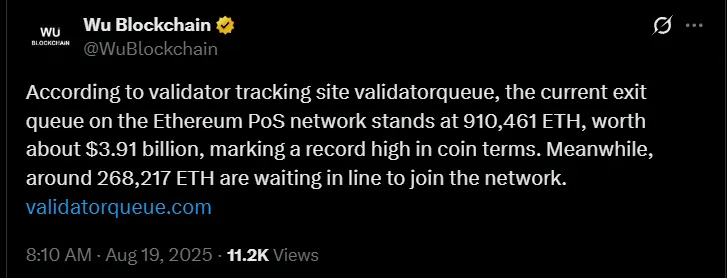
Source: Wu Blockchain X
Detailed Explanation: High Exit and Entry Queue
Ethereum has a proof-of-stake (PoS) protocol in which validators put up ETH to assist in securing the network. The system, however, restricts the amount that can enter or leave staking within each epoch. The current cap is 256 ETH per epoch, which occurs every 6.4 minutes.
Because of this limit, the large numbers waiting to exit lead to delays. Validator queue data shows that exits could take about 15 days and 19 hours to complete. This mechanism is intentionally set to prevent network instability, even when large amounts of Ethereum want to move in or out.
In the meantime, there are platforms where it is possible to restake ETH, e.g., EigenLayer, where stakers can reuse their own to earn additional yields. This is adding another layer to the congested staking and exit queues.
Reasons for High Exit
The leaving queue is at a record high mainly because:
Profit-taking: A lot of stakers are selling Ethereum to realize profits.
Leveraged deleveraging in DeFi: DeFi investors are deleveraging.
Market dynamics: Stakers will leave temporarily and restake in the future to get additional rewards.
A combination of these elements produces a dynamic and emotional staking, where ETH is continuously leaving and entering the network.
Potential Risks and Benefits
The hectic staking market is associated with both risks and benefits:
Benefits: Restaking services such as EigenLayer can enhance security by putting more ETH into use across protocols.
Risks: Exit queues and delays may divide the market, resulting in short-term congestion in the PoS system. In case exits are too numerous and are not balanced, this may influence stability.
According to experts, although these queues appear alarming, the system can safely cope with high validator churn.
Conclusion
This staking activity is at a record high, showing a lively and dynamic market. Over 910,000 are waiting to exit, while 268,000 wait to join. The PoS limits cause delays, but they ensure stability. Platforms like EigenLayer add opportunities for extra yields but also influence queue dynamics.