Zcash Release Urgent Security Updates After Four Bugs Threaten Network

Zcash Security Update: New Patch Targets Crash and Chain Split Risks
Zcash has pushed urgent software updates after developers found four security flaws across its two main node clients. The disclosure appeared in posts from ZODL, the Zcash Foundation, and Wu Blockchain X. The issue matters because Zcash depends on multiple clients to keep the network secure, stable, and decentralized.
What broke, and why does it matter?
The headline fix centers on Zcashd v6.12.1 and Zebra v4.3.1. Those are the two main software implementations used to validate Zcash transactions and blocks. When two clients read the same data differently, they can split on the chain history. That’s a consensus split.
The most serious public detail involved an Orchard action encoding flaw. Orchard is part of Zcash’s shielded, or privacy-preserving, transaction system. Developers said the bug could crash nodes and could also create split behavior between the C++ client, zcashd, and the Rust client, Zebra.
That’s why this update moved fast.
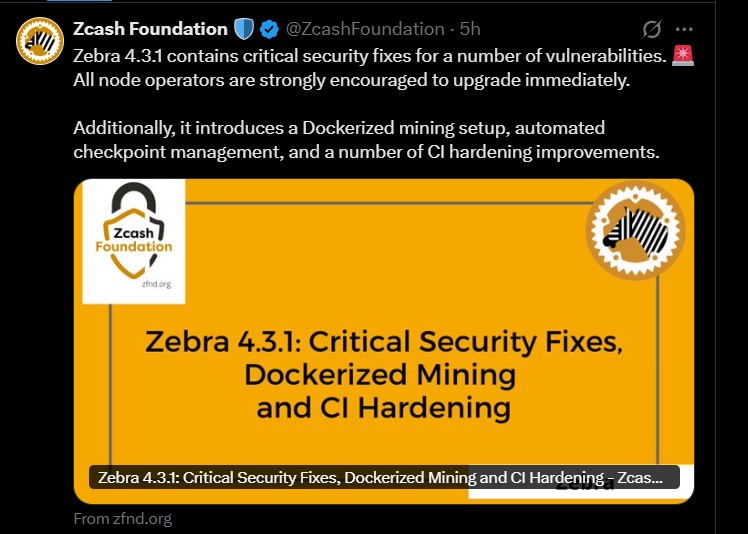
The Zcash Foundation Zebra release notes also described several related security fixes. These included a transaction verification cache issue, an addr or addrv2 memory exhaustion bug, transparent sighash handling that could cause consensus divergence, and an Orchard rk identity-point panic during transaction verification. The release urged all node operators to upgrade immediately.
Source: Official X
Inside the patch: four flaws, one urgent message
The official update stressed that mining pools already running both implementations had finished deployment. That reduced the risk of chain instability at the most sensitive layer of the network. Developers also said they had found no evidence that anyone had exploited the flaws in the wild.
Just as important, the teams said the incident did not put user funds at risk. They also said privacy protections remained intact. There was no sign of ZEC inflation, which means the flaws did not create a path to mint extra coins outside the protocol rules.
Zebra v4.3.1 shipped more than security patches. The release also added a Dockerized mining setup, automated checkpoint management, and CI hardening changes. Those upgrades do not drive the story, yet they show the team used the release to tighten operations as well.
How did the market take it?
This announcement read more like a network-safety event than a price catalyst. The materials provided did not include a confirmed ZEC price swing, so any claim about market direction would be premature. What we can say is this: the message to operators was clear, immediate, and practical. Upgrade now.
For traders, the bigger signal is operational trust. The network relies on diverse client software for resilience. Quick disclosure, coordinated patching, and no detected exploitation may help steady sentiment, even if short-term price action stays muted.
Conclusion
The Zcash update shows why client diversity can strengthen a network, while also raising the cost of software mistakes. Fast patching by core teams and mining pools helped contain the risk this time. In the near term, the market will likely watch upgrade adoption, node stability, and any follow-up technical disclosures.
Disclaimer: This article is for information only. It is not investment advice, trading advice, or a recommendation to buy or sell ZEC. Crypto assets are volatile, and software incidents can affect sentiment quickly.