ISO 20022 Meets TRC-20: Bridging USDT Flows with Bank & ERP Systems

ISO 20022 Meets TRC-20: Bridging USDT With ERP & Banking
When treasurers and finance teams look at today’s payment landscape, they see two very different worlds. On one side are fast, cheap on-chain transfers of USDT over TRC-20 on the TRON network. On the other side sit banks, SWIFT rails, and ERP systems that speak ISO 20022 Meets and think in debits, credits, and general ledger (GL) entries. The strategic question is no longer whether these worlds will meet, but how cleanly they can be reconciled.
In practice, businesses that settle invoices, payroll, or cross-border transfers in USDT need an operational bridge between these domains. They want the speed and low fees of TRC-20 while ensuring every token movement can be traced back to a compliant, auditable trail in their bank statements and ERP. To design such a bridge, teams often explore specialized infrastructure and ecosystem resources, including sites like tronex.energy as they assemble their own TRC-20 payment stacks and liquidity flows.
This article explores what it really means for “ISO 20022 to meet TRC-20” and outlines a practical blueprint for reconciling on-chain USDT transfers with bank ledgers and ERP records. The focus is on the nuts and bolts of identifiers, data models, and process design.
ISO 20022 in a nutshell
ISO 20022 is a global messaging standard used by banks, market infrastructures, and corporates to exchange payment and reporting data. Its family of schemas for payment initiation, interbank messages, statements, and notifications is built around structured, machine-readable fields.
Three aspects matter most when you bring blockchains into the picture:
-
Rich identifiers. End-to-end IDs, instruction IDs, and transaction references allow a single payment to be followed across initiation, clearing, and reporting.
-
Counterparty data. Legal names, account numbers, and addressing details give compliance teams what they need for KYC/AML.
-
Remittance information. Dedicated fields carry invoice numbers, contract references, and other business keys that ERP systems use to auto-match cash movements.
When you add TRC-20 flows, the goal is to reuse these strengths instead of inventing parallel reference schemes no one outside the crypto team understands.
TRC-20 USDT as a payment rail
USDT on TRC-20 behaves like any other token on the TRON network: balances live on addresses, transfers are recorded as events, and each transaction is uniquely identified by a hash. Fees are low, settlement is near-instant, and addresses can be generated programmatically—features that make TRC-20 attractive for high-volume payment use cases.
From a reconciliation standpoint, a TRC-20 transfer offers a few core data points: the transaction hash, the sending and receiving addresses, the amount, and the block timestamp. In some architectures you may also carry extra metadata in the transaction input or link the transfer to an off-chain message.
None of these fields, however, line up neatly with ISO 20022. That is where a mapping layer and clear conventions come in.
Designing an ISO 20022 TRC-20 data model
A robust design starts with a canonical data model that sits between the blockchain and your banking/ERP systems. Conceptually, each USDT transfer should be expressible as a “payment event” with at least:
-
A technical reference (TRON transaction hash)
-
One or more business references (customer ID, invoice, or order number)
-
Internal and external accounts (mapped to wallet addresses)
-
Amount, currency, and timestamps
-
A lifecycle status (initiated, confirmed on-chain, reconciled to bank, posted to GL)
Once you have this model, you can define deterministic mappings in both directions.
ISO 20022 TRC-20. When initiating a payment from ERP (for example, via a payment file in ISO 20022 format), allocate a unique end-to-end ID and embed it both in the ISO message and in the metadata of the outbound TRC-20 transaction. Your orchestration layer stores the association between that ID and the TRON transaction hash.
TRC-20 ISO 20022. When monitoring on-chain transfers, parse incoming events, extract the hash and any embedded reference, and upsert them into your payment event store. Those events can then be turned into statement-like reports or internal ISO 20022-style notifications that your ERP can digest.
The golden rule is simple: every on-chain transfer must carry at least one stable business key that also lives in your ISO 20022 messages and ERP records.
End-to-end architecture for reconciliation
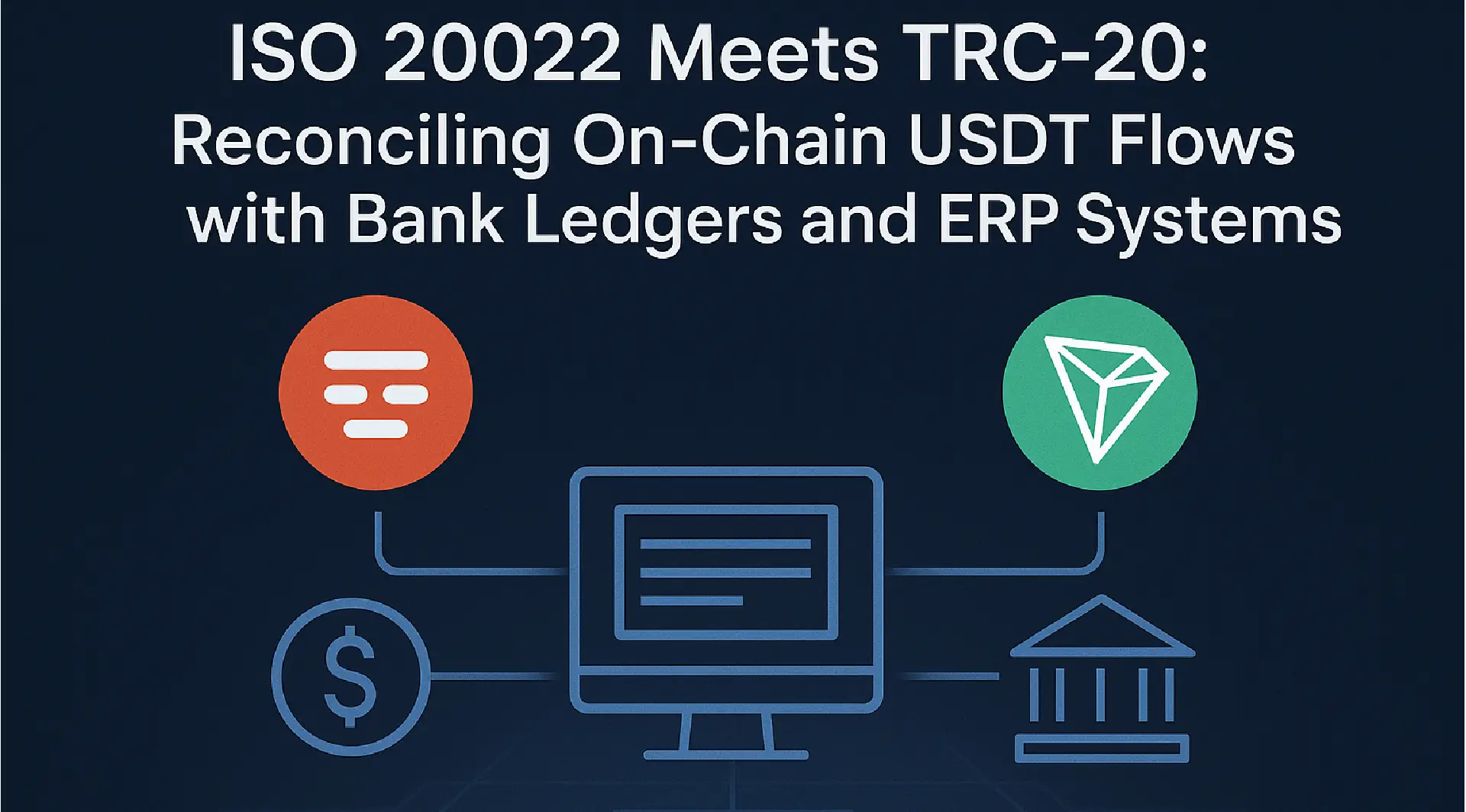
At a high level, an ISO 20022 TRC-20 bridge usually consists of four layers:
-
On-chain access. Nodes, APIs, or indexers listen for TRC-20 USDT transfers involving your controlled addresses and normalize them into payment events.
-
Address and counterparty registry. Each blockchain address is mapped to an internal wallet or customer/supplier record, enabling attribution, KYC/AML, and reporting.
-
Reconciliation engine. This component compares on-chain events, bank statement entries, and ERP postings using matching rules based on amounts, dates, references, and transaction hashes. Ideally, the majority of flows auto-match, with only exceptions sent to human operators.
-
Integration adapters. Connectors that transform payment events into ISO 20022 messages for banks, journal entries for ERP, and dashboards for treasury and operations.
With such an architecture in place, USDT flows stop being opaque token movements and instead become first-class objects in your financial stack.
Valuation and accounting treatment
Even though USDT is designed to track USD, accounting standards generally expect explicit valuation logic. You will need to define:
-
How you convert USDT amounts into your functional currency (pricing source and valuation time)
-
How you store the applied FX rate with each payment event
-
Whether USDT is treated as cash, a cash equivalent, or another financial asset in your chart of accounts
Your reconciliation engine can then verify that fiat amounts reported in bank statements align with ERP entries derived from on-chain USDT flows, taking FX differences into account.
Compliance, auditability, and control
Regulators and auditors focus on evidence, not technology branding. A well-designed bridge between ISO 20022 and TRC-20 should provide:
-
Traceability. From an invoice in the ERP, to a payment instruction, to an on-chain transfer, to any related bank funding or redemption, and finally to GL postings.
-
Immutable proofs. Transaction hashes and block data serve as independent, timestamped records that complement traditional bank statements.
-
Governance. Clear segregation of duties for initiating, approving, and signing TRC-20 payments, with logs and approval workflows that mirror traditional payment processes.
By exposing this information through dashboards and reports, you make blockchain activity intelligible to CFOs, risk managers, and auditors.
Getting started
For organizations exploring the convergence of ISO 20022 and TRC-20, a phased approach usually works best:
-
Start with a narrow pilot flow—such as settling a specific category of vendor invoices in USDT—and build the full reconciliation loop just for that flow.
-
Standardize reference conventions for transaction hashes, end-to-end IDs, and invoice numbers across systems and teams.
-
Automate as much matching as possible and surface only exceptions for human review.
When ISO 20022 meets TRC-20 in a disciplined way, USDT ceases to be “just another crypto asset” and becomes a programmable, auditable payment rail that plugs directly into the language banks and ERPs already understand. The payoff is not about replacing existing systems, but about extending them with on-chain speed and transparency while preserving the control and accountability that enterprise finance depends on.
Also read: