Binance Delists ATA FARM MLN PHB SYS May 27: How Low Can Prices Go?


Five tokens. One announcement. A week of panic selling is already underway.
On May 13, 2026, Binance published an official notice confirming the delisting of Automata (ATA), Harvest Finance (FARM), Enzyme (MLN), Phoenix (PHB), and Syscoin (SYS) from all spot trading pairs effective May 27, 2026 at 03:00 UTC.
The Binance delist price prediction for each of these tokens is now the single most searched question across all five communities.
The market did not wait for May 27.
Every chart shown here tells the same story: prices broke down the moment the announcement dropped.
ATA is already down over 10% today. SYS crashed 17%. PHB shed 12%. The delist panic is not coming. It is already here.
This article covers the technical picture for each token, where prices could go before May 27, where liquidity migrates after, and what a realistic post-delist recovery looks like based on historical Binance removal data.
Withdrawals remain open until July 27, 2026. That is the real deadline most holders are not focused on yet.
What Binance Delist Actually Does to a Token Price
Before getting into individual token levels, the pattern is worth understanding because it repeats across almost every Binance delisting case.
The announcement triggers three waves of selling. First wave hits within 24 to 48 hours of the notice: panic sellers, stop losses triggered, and leveraged positions force-closed.
Second wave hits around the actual delist date as remaining Binance holders exit before trading stops.
Third wave is smaller holders who forgot or waited too long trying to sell at market on Gate.io or MEXC where liquidity is thinner.
Historical data from past Binance delist events gives a rough range. NEBL dropped 65% from announcement to delist.
AKRO shed around 55%. WAVES, already in a downtrend, lost another 40% in the post-announcement window.
The average peak-to-delist drawdown across 2023 to 2025 removals sits somewhere between 40% and 70%; Binance has shared the complete delisting timeline and criteria in the official announcement depending on how much liquidity existed before the announcement.
All five tokens here were already in downtrends before May 13. That matters. A token delisted from a position of strength behaves differently from one delisted mid-downtrend.
These five were mid-fall when the announcement accelerated everything.
The Binance delist price prediction for each token below is built on that framework, not hope or hype, just what the chart and historical pattern suggest.
ATA Price Prediction After Binance Delist
Current Price: $0.0043 | Today: -10.42%
ATA broke down from a symmetrical triangle pattern that had been forming since late March.
The structure held a price between $0.0095 and $0.0124 for nearly six weeks. 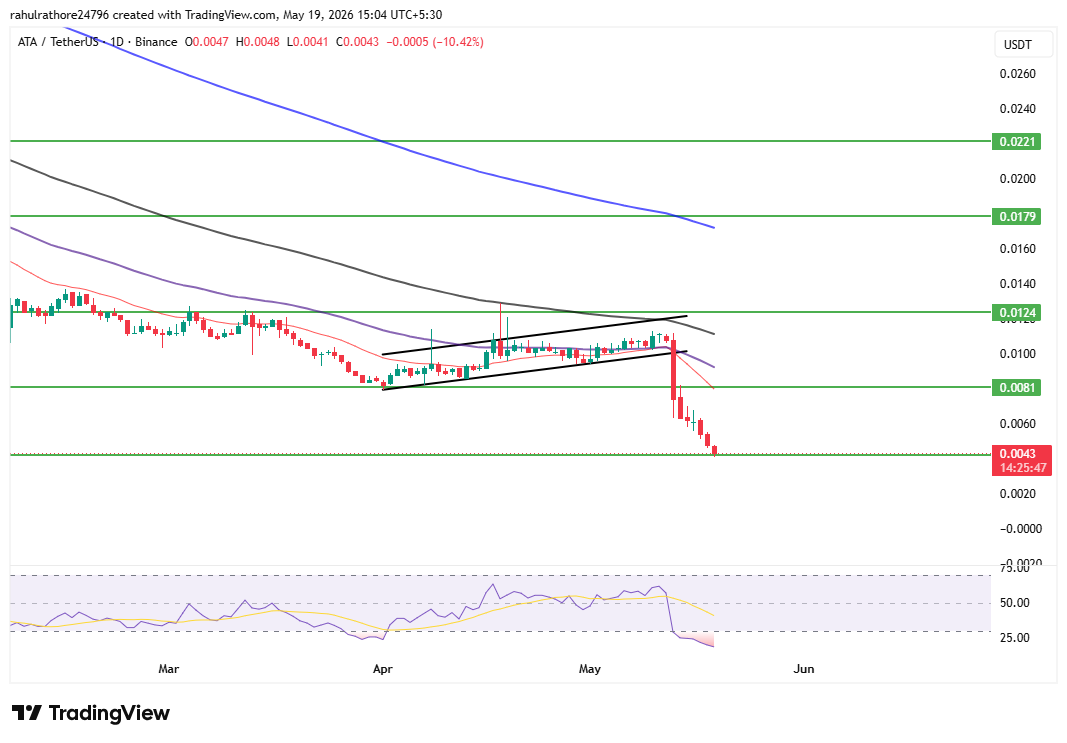
The Binance delist announcement shattered that base entirely.
Price is now trading below every significant EMA the 20, 50, 100, and 200 are all stacked above current price in a bearish cascade, and none of them are close to providing support at these levels.
RSI has dropped to approximately 25, sitting in oversold territory.
But oversold on a delisted token does not mean a bounce is incoming; it means selling pressure has been intense and relentless, which is exactly what the chart shows.
Key Levels:
The ATA delist price target on the downside runs toward $0.0025 to $0.0030 if panic selling accelerates into the May 27 deadline.
The $0.0081 level is the only meaningful structural support left before price enters uncharted territory below recent lows.
Post-delist, ATA will continue trading on Gate.io and MEXC. Volume will drop sharply.
Recovery above $0.0081 requires sustained buying pressure that is hard to build without Binance order book depth.
Will ATA recover after the Binance delist?
Not quickly. The technical damage to the chart is significant. Any bounce from current levels is more likely a dead-cat relief rally than a structural reversal.
FARM Price Prediction After Binance Delist
Current Price: $7.20 | Today: -3.36%
Harvest Finance had already been in a confirmed downtrend since October 2025, with price steadily losing ground from the $24 zone.
By February 2026, FARM broke down hard toward the $11 to $12 range, where it consolidated for approximately two months.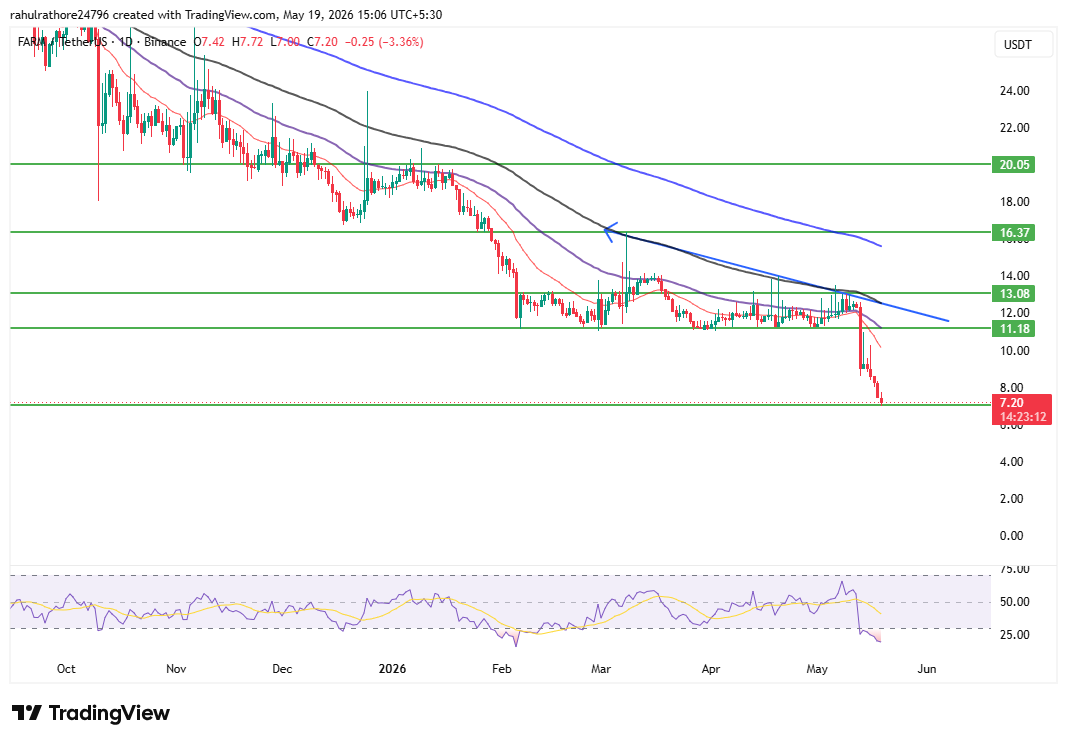
That consolidation looked like a potential base until the Binance delist announcement ended the discussion entirely.
The descending channel that defined FARM's entire 2025 to 2026 structure is now broken to the downside.
All four EMAs 20, 50, 100, and 200 -- are pointing downward and positioned well above the current price. Price is not near any of them.
RSI is reading approximately 20, which is extremely oversold, but again, delist momentum does not respect oversold signals the way normal market conditions do.
Key Levels:
The FARM Binance delist crash target sits between $5.50 and $6.50 if second-wave selling arrives before May 27.
The $11.18 zone is now the key level to reclaim post-delist for any recovery narrative to make sense.
Without Binance volume, FARM's daily trading activity will fall significantly.
Harvest Finance's DeFi product is still functional; the protocol did not fail. But without top-tier exchange presence, price discovery becomes very difficult to sustain.
MLN Price Prediction After Binance Delist
Current Price: $2.26 | Today: -4.24%
Enzyme (MLN) is the only token in this group that had shown genuine recovery momentum before the delist announcement hit.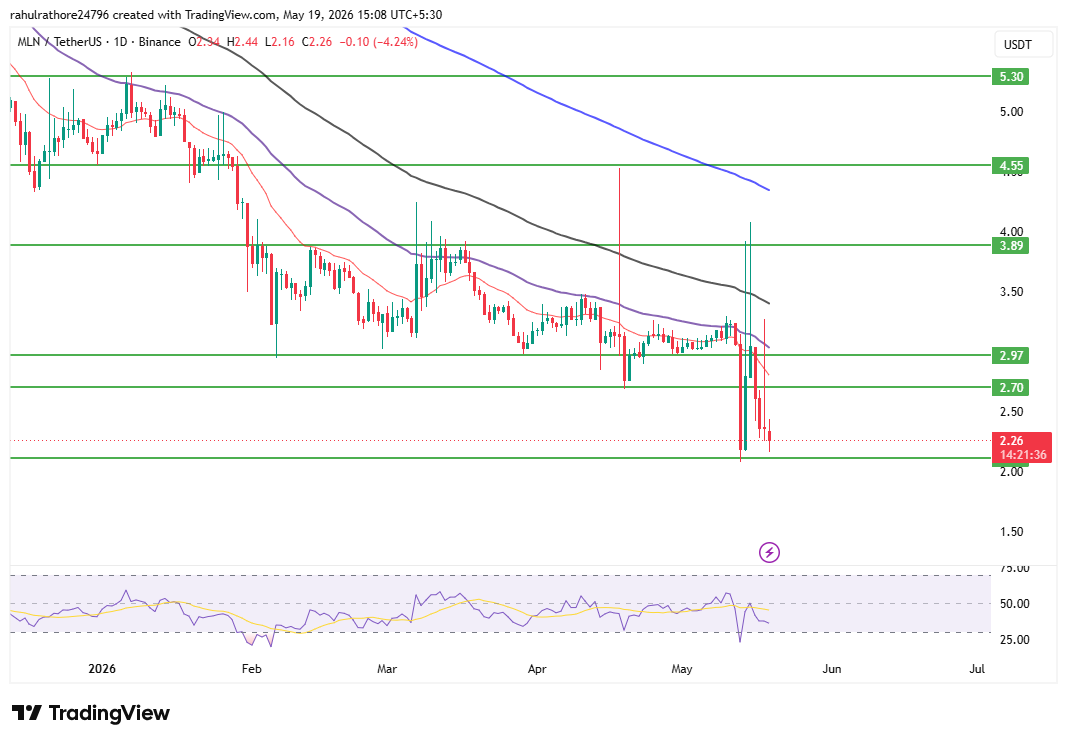
In early April, the price spiked to nearly $3.90 and briefly touched the $4.55 resistance zone, which was the most bullish price action MLN had seen in months.
That move was likely Binance listing-adjacent speculation or protocol-specific catalysts, but whatever the cause, it got completely wiped by the delist news.
From the April spike high near $4.55, MLN has now retraced all the way to $2.26 -- roughly a 50% drawdown in under six weeks.
The 200 EMA is sitting far above at around $4.50. The 100 EMA near $3.50.
The 50 and 20 are both pointing aggressively downward. Price is below all of them.
RSI is near 20 same extreme oversold reading as FARM.
The chart shows the delist selloff as a near-vertical red candle cluster starting around May 13.
Key Levels:
MLN delist crash targets run toward $1.80 to $2.00 in a worst-case scenario. The $2.70 zone is the first line that needs to hold for any stabilization.
Enzyme's protocol has genuine DeFi utility in asset management; it is not an empty shell.
Post-Binance, MLN will trade on Uniswap and smaller CEX venues. The utility argument is real, but retail access shrinks meaningfully without a top-tier exchange listing.
PHB Price Prediction After Binance Delist
Current Price: $0.057 | Today: -12.31%
Phoenix had one of the more dramatic chart setups in this group.
Back in April, PHB spiked violently from around $0.135 all the way to $0.222 in a single session, a move that looked like a potential trend reversal.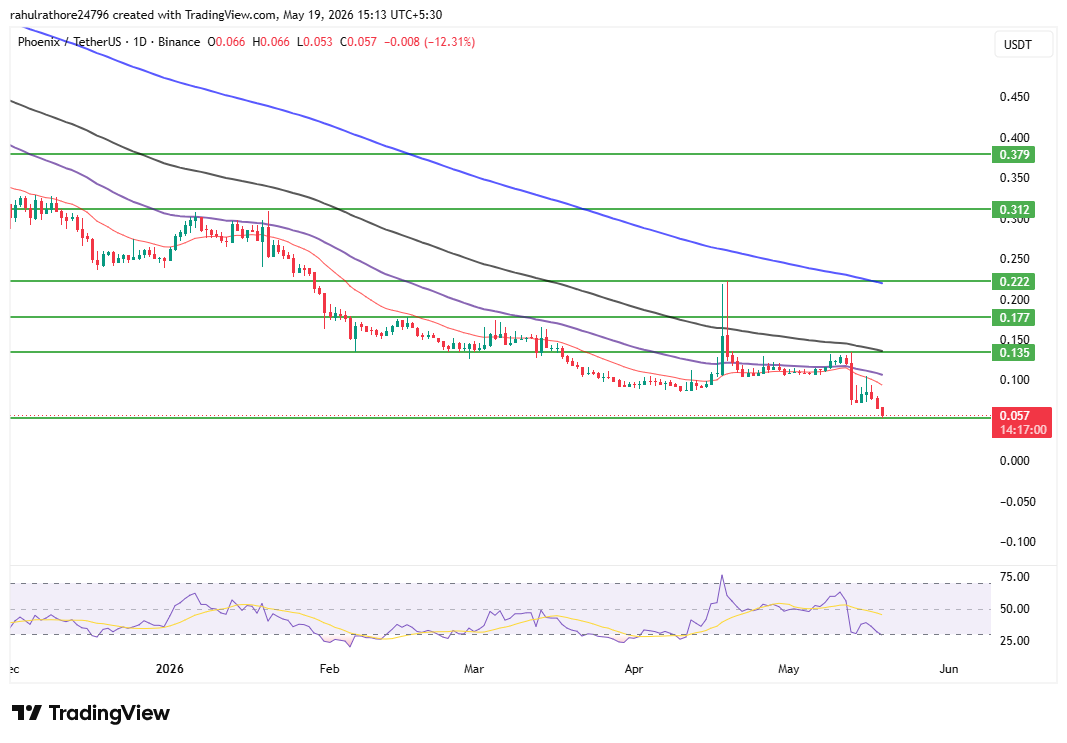
But that spike was not sustained. Price pulled back, consolidated briefly around $0.135, and then the delist announcement triggered a complete breakdown of that entire support structure.
From the April spike high near $0.222, PHB has now lost nearly 75% in roughly six weeks. That is a significant destruction of any bullish thesis.
All EMAs -- 20, 50, 100, 200 -- are above the current price.
The descending channel that has defined PHB since late 2025 continues to press lower.
RSI is around 25, the same oversold zone as ATA.
Key Levels:
PHB delist downside target sits between $0.040 and $0.050 if selling continues into May 27.
The $0.135 zone is now a very distant first recovery target; getting back there requires significant buying pressure that is unlikely to materialize on smaller exchanges post-delist.
Phoenix's AI and oracle infrastructure is still operational, but the Binance delist removes the primary price discovery venue the community relied on.
SYS Price Prediction After Binance Delist
Current Price: $0.0040 | Today: -17.18%
Syscoin has the worst chart in this group. Not just because of today's 17% drop -- but because the structure behind it is the most broken of all five tokens.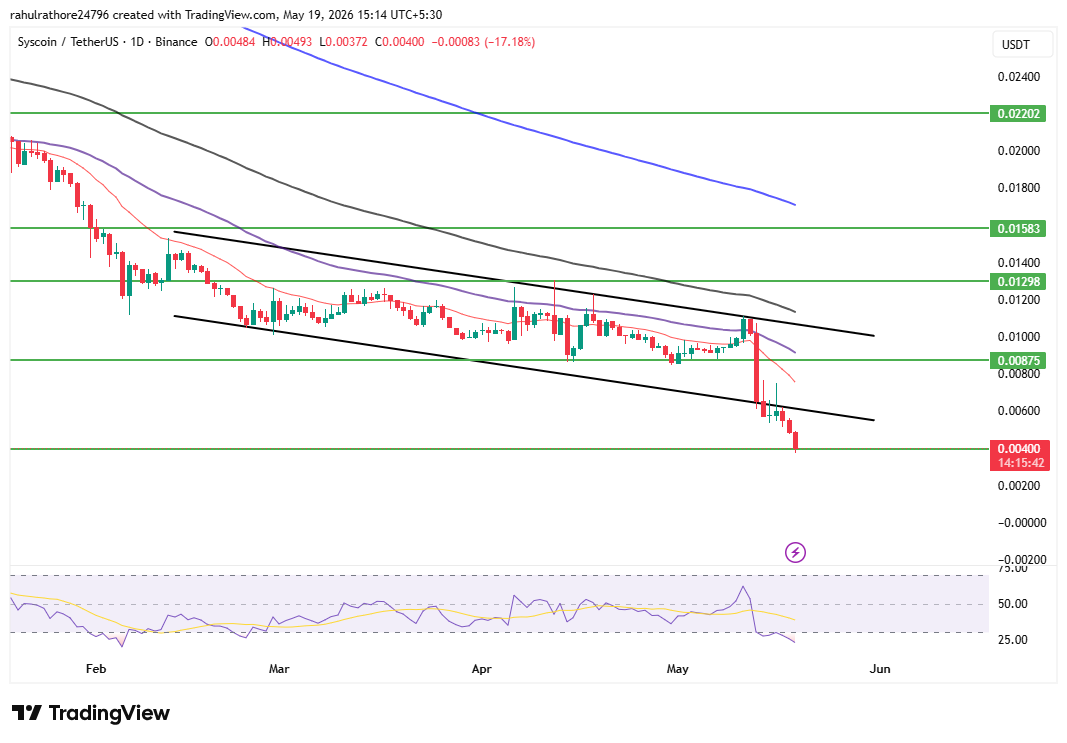 SYS had been trading in a confirmed descending channel since January 2026, with both the upper and lower trendlines clearly defined.
The delist announcement did not just break the lower channel boundary -- it blew through it entirely with a near-vertical candle that left almost no support structure visible on the chart.
All four EMAs are stacked well above current price.
The 200 EMA is at roughly $0.01583 -- that is nearly 4x the current price.
RSI is at approximately 20, the most extreme oversold reading in this group. Price is effectively in price discovery to the downside.
Key Levels:
SYS delist downside target is open -- there is no meaningful chart support below $0.0040 based on visible price history.
The $0.0020 to $0.0030 zone is a plausible worst-case scenario if holders rush to exit before May 27.
Syscoin's Layer 1 infrastructure and UTXO architecture are technically solid but that is irrelevant to short-term price action when Binance delist panic is the dominant force.
Post-delist, SYS will trade on Gate.io and a handful of smaller venues where order book depth will be a fraction of what Binance provided.
Where Liquidity Goes After Binance Delist
This is the practical question most holders are not thinking about clearly right now.
When Binance removes a token, volume does not disappear -- it migrates.
As highlighted in the Binance Square alert post, holders are strongly advised to manage positions and cancel all trading bots before May 27.
The primary destinations for all five tokens post-May 27 are Gate.io, MEXC, and, in some cases, decentralized exchanges like Uniswap or relevant chain DEXs.
The problem is not whether trading continues. It is how thin the order books become.
Binance typically accounts for 40% to 70% of total volume for mid-cap tokens.
When that disappears, bid-ask spreads widen, slippage on larger orders increases significantly, and price becomes easier to move in either direction, which sounds good for recovery but is equally dangerous for further downside.
Holders who plan to exit should prioritize doing so before May 27, not after. Post-delist liquidity on alternative venues will be measurably worse.
The July 27 withdrawal deadline is not a price deadline -- it is simply the last date to move tokens off Binance.
Price action on Gate.io and MEXC will be independent of that date.
Expert View
CoinGabbar analysts reviewing the Binance delist price prediction picture across all five tokens note that the selling pattern here is not irrational; it is structural.
When the world's largest crypto exchange removes a token, the addressable buyer pool shrinks immediately and permanently until a comparable exchange picks it up.
None of these five tokens have confirmed a replacement Tier-1 or strong Tier-2 CEX listing yet.
That is the real risk sitting underneath all five charts.
The technical levels published here, the supports, the resistances, the EMA clusters all assume some degree of continued trading activity.
If liquidity migrates only to very small venues, those levels become less meaningful because the order depth to defend them simply does not exist.
For traders, the 25% to 60% volatility range flagged in the briefing is accurate and may understate the downside for the weakest charts (SYS, PHB).
Knife-catch attempts on delist names carry significantly higher risk than normal volatile-asset trades. RSI oversold signals are less reliable in forced-sell environments.
For holders with meaningful positions, the withdrawal deadline of July 27, 2026 is the hard operational date.
Price exposure can be managed between now and then but waiting until July for execution is not the same as having until July to decide.
Disclaimer: This article is published for informational and educational purposes only and does not constitute financial or investment advice. All technical levels, price targets, and scenario analysis are based on chart observations and historical delist pattern data as of May 19, 2026 -- not guaranteed outcomes. Cryptocurrency investments carry extreme risk including total loss of capital. Binance delist events create abnormally volatile conditions where standard technical signals are less reliable. Always verify official timelines at binance.com before making any financial decision. CoinGabbar does not recommend buying, selling, or holding any cryptocurrency.
Also read:







.webp)