Bitcoin Drops to $74K as Gold and Google Charts Hint at an $800K Run


Bitcoin slid to $74,662 on May 23rd. Down 3.29% in a day. Nothing dramatic on its own, except for the fact that this pullback is landing almost exactly where one analyst said it would, on a chart comparison that has been quietly making the rounds for weeks now.
The comparison is between Bitcoin and Gold. Not in a loose, hand-wavy way. Structurally. Tick by tick.
CryptoPatel, a technical analyst who posts on TradingView, put out a side-by-side chart recently. The left panel is Gold going back to 2008.
The right panel is Bitcoin from 2020 onward. When you look at them next to each other, it is genuinely unsettling how closely they match.
Gold built a long base inside a rising channel, broke its 2011 highs, came back to retest that breakout zone, held, and then ran hard. Not a little. Hard.
From around $2,000 to north of $3,000 in under two years, and still going.
Bitcoin has done the same three things. Broke the 2021 highs. Came back to retest. And right now, sitting at $74,662, it appears to be in the middle of that third step — the bounce.
That is where things get interesting.
The $800,000 figure is not a guess
When you take Gold's expansion leg, measure it proportionally from the breakout point, and apply that same ratio to Bitcoin's current structure, you land somewhere around $800,000. That is the math CryptoPatel's chart is pointing at.
Nobody is saying it happens tomorrow. Nobody is saying it happens without Bitcoin cutting through a few more panic moments along the way. But the proportional argument is real, and it is not coming from a random Twitter account. It is coming from the chart itself.
There is a second comparison floating around, too — Google's stock. Same pattern. As per Crypto Tice, Google Broke prior highs, retested, bounced, then went on a run that made everyone who called it overpriced look foolish in hindsight. Different asset, same psychology, same structure.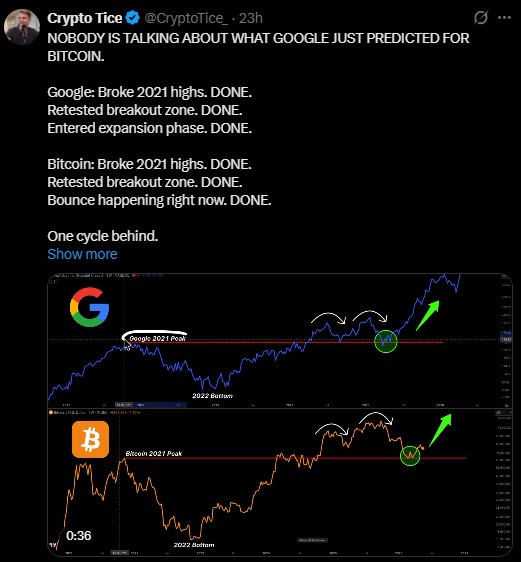
Here is the part most people are getting wrong right now
The loudest sentiment in crypto at the moment is that this cycle is basically done. Bitcoin ran, people made money, and now it's late. That narrative is everywhere.
It was also everywhere when Gold was sitting at its retest zone.
The investors who cleaned up on Gold were not the ones who caught the initial break. They were the ones who sat through the retest phase, when it genuinely looked like the move was over, and held their position anyway.
That required something most investors do not have in the moment — a willingness to trust what the chart is showing when the headlines are telling a different story.
Bitcoin's daily chart on May 23rd looks messy. A 3.29% drop with no obvious catalyst is the kind of thing that shakes retail out. That is also, if you accept the Gold analog, almost precisely the point where the setup completes.
What the chart actually shows
On the CryptoPatel TradingView chart, both Gold and Bitcoin have green circles marked at three specific structural moments. The breakout. The retest. The bounce initiation.
Bitcoin's third circle is forming right now.
The channel structure, the angle of the trend line, and the depth of the retest — they are all matching. That does not mean the $800,000 target is locked in. Markets do not work like that. Regulatory surprises, macro blowups, liquidity crises — any of those can alter the timeline or kill the setup entirely.
But the structure is there. It is not being forced onto the chart. It is sitting there plainly.
The people who will look back at May 2026 and wonder why they did not act are probably the same ones staring at a red candle right now and waiting for permission to feel confident. That permission rarely comes before the move. It usually comes after.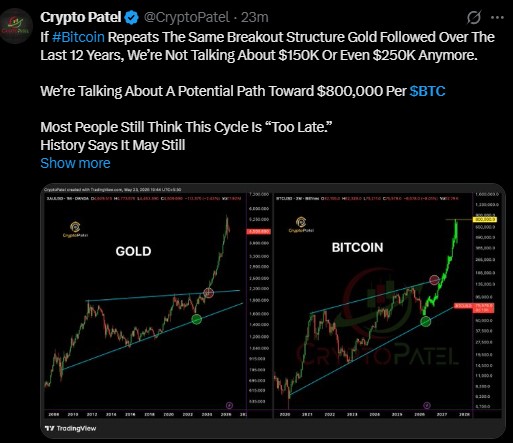
The question is not whether the chart is right
The question is whether you trust a pattern that has already played out on two major assets, mapped nearly identically onto a third, at the exact moment the retest is completing.
Gold did not warn people politely. It just moved. Google did not wait for consensus. The chart showed the structure, most people ignored it, and then the price went where the structure said it would go.
Bitcoin is doing the same thing. Quietly. At $74,662. On a Saturday.
Disclaimer: This article is for informational purposes only and does not constitute financial advice. Markets are volatile, and past patterns do not guarantee future results. Do your own research before making any investment decisions.
Also read:









.webp)