Mozone AI Listing in 3 Days: Last Chance for $MZONE DEX Hits on May 16


Mozone AI Listing Verdict: $MZONE Price Prediction 2026
Three days.
That is what is left before the Mozone AI listing goes live on PancakeSwap on May 16, 2026. And honestly, the community is more charged up right now than it was a week ago — which says something.
Not because of hype alone.
Something structurally different is happening here compared to the AI tokens that launched this cycle and collapsed within hours.
The MZONE listing date has been confirmed. Price is set at $0.006. Liquidity locked for 2 years. AI agents are already running.
Airdrop distributed. The project is not promising these things — they are already done, live, and verifiable before the first trade even happens.
That is where this story starts.
Why the Countdown to the Mozone AI Listing Feels Different This Time
Everyone who has been watching AI token launches on BSC knows the pattern. Big raise. Community hype.
Token hits DEX. Early holders exit within minutes. Price collapses 80% to 99% in the first hour. The community blames insiders.
The Mozone AI official X channel tweet about Mozone AI listing going live in 3 days has a different setup—and the difference is not in the whitepaper.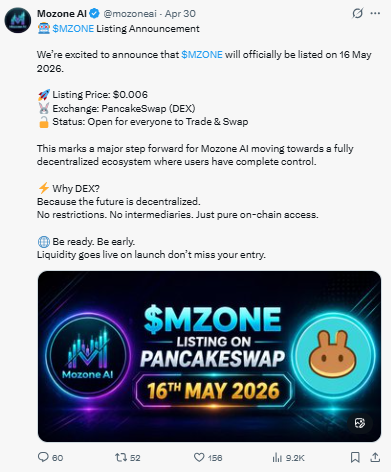
It is in what has already happened before May 16.
On May 10, Mozone activated its AI agent plans inside the Mozone Wallet—six days before the MZONE PancakeSwap listing.
Users deposited MZONE plus USDT, selected a tier, and launched 21-day automated trading cycles. Real funds, real cycles, real activity. Not a demo. Not a beta. Live.
When a token has active utility generating returns before it even lists on an exchange, the holder psychology changes.
People with active 21-day cycles running do not rush to sell on listing day—they are mid-cycle.
That is not luck. That is the design.
The AI Agent Tiers Running Right Now (Before the MZONE Listing)
The Mozone AI BSC token launch comes with three tier levels already processing user funds:
The AI system converts the MZONE balance into USDT trading value and runs the full 21-day cycle automatically.
Variable returns — yes. But the mechanism is running, the tiers are published, and users are already inside active cycles.
That is a structural reason to hold MZONE through listing day, not sell it.
MZONE Listing Tokenomics: Where Does the Supply Go?
Before looking at price levels, the Mozone AI supply setup matters. Total supply is 10 billion MZONE — a large number.
But how it is distributed going into the Mozone AI listing is what determines whether the price holds.
-
30% Community and Airdrop — largest allocation, distributed before listing
-
25% Liquidity Pool — locked for 2 full years from listing day
-
15% Team — 12-month vesting; no team tokens hit the market on May 16
-
15% Ecosystem Development — staking, platform growth
-
10% Marketing — structured release for campaigns
-
5% Reserve
Two points matter here. The team tokens are locked — no founder dump on listing day.
The liquidity is locked for 24 months—the pool cannot be drained the way DeepSnitch's Uniswap pool was in March.
At that time, thin liquidity and no lock created a one-sided exit. The $DSNT price fell nearly 99.70% within hours of launch.
Mozone AI listing is built to avoid exactly that structure.
$MZONE Token Utility: Why People Actually Need This Token
A lot of AI tokens launch with no reason to hold the token post-listing. The platform runs fine without it.
That disconnect is what kills DEX launches after the initial hype fades.
MZONE is woven into the platform in ways that create actual demand.
Subscription discount — Pay up to $15 of the $39 monthly subscription in MZONE. Regular users want this discount. They need to buy and hold MZONE.
Boosted returns—Holding MZONE unlocks higher profit tiers and priority execution in AI agent cycles. A bigger position = more MZONE needed.
Referral multiplier — MZONE holders earn 2x referral commissions. Active community members have a direct financial reason to hold.
$100,000 AI error insurance — Full coverage unlocks only for token holders.
2% monthly buyback and burn — Platform subscription revenue feeds a permanent deflationary mechanism. Supply reduces over time as long as users pay subscriptions.
This is not utility added on paper to justify a token. Each feature creates a reason to acquire and hold MZONE. Demand does not disappear after listing — it grows as the user base grows.
Mozone AI Price Prediction 2026: Bull, Base, Bear
The MZONE listing starts at $0.006. No trading history exists yet. Price discovery begins May 16. Here is what the three scenarios look like based on structure, not hope.
Bear Case — $0.003 to $0.005
Airdrop recipients sell immediately . Volume thins out within the first week. Buying pressure is absent. Price breaks below $0.006 listing level and stalls in the $0.003 to $0.005 band. Invalidation: drop below $0.003 and stays there for 10+ days post-listing.
Base Case — $0.008 to $0.018
Liquidity lock holds the floor. AI Agent cycles keep mid-cycle holders from selling. Light CEX interest materialises in Q3. Price trades at a steady 1.5x to 3x from listing level across mid-2026. For early airdrop holders this is already meaningful.
Bull Case—$0.03 to $0.06 by end of 2026
AI agent tier adoption grows fast. Users need MZONE to access higher tiers—organic buy pressure builds.
A CEX listing confirmation drops in Q3. Buyback burn reduces supply while demand increases. The price reaches 5x to 10x from listing level before the bull cycle peaks.
Key levels to track post-listing:
-
Support: $0.006 — listing price must hold in week one
-
First target: $0.010 — first structural milestone
-
Bull trigger: Sustained volume above $0.015 within 30 days
-
Invalidation: Break below $0.003 in first two weeks
MZONE Price Prediction 2026 to End of Cycle
Looking beyond the immediate listing:
Q2 2026 (Post Listing): DEX price discovery phase. If liquidity holds and AI agent adoption grows, expect the $0.008 to $0.020 range by the end of June.
Q3 2026: Phase 4 begins—standalone web app, iOS, and Android apps launch; 100,000 users targeted. CEX listing speculation likely peaks this quarter.
If one tier-1 or tier-2 CEX confirms, the price range widens to $0.025 to $0.05.
Q4 2026 Bull Scenario: If the broader crypto bull cycle continues and MZONE is live on a CEX with real subscription revenue feeding the buyback burn, the $0.05 to $0.10 range becomes realistic for high-conviction holders.
Bear scenario, end of 2026: If platform adoption stalls and no CEX listing materializes, $0.004 to $0.008 is a likely consolidation zone.
The honest reality—a 10 billion total supply creates a large ceiling to push through. At a $0.006 listing price, the fully diluted market cap is around $60 million. Holding the price above that requires real users paying $39/month subscriptions, not just token speculation.
Expert View
Coingabbar analysts tracking the Mozone AI listing date for this cycle point to one detail most surface-level coverage is missing: the AI trading cycles went live May 10—six days before the DEX opens.
That is not a coincidence. Projects that activate real utility before exchange listing create a holder base with an active financial reason not to sell immediately.
The 21-day cycle lock-in is product engagement that mechanically delays selling pressure in the first critical days post-listing.
Combined with the 2-year liquidity lock and 12-month team vesting, the three main failure modes of a DEX launch — team dump, liquidity drain, and immediate airdrop sell-off — are structurally addressed before the first trade.
Whether the MZONE price prediction bull case materializes depends entirely on post-listing adoption—whether users sign up, pay subscriptions, and run cycles at scale. The listing mechanics set up a floor. The platform has to build the ceiling.
Three days left.
Disclaimer: This article is for informational purposes only and does not constitute financial advice. Cryptocurrency investments carry extreme risk including total loss of capital. AI Agent return figures are from the project's published tiers—actual returns vary by market conditions and are not guaranteed. DEX listings involve high volatility. Always conduct independent research before making any investment decision. Do not invest more than you can afford to lose.