Nexus Price Prediction: $NEX Hits 5 Exchanges in 24 Hours—What's Next?


The listing is done. NEX is live on KuCoin and Binance Alpha.
And now everyone is asking the same question.
The Nexus price prediction for what happens next is more interesting than the launch day hype because the real price discovery starts now, not when the call auction opens.
As of May 21, 2026, NEX is trading around $0.000005 on CoinMarketCap. The 24-hour trading volume hit $111 million.
Market cap sits at $321 million, and CoinMarketCap already ranks it at #112 globally.
That is not a quiet debut. Most tokens that land on Binance Alpha and KuCoin in the same week never see those numbers in their first month.
But volume on day one proves nothing by itself. What matters now is what the structure looks like going forward.
Why NEX Behaved This Way on Day 1
Before getting into levels and targets, it helps to understand why the price moved the way it did.
KuCoin ran a Call Auction from 14:00 to 15:00 UTC on May 20. That structure slows down bots and prevents any single large order from setting the opening price in the first second.
It was a deliberate design choice, and it gave NEX a more stable entry than most new listings see.
Then trading opened. And the airdrop selling started.
Every Binance Alpha recipient who claimed NEX for free has a zero cost basis. At any price above zero, they are in profit.
So they sell. That is not a sign of weakness; it is completely normal. The real question is how much of the sell wave gets absorbed and by whom.
The answer, based on the $111 million volume figure and the fact that NEX held a $321 million market cap through day one, is that there were real buyers on the other side. Not just bots filling small orders. Actual demand.
That matters for the Nexus price prediction going into week two.
NEX Token: What You Are Actually Buying
This section matters because a lot of people buy a new listing without understanding what the token actually does.
Nexus is a Layer 1 blockchain built specifically for verifiable finance. It runs a native zkVM 3.0 a Zero-Knowledge Virtual Machine on every node.
Every computation on the network gets mathematically verified before it is accepted. You do not trust the system. The math proves it.
NEX has three primary uses right now:
Gas fees: Every transaction on the Nexus Layer 1 requires NEX. Contract deployments, asset transfers, and NexusEVM interactions all of it burns NEX.
Staking: NEX is used to stake and secure the network. Validators need it. This creates structural demand that does not depend on speculation.
Exchange utility (coming October 2026): The flagship product is an enshrined CLOB exchange, a central limit order book baked into the blockchain itself, not sitting on top as a separate DEX.
When that launches, NEX gets exchange-related utility functions that have not yet been detailed publicly.
The network numbers are real: 4.4 million ERC20 tokens deployed, 60,000+ active nodes, operations across 1,120 cities, and 269.9 million operations per second.
And $27.2 million raised from Pantera Capital, Lightspeed Venture Partners, Dragonfly Capital, SV Angel, and Alliance DAO.
These are not paper metrics. Testnet alone pulled 3.2 million verified users across 90% of countries globally before there was any token to earn.
Nexus Price Prediction: Live Price and Supply Reality Check
Current price: ~$0.000005
24h volume: $111 million
Market cap: $321 million
CMC rank: #112
Circulating supply: 60 trillion NEX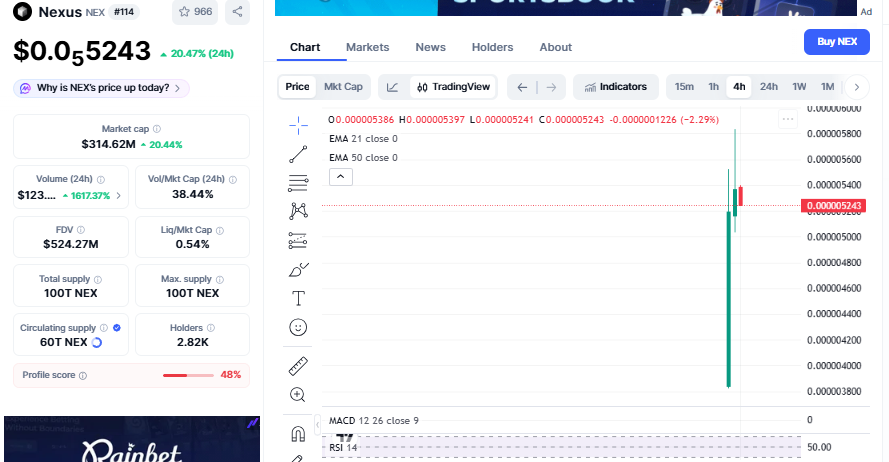
That supply number is the single most important figure for any honest Nexus price prediction.
60 trillion tokens means the math works very differently compared to a low-supply coin. For NEX to reach $0.0001, the market cap would need to cross roughly $6 billion.
That is achievable. Solana, Avalanche, and other Layer 1s with real infrastructure have done it, but it requires sustained on-chain activity, not just exchange listing momentum.
For $0.001, you are looking at a $60 billion market cap. That puts NEX in Bitcoin and Ethereum territory. Possible in a multi-year bull cycle with a live, high-volume exchange, but not a near-term reality.
The practical near-term range sits between $0.000005 and $0.000025. That is where the Nexus price prediction May 2026 is actually anchored, based on current market conditions.
Nexus Price Prediction: Support and Resistance Levels That Matter
Post-Listing Support Zone: $0.0000035 to $0.0000055
This is where the price has been stabilizing after the initial day-one volatility. The lower end of this range is the structural floor.
A daily close below $0.0000035 with rising volume would signal that airdrop selling is still in progress and a further leg down toward $0.000002 is possible.
Above $0.0000055, the market is saying the day-one selling is done.
First Resistance: $0.0000080 to $0.0000100
Early buyers and testnet participants who did not sell on day one will start looking at exits here. This zone will see selling pressure.
A clean breakout above $0.00001 with strong volume above $50 million that day changes the narrative meaningfully.
Second Resistance: $0.000015 to $0.000020
This range only activates if Coinbase confirms the NEX listing or Binance moves NEX from Alpha to its main spot exchange.
Both are possible within 30 to 60 days. Neither is confirmed.
Invalidation Level: $0.0000020
A sustained close below this level breaks the post-listing structure entirely.
It would mean the project failed to retain buyers after the launch event and is repricing toward low-activity floor levels.
Nexus Price Prediction May 2026: Short-Term Scenarios
Bullish case 30 days: $0.000015 to $0.000025
This plays out if Coinbase formally confirms the listing (the roadmap was added May 7; confirmation could come within weeks), if Binance moves NEX to the main exchange, or if mainnet transaction volume shows consistent weekly growth.
At $0.000025, the market cap would sit around $1.5 billion. That is not aggressive for a project at CMC #112 with $321 million already at day one.
Bearish case, 30 days: $0.0000015 to $0.0000030
Heavy token unlock events, missing developer activity on mainnet, or a broader crypto market correction could push NEX here. The tokenomics have not been fully disclosed. That is the risk.
Base case 30 days: $0.0000060 to $0.0000090
Quiet consolidation. Volume drops after launch week. Price holds above the post-listing floor and grinds sideways while the market waits for the next catalyst.
Nexus Price Prediction 2026: Mid- and Long-Term Targets
The year-end Nexus price prediction 2026 is almost entirely dependent on one thing: the Nexus Exchange launch in October. A live CLOB exchange embedded in the Layer 1 with real trading volume generates fee demand.
Fee demand means gas burns. Gas burns mean structural buy pressure for NEX as the network's gas token. That loop is what drives the bull case not speculation.
NEX Now Live on 5 Exchanges: What This Means for Price
KuCoin. Binance Alpha. Bitget. BitMart. And now Coinbase Advanced.
Five exchanges went live with NEX in a single 24-hour window on May 20, 2026.
That kind of multi-exchange coordination on day one is rare for any Layer 1 token, and the market responded with $111 million in volume on day one alone.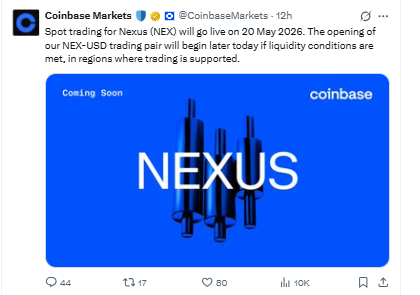
Coinbase Advanced now trades NEX against both USD and USDT. An "Experimental" label has been applied, which is Coinbase's standard warning for newly listed assets with higher volatility and thinner liquidity compared to established tokens.
This label is not a red flag. It comes off as order books deepen and volume stabilizes.
Every major token that is now a Coinbase staple went through this phase.
What the Coinbase listing actually changes is the buyer base. US-based retail and institutional investors who rely on Coinbase as their primary exchange now have direct access to NEX without needing a KuCoin or Binance account.
That is a completely different pool of capital.
Coinbase listings have historically triggered what analysts call the "Coinbase Effect," a short-term spike in volume and price driven by fresh demand from that new buyer pool.
NEX is inside that window right now.
BitMart went live with NEX/USDT on May 20 at 16:00 UTC. Bitget followed at 15:00 UTC the same day.
Three mid-to-large exchanges and one of the world's largest regulated exchanges all going live within the same day is not accidental.
This level of listing coordination reflects institutional-grade launch management, the kind that happens when Pantera Capital and Lightspeed Venture Partners are involved in the process.
The result: NEX entered price discovery with deeper liquidity than almost any comparable Layer 1 launch this cycle.
The Risk Every NEX Holder Needs to Know
Nexus has not published its full tokenomics.
Circulating supply is confirmed at 60 trillion. But the vesting schedules for investor tokens, team allocations, and ecosystem reserves have not been disclosed in full detail.
That is the biggest single risk sitting over every Nexus price prediction in this article.
Token unlocks have destroyed projects with stronger fundamentals than Nexus. A large unlock event in the weeks following listing can flood supply into a thin market and crash the price regardless of how good the technology is.
Until the full unlock calendar goes public, treat every target here as an estimate. The moment that document lands, revisit every level.
Expert View
Coingabbar analysts tracking the Nexus price prediction after listing note that the same-day mainnet launch and multi-exchange debut are an unusual structural setup.
Most projects list tokens before the network is live Nexus did the opposite. That removes one of the most common post-listing disappointments.
The Binance Alpha airdrop running simultaneously with the KuCoin spot launch created two independent demand sources on day one.
Combined with the Coinbase roadmap already triggered and a backer list that includes Pantera and Lightspeed, the NEX token price enters its post-listing phase with fewer structural risks than comparable Layer 1 debuts of 2026.
The real catalyst watch is the Coinbase NEX listing date confirmation. If that drops in June, the current price levels will look conservative in hindsight.
The October exchange launch is the bigger event, but June could set the setup.
Disclaimer: This article is published for informational and educational purposes only. It does not constitute financial advice, investment advice, or any recommendation to buy, sell, or hold any cryptocurrency. The Nexus price prediction figures in this article are analyst estimates based on publicly available market data; they are not guaranteed outcomes. Cryptocurrency markets carry extreme risk, including total loss of capital. Always conduct independent research and consult a qualified financial advisor before making any investment decision. CoinGabbar does not recommend or endorse any specific cryptocurrency investment.
Also read:








.webp)