Bitcoin Rising Wedge Pattern 2026: $100K Breakout or $59K Breakdown?


Bitcoin Price Prediction: $100K Dream or $41K Nightmare in 2026?
I've been staring at Bitcoin charts for years. And right now — this specific setup — is one I haven't seen in a long time.
BTC is printing a Rising Wedge on the 3-day timeframe, and every serious trader needs to understand what that means before the next candle closes. This isn't noise.
This is a pattern with real historical weight behind it, and the next move could genuinely change portfolios — either direction.
What Exactly Is a Rising Wedge and Why Should You Care?
A Rising Wedge isn't complicated once you see it. Price keeps climbing, right? Looks healthy on the surface. But the highs and lows are converging — each rally gets weaker, each dip gets shallower. The two trendlines are slowly squeezing Bitcoin into a corner.
That compression has to release somewhere. And more often than not, it releases downward.
Across decades of charting data, Rising Wedges resolve bearishly around 65 to 70 percent of the time. Only 30 to 35 percent actually break upward with real follow-through. That's not a coin flip. That's a leaning. And right now, that leaning favors sellers — unless Bitcoin does something structurally convincing to change the picture.
Bitcoin Breaks Out Upward — Here's the $100K to $104K Case
Let's not ignore the bull case — it's real, and it matters.
As per Egrag Crypto, if Bitcoin pushes cleanly above the upper wedge boundary — not a wick, not a close that immediately reverses — but a proper confirmed breakout with expanding volume, the measured move from this wedge structure projects toward $100,000 to $104,000.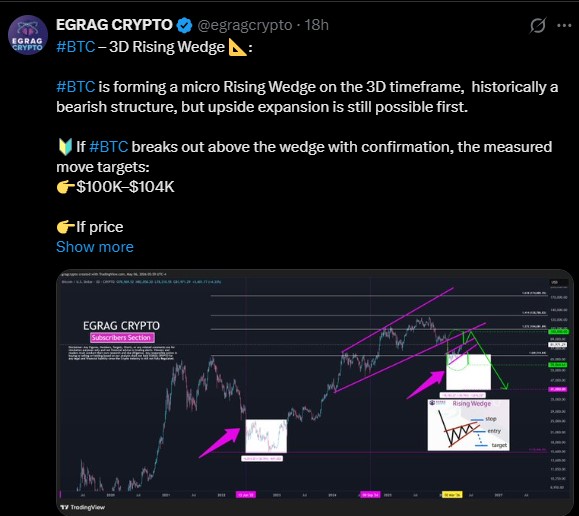
That target comes straight from the pattern geometry. You take the widest point of the wedge and project it forward from the breakout level. Clean math. No guesswork.
But here's what I always tell people — don't anticipate the breakout. Let price confirm it first. A weekly close above the wedge is your green light. Anything before that is just hope, and hope is expensive in crypto.
Bears Are in Control If Support Breaks — $59K Then $41K in Play
Now the harder conversation.
If Bitcoin fails to break upward and instead loses the lower wedge trendline, the first measured downside target comes in around $59,000. That's not a catastrophe level, but it would hurt badly for anyone who loaded up near current prices expecting an immediate rally.
What worries me more is the second scenario. If sellers get aggressive and panic spreads across the market, the extended measured move drops all the way to $41,000. I've seen that kind of acceleration before in crypto. It doesn't need a reason to get there fast. Fear is its own fuel.
The $80,200 to $81,862 Liquidation Zone Is the Real Trigger Point
This is the level I'm watching tightest right now.
There are massive short liquidations stacked near $81,862 — meaning a push above that level forces shorts to cover, and price accelerates upward quickly.
On the flip side, heavy long liquidation clusters sit between $80,200 and $80,300 — meaning a dip into that zone stops out leveraged longs and triggers a fast flush downward.
Bitcoin is literally sandwiched between these two magnets. The market makers know exactly where both piles of stops are sitting. Price will visit one of these zones — probably both — before it decides on direction.
As per CoinGlass data, in the last 24 hours alone, 136,505 traders were completely wiped out. Total liquidations? $515.25 million. Shorts took the bigger hit at $286 million. Long's lost $229 million. This market is hunting both sides aggressively, and retail is paying the price.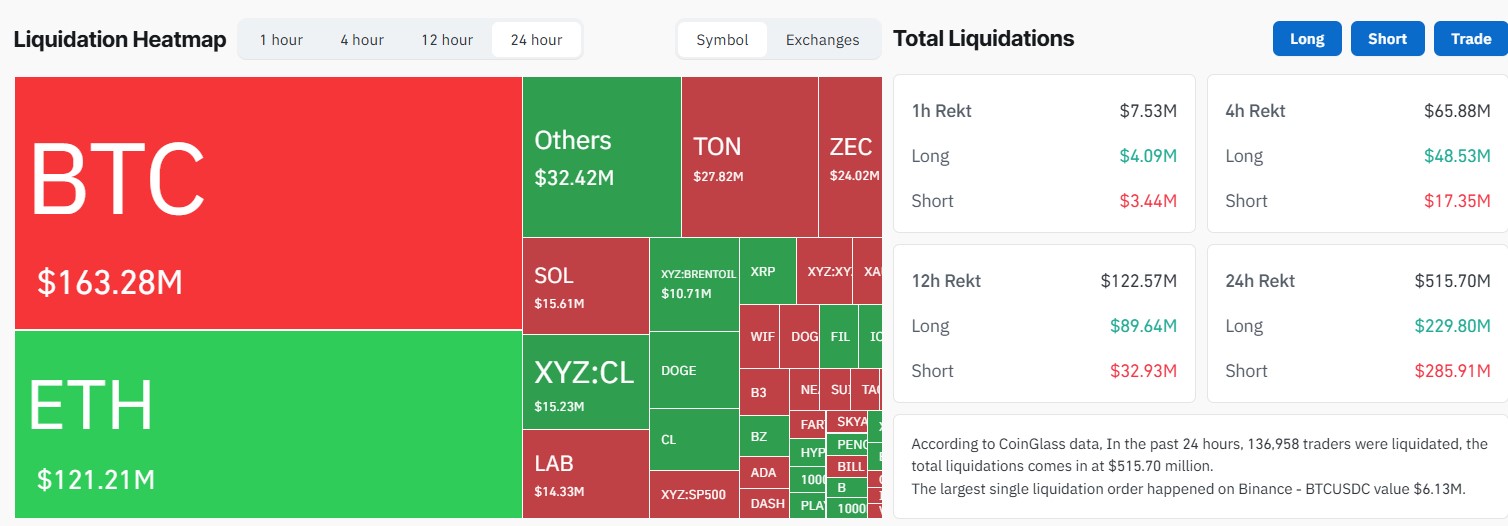
Bitcoin ETF Inflows Are Throwing a Wrench Into the Bearish Setup
Here's what makes this analysis genuinely complicated.
While the chart structure leans bearish, the institutional money flow is doing the opposite. Bitcoin spot ETFs recorded a net inflow of $46.33 million on May 6, stretching the positive inflow streak to five consecutive days. Total ETF inflows for May alone have already crossed $1.675 billion.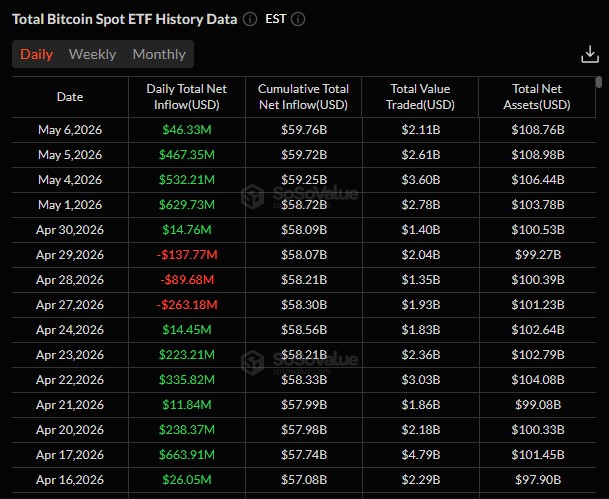
That's not small money. That's not retail buying the dip emotionally. That is calculated, deliberate institutional accumulation happening while uncertainty is high.
When that kind of buying pressure exists underneath a bearish chart pattern, breakdowns tend to be shallower or get bought quickly. It doesn't eliminate the downside risk — but it absolutely changes the odds.
What Comes Next for Bitcoin Price?
My read on this is straightforward. The Rising Wedge structure gives bears the statistical edge. The liquidation zone between $80,200 and $81,862 is the immediate battleground. And the ETF inflows are the one variable that could flip the bearish script entirely.
Watch for a confirmed close above $81,862 — that's your first real bullish signal toward $100K. A clean break below $80,200 puts $59K firmly on the table. Until one of those levels breaks with conviction, Bitcoin stays in no-man's land.
Trade levels, not emotions. And right now, the levels are very clear.
Disclaimer: This article is for informational purposes only and does not constitute financial advice. Cryptocurrency investments carry significant risk. Always do your own research before investing.