Ripple ODL Volume 2026 Growth: XRP Role in Banking Explained

What Is On-Demand Liquidity and Why Ripple ODL Volume 2026 Growing?
Are banks actually using XRP in 2026 — or is it still just a trader's dream?
The answer is more interesting than most people expect. Ripple ODL volume 2026 latest data confirms it is real, but it works differently from what crypto headlines usually suggest. Ripple doesn't sell XRP to banks. It sells a payment product called "On-Demand Liquidity" (ODL) that uses XRP as a bridge asset. And that distinction changes everything.
Quick Highlight
XRP Ripple bank adoption is live across 40+ payment corridors
Over 300 financial institutions use RippleNet infrastructure
ODL processed $2.4B in notional value in 2020—and has grown since
XRP settles cross-border payments in 3–5 seconds at $0.0002 per transaction
Ripple holds 75+ global licenses, including a DFSA license in Dubai
RLUSD stablecoin now works alongside XRP in Ripple Payments
What Is ODL?
ODL stands for On-Demand Liquidity. It is Ripple's core payment product, and the reason banks are paying attention to XRP price prediction 2026. Here is the problem ODL solves. When a bank sends money abroad, it usually needs cash sitting in a foreign account before the payment even starts. That pre-funded money sits idle, earning nothing, sometimes for days.
ODL removes that step entirely. Instead of parking cash abroad, a payment firm converts local currency into XRP, sends it across the XRP Ledger in seconds, and converts it into the destination currency on arrival. The whole process takes 3 to 5 seconds. No waiting. No trapped capital. No middlemen. That is the core of XRP ripple banks adoption in 2026—not token speculation, but a live payment tool that cuts costs and frees up working capital for financial firms.
The Hybrid Model: Ripple now uses RLUSD (Stablecoin) alongside XRP. Banks use RLUSD for price stability, while XRP acts as the "Bridge" to swap between different currencies in seconds. This takes away the chance that prices will change during the transfer.
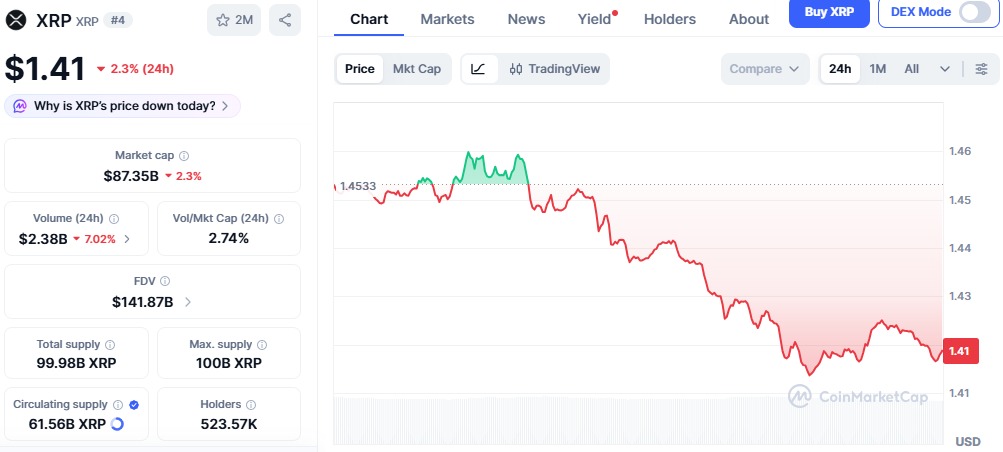
Source: Coinmarketcap chart
How XRP Ripple Banks Adoption Works Through ODL
Most cross-border payments have a hidden problem. Banks need to park cash in foreign accounts before a customer payment even arrives. That's called pre-funding, and it ties up billions in dead capital sitting overseas doing nothing.
Ripple's ODL On-Demand Liquidity fixes this. Here's how it works.
A payment firm converts local currency into XRP
XRP travels across the XRP Ledger in 3–5 seconds
XRP converts into the destination currency on arrival
No pre-funded foreign account needed
XRP enables cross-border settlements in 3–5 seconds with fees averaging $0.0002 per transaction. That's not a theory. That's a live payment rail used by real firms today.
Key features of Ripple ODL:
Speed — 3 to 5 second settlement on the XRP Ledger
Cost — transaction fees as low as $0.0002
Capital efficiency — no pre-funded foreign accounts required
Always-on — 24/7 settlement, no banking hours
Blockchain tracking — full audit trail on every payment
Scalability—XRP Ledger can handle up to 1,500 transactions per second
Ripple CTO David Schwartz says XRP Ledger adoption is measured by transaction volume and liquidity, not price, and the XRPL has now processed over four billion transactions.
That's a live network and a real XRP use case. Not a whitepaper
Ripple ODL Volume 2026 is growing because cash trapped abroad is expensive. ODL unlocks that capital and puts it back to work.
Ripple ODL Volume 2026: Who Is Actually Using It?
This is where most blogs get vague. Let's be specific.
Over 300 financial institutions use RippleNet infrastructure. SBI Holdings, Santander, and PNC Bank lead institutional XRP adoption across Asia, Europe, and North America.
One important detail: not all 300 use XRP directly. Some use RippleNet only for messaging. ODL, the part that actually uses XRP is live in a growing but still selective set of corridors.
Named partners using ODL or Ripple Payments:
SBI Remit — Japan to Philippines, Vietnam, Indonesia
Tranglo — Southeast Asia and Europe corridors
Zand Bank and Mamo — UAE cross-border transfers (May 2025)
FINCI—Lithuania, Europe
Xbaht—Sweden to Thailand route
Coins.ph — Philippines remittance
FlashFX, Pyypl, I-Remit, Novatti — regional payment firms
In May 2025, Zand Bank and Mamo in the UAE joined Ripple Payments for cross-border transfers. That followed Ripple's DFSA license in Dubai in March 2025, making it the first blockchain-enabled payments provider licensed by that regulator.
SBI Ripple Asia (Japan): Now issuing prepaid payment tokens on the XRP Ledger for a $200B annual market. [1]
Kyobo Life (South Korea): Using the ledger to tokenize government bonds, cutting settlement from 2 days to 3 seconds
ODL volume data — what we know:
2020: ODL handled $2.4 billion in notional value
Q3 2021: ODL made up 25% of total dollar volume on RippleNet
Late 2022: Millions of transactions across nearly 40 markets
2026 projection: ODL volume expected to grow 30–50% as payment providers adopt on-chain settlement.
Ripple ODL Volume 2026 is no longer a promise. It's a pattern — and that pattern keeps expanding by region and by customer type.
XRP ODL vs. SWIFT: Is Ripple ODL a Real Alternative in 2026
People online often say XRP will "replace Swift." That's an oversimplification.
XRP operates alongside SWIFT as a fast lane alternative—not a complete replacement. Most banks maintain both systems for different transaction types.
Swift has improved significantly. Swift GPI now delivers nearly 100% of payments within 24 hours, and 90% reach the destination bank within an hour. Swift connects over 11,500 institutions in 200+ countries. That's a huge network advantage Ripple simply doesn't have yet.
But Ripple's pitch is different. It's not just speed. It's about
Always-on settlement — no cutoff times or banking hours
Lower pre-funding costs — capital freed from foreign accounts
Fewer intermediaries — direct corridor payments
Blockchain-native tracking — full transparency per transaction
Regulatory compliance — 75+ licenses globally
Ripple has applied for a US national bank charter, designed to provide direct access to the Federal Reserve's payment systems and offer a compliance-first environment for institutional clients.
That's a big move. If approved, it changes how US banks can integrate XRP-based payments directly.
Honest comparison:
Feature | XRP Ripple ODL | Swift GPI |
Settlement time | 3–5 seconds | Up to 1 hour |
Pre-funding needed | No | Yes |
Transaction fee | $0.0002 | Variable, higher |
Network reach | 40+ corridors | 200+ countries |
Always-on | Yes | Limited |
Regulatory status | 75+ licenses | Established globally |
Swift wins on network size. Ripple wins on speed and capital efficiency in specific corridors.
Pros and Cons of Ripple ODL Adoption
Pros of Ripple ODL adoption:
Fast, cheap cross-border settlement
Real institutional partners — not just pilots
SEC lawsuit ended in August 2025 — regulatory clarity gained
Seven spot XRP ETFs now operating in the US and Europe as of April 2026
RLUSD stablecoin adds stability for bank-friendly corridors
XRP Ledger has processed over 4 billion transactions
Cons to know:
Not all 300 RippleNet partners use XRP directly
XRP price volatility remains a concern for institutional scale
Swift's network advantage is still enormous
ODL corridors are growing but still limited compared to global payment flows
On-chain XRP transaction volume has actually declined even as RippleNet grows because XRP remains optional, not required, for settlement.
Future Outlook: What Comes Next for Ripple ODL Volume 2026
The story is still being written.
Ripple ODL expansion continues, with $2.7 billion invested in acquisitions including Hidden Road, Rail, and GTreasury, expanding its reach across payments, settlement, and treasury infrastructure. That's a serious institutional build-out.
RLUSD — Ripple's own stablecoin — is now live alongside XRP in Ripple Payments. This matters because many banks prefer stablecoin settlement over volatile crypto. By offering both, Ripple meets financial institutions exactly where they are.
ODL volume is projected to grow 30–50% in 2026 as payment providers adopt on-chain settlement at scale.
Ripple ODL Volume 2026 in 2026 is entering a new phase, one driven by regulatory clarity, institutional infrastructure, and real payment volume rather than speculation.
Conclusion
Ripple ODL Volume 2026 is real, but it's specific. Ripple Payments and ODL are live in 40+ corridors with named partners processing real cross-border flows. The 300-bank headline is true but nuanced; not all use XRP directly.
The honest picture is this: XRP is no longer just a trading token. It's part of a live global payment infrastructure, and it's quietly growing bigger every quarter.
Disclaimer: This content is for informational purposes only, not financial advice. Always do your own research before investing in any crypto asset.