Vitalik Says AI Formal Verification Could Redefine Crypto


Can one technology actually make billion-dollar crypto hacks a thing of the past?
On May 18, 2026, Ethereum co-founder Vitalik Buterin published a detailed blog post and X thread arguing that AI could become one of the most important security tools the crypto industry has ever seen. His argument is not hype. It is built on mathematics — and it comes at a moment when crypto hacks are accelerating, not slowing down.
Here is what Vitalik actually said, what the technology does, and what every crypto user needs to understand right now.
AI formal verification uses mathematical proofs to confirm code works correctly before it goes live. Vitalik Buterin said on May 18 that combining AI with offers the most optimistic path to secure smart contracts. He also warned it is not a complete solution — and that developers must still understand its limits.
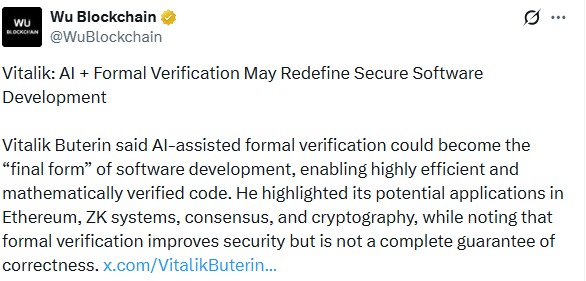
Source: X Account
What Is AI Formal Verification and Why Does It Matter Now
Most crypto hacks do not happen because blockchains fail. They happen because smart contract code has a bug — one edge case the developers did not think of, one logic error hiding in thousands of lines of code.
Traditional audits help. But they are slow, expensive, and depend entirely on humans who make mistakes. An audit samples likely paths through your code. It cannot test every possible outcome.
AI takes a completely different approach.
Instead of testing samples, it writes mathematical proofs about your code — rules your code must always follow no matter what input it receives or what state it reaches. The system then checks automatically whether your code can ever break those rules. It does not sample. It exhausts every logical possibility at machine speed.
Think of a traditional audit as checking whether a bridge holds under normal traffic. AI checks whether it holds under every possible load, wind speed, and failure scenario simultaneously.
The technology has existed for decades. NASA and aerospace firms used formal verification for mission-critical systems for years. What changed in 2026 is that AI now makes it fast and affordable enough for any blockchain team to use.
Tools like Certora Prover and Runtime Verification's platform are already live on Ethereum. Certora verified the Aave v3 contracts before launch and found edge cases no previous human reviewer had spotted. Over 60 DeFi protocols now use some form of it — up from just 12 in 2022, per Tokenomist data as of Q1 2026.
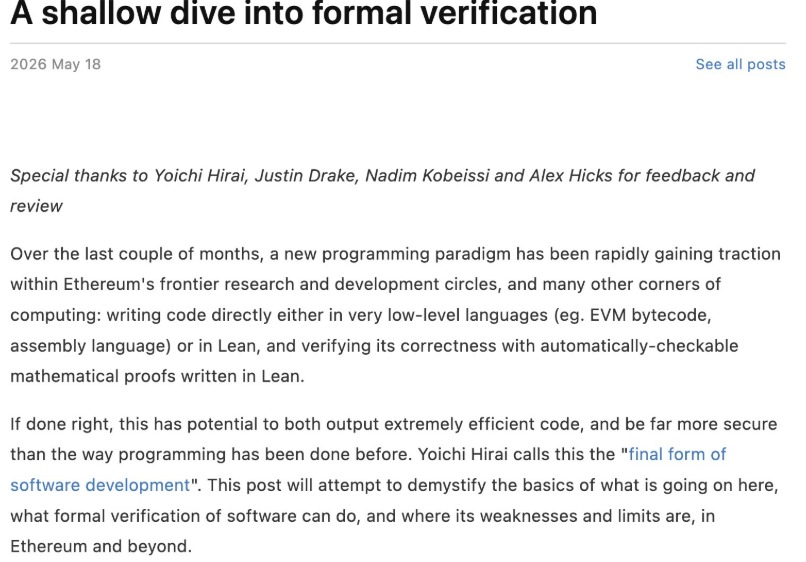
What Vitalik Said — AI Formal Verification on May 18 2026
Vitalik's May 18 post addressed a growing fear in the security community directly.
"Many people have claimed that with AI-assisted bug finding, secure code will be impossible," Buterin wrote. "I have a much more optimistic take, and AI-assisted it is a major part of the reason why."
His argument is that while AI may initially lead to more vulnerable software — by generating large volumes of code at speed—pairing AI-generated code with it could ultimately create more secure systems for blockchains, cryptography, and critical internet infrastructure.
"AI gives you the ability to write large volumes of code at the cost of accuracy, and it gives you back accuracy," Buterin wrote. "By default, AI will enable large amounts of very sloppy code. But there is an optimistic future for cybersecurity here."
Vitalik highlighted specific Ethereum applications where AI is most critical — ZK-EVMs, STARK proofs, quantum-resistant signatures, and consensus algorithms. He pointed to Arklib and EVM-asm as two projects already working on formally verified implementations of key Ethereum components.
Researcher Yoichi Hirai — who reviewed Vitalik's post — has called this direction the "final form of software development." Vitalik framed it as especially important for systems where a single bug can create outsized security damage.
The flywheel is clear. Better specs lead to cleaner code. Cleaner code builds safer protocols. Safer protocols attract more users and capital. More capital funds deeper AI verification tools. Better tools generate better specs — and the cycle compounds.
AI Formal Verification vs Traditional Audits in 2026
The numbers tell a direct story.
Feature | Manual Audit | AI Formal Verification | Hybrid Approach |
Speed | 2 to 4 weeks | Hours to days | 1 to 2 weeks |
Cost | $50K to $200K | $5K to $30K | $20K to $80K |
Path Coverage | Partial | Near-complete | High |
Bug Types Caught | Known patterns | All logical errors | Both |
Best For | Small contracts | Complex DeFi | Production protocols |
Data sourced from Tokenomist Q1 2026 and Runtime Verification public documentation.
Grigore Rosu, CEO of Runtime Verification, has said formal methods are "the only path to provably secure code." His team has verified contracts for Ethereum and Cardano projects directly.
AI tools now cut verification costs by up to 80% compared to full manual audits. Traditional auditing still matters — but relying on it alone is no longer a responsible choice for protocols handling significant user funds.
Where AI Formal Verification Has Real Limits — Vitalik Warns
This is the section most coverage of Vitalik's post is skipping.
Buterin was careful not to overstate the case. Formal verification has real failure modes. Proofs can cover only part of a system while critical bugs hide in unverified sections. Developers can forget to specify properties that matter. The formal specification itself can be wrong. Hardware vulnerabilities like side-channel attacks can bypass even mathematically correct software.
"Formal verification is not a panacea," Buterin wrote. "But it is particularly well-suited for situations where the goal is much simpler than the implementation — this is particularly true in some of the most devilishly hard pieces of technology that we will need to deploy in the next major iteration of Ethereum."
He also warned developers not to expect magic from AI-generated code, saying they should "not assume that you'll be able to put in a single prompt and get a highly-secure version out anytime soon—there WILL be lots of wrestling with bugs and inconsistencies between implementations."
The honest picture: AI formal verification dramatically raises the security floor. It does not eliminate risk entirely. A verified proof is only as good as the specification it was written against — and writing good specifications still requires human judgment.
3 Scenarios for AI Formal Verification in Crypto
Scenario 1 — The Trust Revolution: Every top-tier DeFi protocol mandates AI formal verification by 2027. On-chain insurance premiums drop 70%. Annual hack losses fall below $100 million for the first time. Ethereum's roadmap — ZK-EVM, STARK proofs, quantum signatures — ships faster and at higher security than anyone expected.
Scenario 2 — Steady Progress: AI formal verification becomes standard for Tier-1 protocols only. Smaller projects skip it due to upfront cost. Hacks drop by 40% but do not disappear. The security gap between large and small protocols widens.
Scenario 3 — Over-Reliance Risk: Teams trust AI verifiers too much without carefully reviewing specifications. A major verified protocol still gets exploited through an unspecified edge case. Trust in AI auditing takes a serious hit — and the ecosystem temporarily overcorrects back toward manual-only audits.
Glossary
Formal Verification — A method using mathematical proofs to confirm code always behaves exactly as intended under every possible condition.
Smart Contract — Self-executing blockchain code that handles money automatically without a bank or intermediary.
Invariant — A rule that must always remain true in your code regardless of what input or state it encounters.
Model Checking — An AI technique that tests every possible state a program can reach to find logical errors before the code goes live.
Lean — A mathematical proof assistant that Vitalik highlighted for writing machine-verifiable proofs directly in code — used by the Lean Ethereum project to verify complex STARK theorems.
Conclusion
AI formal verification is not a silver bullet—Vitalik said so himself. But it is the sharpest tool the crypto industry has to close the gap between code that seems correct and code that is mathematically proven correct. In a year where DeFi has already lost over $750 million to exploits, that gap is the most expensive problem in the space. Vitalik's May 18 post is worth reading — not because it promises a perfect future, but because it describes the most credible path to a much safer one.
YMYL Disclaimer: This article is for educational and informational purposes only. It does not constitute financial or investment advice. All quotes attributed to Vitalik Buterin are sourced from his verified X post and blog published May 18, 2026 at vitalik.eth.limo.
Also read:









.webp)