15% Non-Filers, 30% High-Risk: Canada Crypto Tax Report Red Flags


Canada Crypto Tax Crackdown Heats Up: Audits, Data Orders & New Rules
Highlights of the News:
40% of Canada Crypto Tax flagged for evasion or high non-compliance
15% non-filers and 30% high-risk underreporting cases identified
$100 million recovered through crypto tax audits
Dapper Labs probe linked to C$72 million in suspected unpaid taxes
New reporting laws expected by Spring 2026
FINTRAC (Financial Transactions and Reports Analysis Centre of Canada) fines exceed $19.5 million on an unregistered exchange
The tax authority has expressed serious concern regarding Canadian cryptocurrency evasion, and its findings showed that there was a high level of non-adherence to it among digital asset users. New probes, data requests, and future legislation demonstrate a fast-growing crackdown.
CRA Finds Widespread Non-Compliance Among Crypto Users
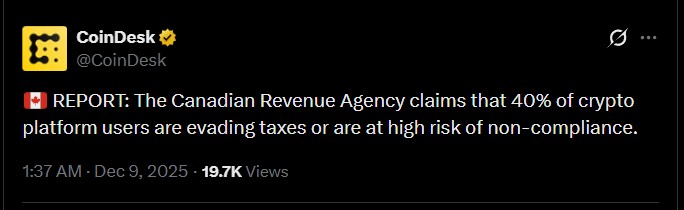
The Canada Revenue Agency (CRA) has reported that 40% of taxpayers using platforms are either evading taxes or are at a high risk of non-compliance, according to findings shared with The Canadian Press.
This estimate combines two major problem groups: 15% who fail to file taxes entirely, and about 30% of filers who are considered high-risk for underreporting or misreporting income.
The CRA says that crypto transactions—due to their decentralized and pseudonymous nature—are increasingly linked to the underground economy, making them difficult to monitor under current laws.
Source: Coindesk X
$100 Million Recovered Through Crypto Audits
The agency has a special asset audit program to fight the increasing problem with 35 auditors. They have audited over 230 taxpayer files in the last three years, retrieving over $100 million in unpaid taxes.
Despite the substantial sums involved, no criminal charges have been laid in cryptocurrency tax cases since 2020. The CRA says most cases are handled civilly because investigations often require complex cross-border evidence and lengthy cooperation with foreign entities.
Dapper Labs Users Targeted in Large-Scale Probe
A major component of the crackdown involves a high-profile investigation into Vancouver-based NFT platform Dapper Labs.
In September, the CRA secured a rare “unnamed persons requirement” order—only the second one ever issued against a Canadian firm—compelling the company to provide user information.
Initially, the agency sought data on 18,000 Dapper users, but negotiations narrowed the request to 2,500 accounts.
The probe is tied to an estimated C$72 million (US$54 million) in suspected unpaid taxes.
Dapper Labs did not oppose the order, but has also not fully commented on the scope of the investigation.
The CRA says this step was necessary due to legal gaps preventing the reliable identification of taxpayers.
Legal Limitations Push Canada Toward New Crypto Reporting Rules
The CRA has openly stated that Canada’s existing tax and reporting laws “cannot reliably identify taxpayers operating in the cryptocurrency space.”
These limitations have prompted the federal government to move toward stricter regulation.
Finance Minister Francois-Philippe Champagne, in October, stated that Ottawa will enact new laws by Spring 2026 to fight financial crimes, such as crypto-related tax evasion. The reform package includes:
A new Federal Anti-Fraud Strategy.
A special Financial Crimes Agency.
Greater reporting and disclosure of digital asset platforms.
This puts Canada in line with the trends in the world, where nations are strengthening regulation as the adoption of cryptocurrency grows fast.
FINTRAC Intensifies Action on Cryptocurrency Sites.
The financial intelligence unit FINTRAC in Canada is also tightening its belt, along with CRA efforts.
It has recently imposed a fine of more than $19.5 million on Seychelles-based exchange Peken Global Ltd. (KuCoin) due to the fact that it was operating in Canada without having registered and due to its failure to meet the anti-money laundering requirements.
What This Means for Crypto Users
For Canadian crypto users, these developments point to stricter reporting requirements, enhanced data sharing, and a higher likelihood of audits. Taxpayers are advised to maintain detailed records of all crypto transactions, including trades, transfers, and NFT activity. Those unsure about their reporting obligations should consider consulting a qualified tax professional to ensure compliance.
Risk Disclaimer
This article is for informational purposes only and should not be considered tax or legal advice. Readers should consult qualified professionals for guidance on cryptocurrency tax compliance and reporting obligations.
Conclusion
The recent actions by the CRA and FINTRAC signal a shift toward more formal enforcement of tax rules in Canada. With increased audits, stronger reporting requirements, and upcoming legislation, both users and platforms can expect greater regulatory oversight as the cryptocurrency market continues to evolve.
Also read:









