Cloudflare Outage 505 Error: React RSC Bug Connection or Not?


Is Cloudflare Outage Hit Crypto Exchanges: Is 505 Server Error Fixed?
When one of the biggest internet services stops working, the whole online world starts shaking. That is exactly what happened today when a sudden Cloudflare Outage created a huge internet slowdown and pushed many websites offline.
Users around the world were shocked as crypto exchanges, trading apps, writing tools, and even outage-tracking websites stopped working at the same time.
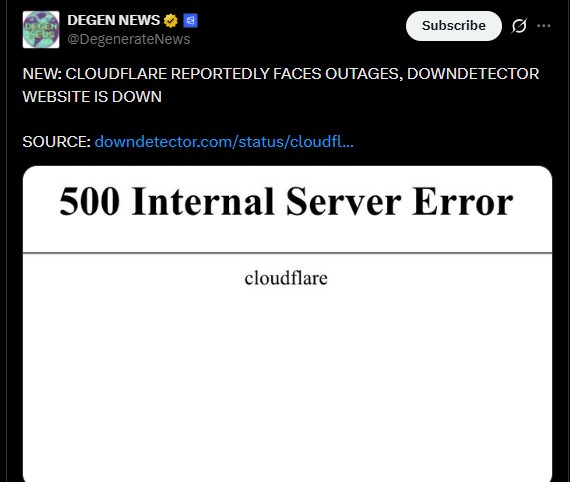
Source: Degen News X Account
Crypto Exchanges and Big Websites Go Down After Cloudflare Outage
The latest crypto news shows how dependent the internet is on this company. A sudden 500 server error appeared across the network, causing problems on many major websites used by millions every day.
Very soon, apps like Coinbase, Kraken, Upbit, CoinDCX, Uniswap and even writing platforms like Quillbot stopped loading.
This chain reaction began right after reports confirmed Cloudflare outage today. Many users started asking: why is it down again? Investors, traders, and students were all affected because the platforms they use daily rely on the network for speed, stability, and security.
Even DownDetector, the website used to check errors, went offline because it also depends on the network's systems. This made the situation even more confusing, as people didn’t know whether their favorite platforms were broken or part of a bigger crash.
Is Today’s Outage Connected to the React RSC Bug?
A major question was raised today: Does the earlier React RSC vulnerability have anything to do with today's outage?
Network’s CTO, Dane Knecht, recently posted that they were closely monitoring the issue.
He said: “If you deploy on netowrk's Workers, you are protected… more variants of this exploit are surfacing… upgrade to patched versions of React and NextJS as soon as possible.”
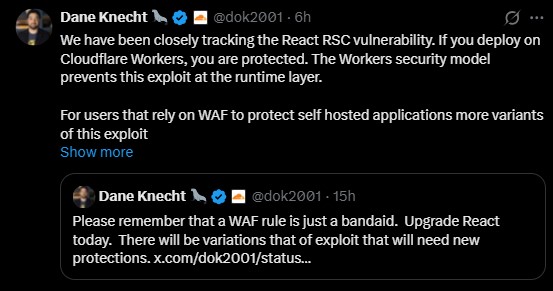
His message increased speculation about whether the error seen today was linked to its internal security systems or the ongoing bug. So far, there is no official statement connecting the two events, but the timing made many users curious.
Flashback: The November 18 Cloudflare Error That Broke the Internet
This incident reminded everyone of the earlier crash that happened on November 18. That day, half the internet went dark. Apps like:
-
X (Twitter)
-
ChatGPT
-
Spotify
-
Several trading platforms
were suddenly unavailable because of a large issue.
It works like the internet’s traffic police. Its network helps websites load fast and stay safe from attacks. So when there is a error, millions of websites lose their speed, safety, and stability. This central point of failure has become a major discussion topic in the crypto world.
Crypto Community Raises Concerns After Platform Freeze
Today’s Cloudflare Outage again exposed how centralized internet infrastructure impacts decentralized finance. Even though crypto exchanges are part of the “decentralized world,” they depend heavily on this system for:
-
UI loading
-
Server security
-
API requests
-
Trading dashboards
When it went down, traders reported frozen charts, failed transactions, stuck login screens, and delays across almost all major platforms. This created fear because many people assumed their exchange had been hacked, when in reality, there were 505 errors on the official system.
Final Outlook: Is the Cloudflare Outage Fixed Now?
Services are now starting to come back online slowly, but many websites are still recovering. The Cloudflare latest news shows that engineers are working to stabilize the system fully.
Today’s incident reminds us that even the world’s biggest platforms can fail when a central service collapses. The internet depends deeply on this network and every new Cloudflare Outage proves how fragile the digital world can be.
Disclaimer: This article is for informational purposes only. Users should always verify information and avoid making financial decisions during service outages.
Also read:








