This content is for informational purposes only and does not constitute legal, financial, or investment advice. Readers should verify regulatory updates from official sources before making decisions related to prediction platforms.
Netherland Polymarket Ban Triggers Major Prediction Market Crackdown

krishna tirthani
Published:
Last Updated:
Netherland Polymarket Ban Explained: Fine, Rules And Market Impact
The Netherland Polymarket Ban has become a major regulatory story after authorities ordered the U.S.-based prediction platform to stop operations across the country. Officials said the service offers gambling activity without a valid license, raising compliance concerns. The Netherlands gambling authority Kansspelautoriteit (Ksa) warned that continued access could trigger a weekly penalty of €420,000 ($494823), rising to a maximum of €840,000($989646). The decision highlights stricter oversight of Polymarket and signals growing pressure on digital betting services operating without approval in Europe.
Official Order From Authorities
Kansspelautoriteit (Ksa) confirmed that the platform must immediately cease activity because users can place wagers on political developments and global conflicts without authorization. According to regulators, these services fall under gambling rules and require licensing before being offered locally.
Key enforcement details include:
Weekly penalty: €420,000
Maximum fine limit: €840,000
Officials stressed that unlicensed space may expose users to risks such as a lack of protection, limited transparency, and unclear dispute resolution.
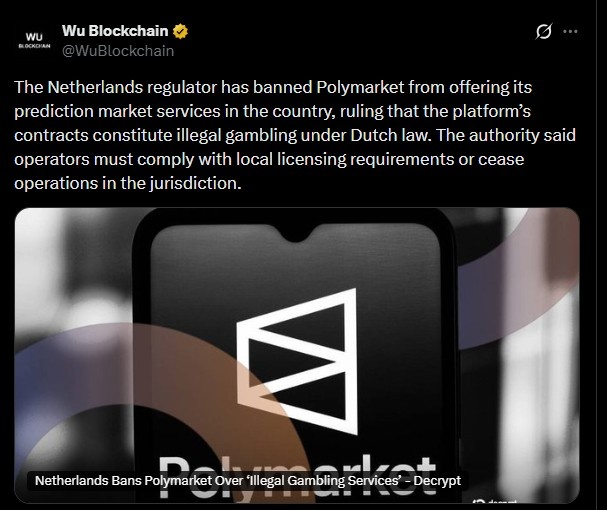
Source: X official
What Is Polymarket?
Polymarket describes itself as the world’s largest prediction market. The platform claims that crowd-driven bets help generate forecasts that can be more accurate than traditional polling or research. The company connects participants who want to wager on outcomes across politics, economics, technology, and major world developments.
This model has attracted traders, analysts, and investors who view prediction markets as alternative data sources. However, regulators often classify these activities as gambling, creating ongoing legal friction.
Election Betting Concerns In The Netherlands
The Netherland Polymarket Ban gained attention after the platform repeatedly appeared in local headlines, especially for markets related to national elections. Authorities said they contacted the company regarding illegal operations, but no visible changes followed. The service remained easily accessible to residents.
To test accessibility, a Ksa supervisor reportedly placed a bet on D66 leader Rob Jetten. The test showed that local users could still interact with the Polymarket without restrictions. Regulators noted the prediction space is owned by Adventure One QSS Inc. and has not secured the required permissions.
Past Incidents And Global Scrutiny
The Polymarket has previously drawn criticism for listing markets connected to international conflict scenarios. Examples included bets on whether Israel might launch another strike on Gaza and whether Russia could capture the Ukrainian city of Pokrovsk before year-end. These listings intensified debate about ethical boundaries around event-based wagering.
Regulatory pressure extends beyond one country. In Belgium, internet providers block access to the platform, while the Netherlands has not yet introduced technical blocking measures.
The company has also faced enforcement in the United States, where it paid a $1.4 million penalty for operating without authorization. Legal challenges later paused during the administration of former President Donald Trump. Reports also highlighted a $10 million investment from Trump’s son, increasing public attention.
A Ksa official stated that any operator without a license has no place in the local market. The statement emphasized that new digital wagering models must follow the same standards as traditional gambling providers.
Conclusion:
The Netherland Polymarket Ban reflects stronger global regulation of prediction space. As enforcement expands, the platform’s European future remains uncertain. This case may influence how governments approach prediction market compliance, licensing requirements, and consumer protection moving forward.
Also read:

Leave a comment







