Strategic Bitcoin Reserve Kansas: SB 352 Proposes State Crypto Fund

Inside the Strategic Bitcoin Reserve Kansas Plan: Crypto Bill Explaine
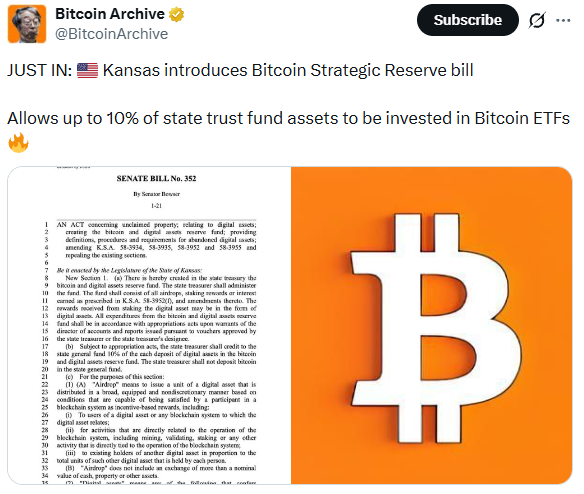
The landscape of American public finance is shifting as Kansas lawmakers introduced Senate Bill 352 on January 22, 2026. This landmark legislation aims to establish a formal Strategic Bitcoin Reserve Kansas can utilize for long-term financial stability. Led by State Senator Craig Bowser, the bill seeks to update the state's treasury by integrating digital assets into the state’s unclaimed property framework. If passed, The Sunflower State would join an elite group of states like Wyoming and Texas in defining the future of sovereign-level digital asset custody.
 Source: X(formerly Twitter)
Understanding Kansas SB 352 and Crypto Unclaimed Property
The core of the proposal involves amending existing laws to recognise Bitcoin and other virtual currencies as "unclaimed property". Under the new rules, custodial assets held by exchanges or banks that show three years of inactivity would be transferred to the Kansas State Treasurer.
Crucially, the bill distinguishes between BTC and other altcoins. While 10% of non-Bitcoin digital asset deposits would be credited to the state general fund, the bill strictly prohibits the liquidation of BTC for general spending. Instead, the Strategic Bitcoin Reserve Topeka would hold BTC in its native form, treating it as a "hard asset" hedge against inflation rather than a liquid revenue source.
KPERS and the 10% Bitcoin ETF Allocation
In a secondary but equally significant move, Senator Bowser has advocated for the Kansas Public Employees Retirement System (KPERS) to allow up to a 10% allocation in Bitcoin exchange-traded products (ETFs). This aligns with a broader national trend where pension funds are seeking "digital gold" exposure to diversify away from traditional bonds.
Custody Rules: Applies only to licensed custodians (exchanges/trusts), not self-custodied hardware wallets.
Yield Generation: The state treasurer is authorized to stake assets and collect airdrops to grow the reserve.
Market Impact: Sales of state-held assets must follow "commercially reasonable" methods to avoid price volatility.
Reddit and Twitter: What the Crypto Community Thinks
Sentiment on Twitter (X) has been overwhelmingly bullish, with prominent voices in the Bitcoin community hailing Kansas as a "sovereign pioneer". However, on Reddit, the discussion is more nuanced. Some users express concern over state custody of private assets, while others argue that using "unclaimed property" is a clever way to build a treasury without using taxpayer dollars.
A common thread across social media is the comparison to the U.S. Strategic Bitcoin Reserve executive order signed in 2025. Many believe state-level reserves are a necessary defense against federal overreach in the digital asset space.
The Future: A Multi-State Digital Stockpile?
As Kansas moves toward committee hearings in early 2026, the success of SB 352 could trigger a "domino effect" in neighbouring states. With the federal CLARITY Act providing a clearer regulatory backdrop, the technical hurdles for state-managed crypto are lowering. The future of Kansas's treasury may soon rely as much on blockchain verification as it does on traditional audits.
Final Thought: The Era of "Digital Gold" Treasuries
We are moving toward a future where a state’s "wealth" isn't just measured in land or tax revenue, but in hash power and block space. SB 352 is an insurance policy. By capping the supply at 21 million, BTC offers Kansas a predictable, math-based future that fiat currency simply can't match.
YMYL Disclaimer: This report is for informational purposes and does not constitute financial or legal advice. Cryptocurrency investments involve significant risk.