Trump Iran Attack Called Off — What Just Happened in crypto?

Trump Iran Attack Called Off — Gulf Leaders Step In at Midnight
What do you do when three of the world's most powerful leaders call you the night before a military strike?
If you are President Donald Trump, you pause—and post about it on Truth Social.
Source: X Account
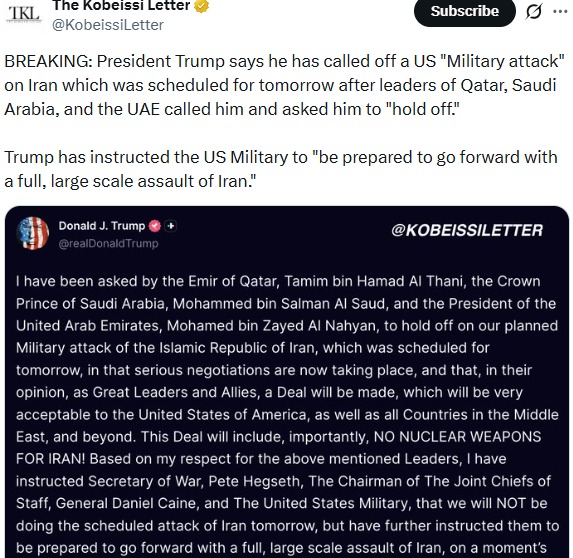
Late on May 18, 2026, his announced that the Trump Iran attack called off decision came directly at the request of three Gulf leaders. The Emir of Qatar, Tamim bin Hamad Al Thani. The Crown Prince of Saudi Arabia, Mohammed bin Salman Al Saud. And the president of the United Arab Emirates, Mohamed bin Zayed Al Nahyan — all three called and asked him to hold off on a planned US military attack on Iran that had been scheduled for the following morning.
The announcement landed without warning. Trump had never publicly disclosed that a strike was planned for Tuesday. The world found out it had been on the calendar at the same moment it found out it was off.
What Trump Said — The Truth Social Post That Shocked the World
His laid out the reasoning in full in his Truth Social post.
The three Gulf leaders told him that "serious negotiations are now taking place" and that "in their opinion, as great leaders and allies, a Deal will be made, which will be very acceptable to the United States of America, as well as all countries in the Middle East and beyond."
The deal, Trump specified, would include one non-negotiable condition—"NO NUCLEAR WEAPONS FOR IRAN."
The announcement was the clearest signal yet that back-channel diplomacy between Washington and Tehran—mediated by Gulf states—had reached a point where the three regional leaders felt confident enough to personally intervene with the US president on a tight deadline.
Iran, for its part, had submitted a new proposal to Washington on Sunday. According to Fars News Agency, Iran's proposal addressed a US five-point list that included a demand to keep only one nuclear site operational and transfer highly enriched uranium stockpiles to the United States. Iran's proposal also emphasized that Tehran would continue to manage the strategic Strait of Hormuz — a vital global energy corridor that Iran has largely kept closed since the war began in late February 2026.
His dismissed an earlier Iranian proposal as "garbage." Whether the latest submission will be treated differently is the question the next 48 to 72 hours will answer.
Why Gulf Leaders Asked Trump to Pause the Iran Attack
The three leaders who called he share a common interest—regional stability and open energy markets.
Trump confirmed the Gulf states had requested "a short delay of two or three days" because "they think they are getting very close to making a deal."
Turkey's Foreign Minister Hakan Fidan added public context on the same day. The immediate focus of negotiations, he said, was keeping the Strait of Hormuz open—a passage through which roughly 20% of the global oil supply moves daily. Iran's nuclear program remained a central issue, but the shipping lane was the immediate pressure point.
Iran's Persian Gulf Strait Authority—a body Iran set up to manage the Hormuz Strait—announced it would provide real-time updates on X of operations and developments in the waterway, a signal that Iran is aware of how closely energy markets are watching every move.
Trump Iran Attack Still On the Table — Military On Standby
The pause is not a cancellation.
Trump was direct about that in the same post where he announced the Iran attack called off decision. He instructed Defense Secretary Pete Hegseth and Joint Chiefs Chairman General Daniel Caine that the US military must "be prepared to go forward with a full, large-scale assault of Iran, on a moment's notice, in the event that an acceptable Deal is not reached."
"I put it off for a little while, hopefully maybe forever, but possibly for a little while," He said separately, acknowledging both the hope for a lasting deal and the reality that the military option remains fully active.
The ceasefire put in place in April 2026 was already described by him as being on "life support" just days before this announcement. US and Iranian forces exchanged fire last week. The two sides have held only one round of formal talks—in Pakistan—since the war began in late February.
For the situation to become a permanent pause, Iran must deliver a proposal that he does not dismiss outright. That has not happened yet. The next window for negotiations is measured in days, not weeks.
Expert Analysis
Geopolitical analysts tracking the US-Iran conflict note that the direct intervention of Qatar, Saudi Arabia, and the UAE on a same-day basis signals that the Gulf states have been actively mediating behind the scenes at a level of intensity not previously visible to the public. The fact that three leaders called simultaneously — and that Trump responded by publicly crediting them — suggests a coordinated diplomatic push rather than three independent requests. The military standby order Trump issued alongside the pause is standard escalation management. What is less standard is announcing a planned strike publicly only after calling it off — a communications pattern that reflects both the domestic political audience Trump is managing and the pressure he faces from Gulf allies who have demonstrated clear strategic value as intermediaries with Tehran.
Conclusion
The announcement on May 18, 2026, is one of the most consequential overnight developments in the US-Iran conflict to date. Three Gulf leaders intervened personally. A Tuesday strike was revealed and cancelled in the same post. The military remains on standby. The next 48 to 72 hours — and whether Iran's latest proposal meets Trump's threshold — will determine whether this pause becomes a turning point or just another chapter in a war that has already reshaped the Middle East.
YMYL Disclaime: This article is for informational and news reporting purposes only. All quotes attributed to President Trump are sourced from his verified Truth Social post published May 18, 2026.
Also read:






