Winterminute: Crypto vs Equities Retail Flow Flip Reshapes Markets


Crypto vs Equities Retail Flow Turns Negative as Stocks Lead
A major shift is unfolding in the Crypto vs Equities Retail Flow dynamic. For years, retail investors treated crypto and U.S. stocks as similar risk assets. When confidence was high, money flowed into both. But data now shows that pattern broke down toward the end of 2024.
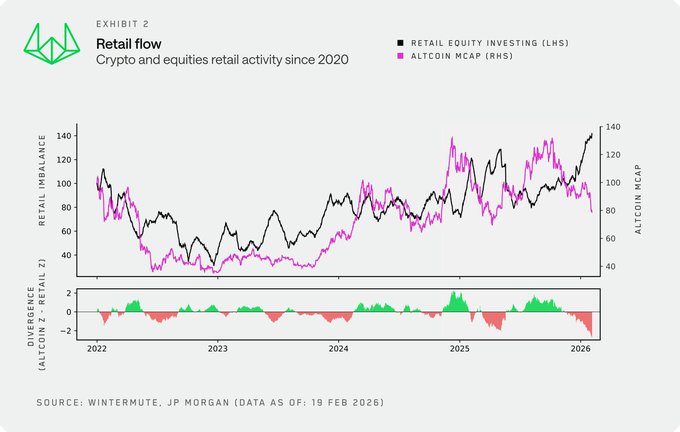
According to Wintermute’s report, retail funds have been moving into U.S. equities at a record pace, while digital currency activity especially in altcoins has slowed. Instead of buying both markets together, everyday investors are now choosing between them. The correlation between equity inflows and crypto flows has flipped from positive to negative.
Current Market Snapshot
Bitcoin is trading around $67,950, showing mild short-term weakness. The total crypto market cap stands near $2.35 trillion, with daily trading volume around $100 billion. The Fear and Greed Index is at 16, signaling extreme fear in the broader market. Altcoin market cap has also declined, which often reflects lower participation of small and active traders.
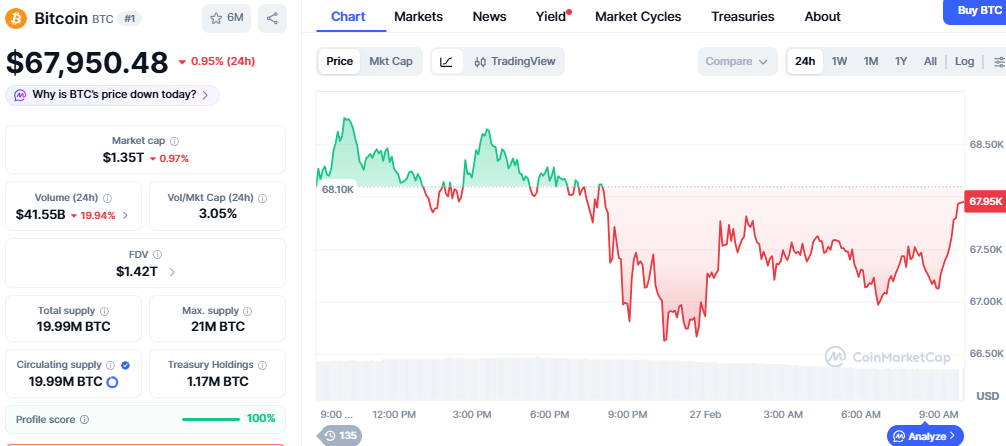
Source: CoinMarketCap Chart
In contrast, the Nasdaq Composite is holding firm near 22,878 and has gained roughly 1.49% over the past five days. It recently touched levels above 23,100 before a small pullback. Everyday investors continue to buy dips in equities, reinforcing the widening the gap.
This divergence supports the idea of ongoing capital rotation, where funds are moving out of virtual currencies and into stocks.
From Moving Together to Moving Apart
Between 2022 and late 2024, crypto and equities broadly moved in tandem. During risk-on periods, investors bought both markets. But that relationship has now clearly changed.
Overlaying retail equity inflow data shows the widest divergence in recent history. Investors shift to stocks aggressively, while retail money leaving crypto has contributed to softer altcoin performance.
Source: Winterminute Report
The rolling correlation confirms it: what was once a mostly positive relationship has turned negative. The Crypto vs Equities Retail Flow story is no longer about shared momentum, it is about substitution.
Volatility Is No Longer the Same Draw
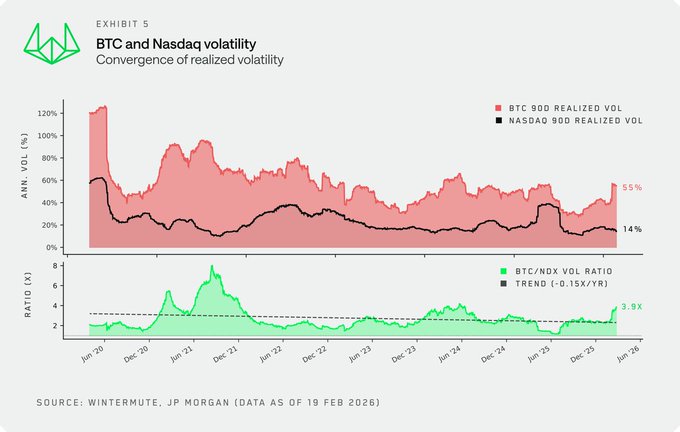
Digital currency has always been attractive to retail traders due to strong price movements. Volatility was the result. But now, this advantage is diminishing.
The BTC/NDX volatility ratio has been moving lower and has fallen below 2 times in the first half of 2025. Although digital asset is still more volatile than stocks, the difference is not as large as it used to be in previous cycles.
Source: Winterminute
With a market cap above $2 trillion, the industry requires increasingly larger amounts of capital to fuel extreme price movements. As volatility decreases, equities are becoming an increasingly attractive option for traders looking for opportunities. This is a major reason for the change in the Retail Flow pattern.
Technology Is Accelerating the Shift
Another important factor is technology. Today, many trading platforms allow users to buy stocks and digital currencies in the same app. ETFs and cross-platform integrations make switching capital simple and fast.
In earlier cycles, money that entered digital assets often stayed there because moving it out was less convenient. Now, the capital rotation happens almost instantly. Retail money leaving digital currency can quickly find its way into equities without friction.
At the same time, AI tools have given small investors a stronger sense of analytical confidence in stock markets. Clear earnings data and valuation models make equities feel more structured compared to crypto’s expanding token universe.
A New Way to View the Market
The shift suggests that digital assets can no longer be analyzed in isolation. Everyday activity in equities is becoming an important forward-looking indicator for digital currency demand.
For investors, this means watching cross-asset flows more closely. The market is evolving, and success may now depend on understanding how the capital moves between asset classes rather than focusing on one market alone.
YMYL Disclaimer: This content is for informational purposes only and not financial advice. Investing involves risk. Do your own research.
Also read:






