XRP Price Prediction 2026: Will XRP Hit $30 or Fall to $1?


XRP is at a crossroads right now, and traders are asking one question: will XRP hit $30 in the next major crypto cycle?
The token is sitting at $1.38, down 0.40% in the last 24 hours, with trading volume around $2.02 billion. Five straight sessions of losses across Bitcoin, XRP, Ethereum, and Dogecoin have kept the market under pressure.
Yet the latest XRP technical analysis shows an unusual setup developing. A major Bollinger Band squeeze, rising $XRP ETF inflows, and key XRP support and resistance levels could determine whether the market moves toward a recovery or another breakdown.
XRP Price Today: What Is Actually Happening
The altcoin hit $3.65 back in July 2025 after Ripple won its legal battle with the SEC. Since then, it has lost roughly 62% of its value and is now trading at $1.38 with a circulating supply of 61.82 billion tokens.
From an analysis today perspective, the market remains divided between weakening short-term momentum and the possibility of a broader recovery. Traders are watching the $XRP RSI, moving averages, trading volume, and nearby support zones to determine whether the current weakness is temporary. This also keeps the question of $XRP price prediction today closely tied to whether buyers can defend the $1.35 and $1.29 levels.
Most recent buyers are sitting at a loss. The short-term sentiment is bearish. But the technical picture tells a more complicated story, and that is exactly what makes this moment worth paying attention to.
Bollinger Band Squeeze: What Does It Mean for Price?
As per crypto analyst Ali , the 3-day chart is showing its tightest Bollinger Band squeeze in over a year. That is not a minor detail.
Traders are also monitoring the $XRP RSI alongside the Bollinger Band setup. RSI can help identify whether momentum is becoming overextended, while the Bollinger Band squeeze highlights the possibility of an upcoming volatility expansion. Together with trading volume and moving averages, these indicators form part of the technical framework used to assess the current forecast.
When Bollinger Bands compress this tightly, it means volatility has almost completely dried up. Price gets coiled like a spring. And when that spring finally releases, the move is almost always sharp and quick.
The bands do not tell you up or down. They tell you something big is about to happen.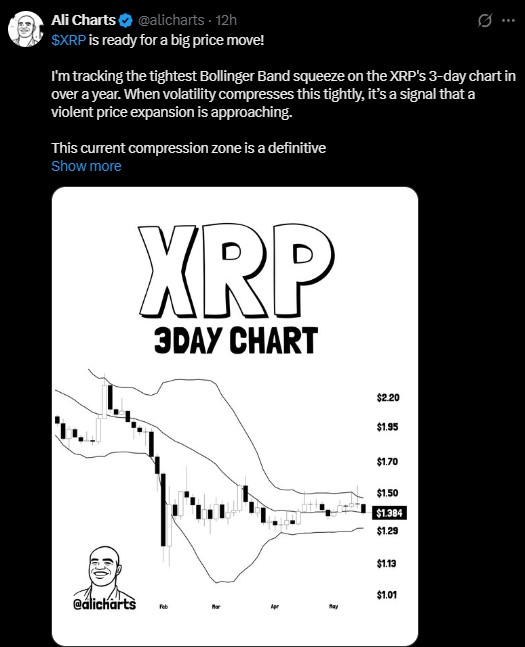
Right now, experienced traders are staying flat. No long, no short. Just watching.
What Are the Key XRP Price Levels to Watch Right Now?
The current XRP support and resistance structure is straightforward. Bulls need to reclaim the $1.50 area, while bears are watching $1.35 and $1.29 as important downside levels. These zones are likely to determine the short-term XRP price prediction this week and whether the current consolidation develops into a larger breakout or breakdown.
Three numbers matter more than anything else this week.
$1.50 is the line bulls need to break. A clean 3-day candle close above it opens the path to $1.80, and then the $2.00 to $2.20 zone after that.
The broader technical picture also depends on XRP moving averages and Fibonacci levels. A sustained move above key moving averages would strengthen the bullish case, while rejection from those averages could keep the market under pressure. Traders are also watching Fibonacci extension levels above $5 as potential long-term XRP price targets if the current cycle develops into a larger breakout.
Every rally in March, April, and May has stalled at $1.50. Breaking it with a confirmed close changes everything.
$1.35 is the immediate danger zone on the 4-hour chart. Losing this level with volume accelerates the selling pressure fast.
$1.29 is the floor that matters most. A 3-day close below $1.29 breaks the bullish structure completely and puts the $1.00 psychological support back on the table.
For the $XRP price prediction this week, the $1.50 breakout level and $1.29 support floor remain the two most important areas. A move above $1.50 with strong volume could improve the short-term outlook, while a breakdown below $1.29 would shift attention toward lower support zones.
So, is XRP bullish or bearish? The answer currently depends on timeframe. The short-term structure remains cautious while price trades below $1.50, but the broader outlook could turn bullish if ETF inflows remain strong and breaks resistance with expanding volume. For now, the market remains in a decision zone rather than a confirmed trend.
$XRP ETF Inflows 2026: Are Institutions Actually Buying?
Here is what the bearish crowd keeps missing. While spot price drifts lower, institutions are quietly loading up.
XRP ETF inflows just hit their highest weekly level of 2026. In the latest session alone, ETF investors bought $750,440 worth of tokens, pushing total ETF-held net assets to $1.14 billion.
The latest weekly figure is therefore important for the forecast because ETF demand provides a measurable view of institutional interest. However, ETF inflows alone do not guarantee a price increase. Traders should compare net flows with spot volume, trading volume, RSI, and price action around major resistance levels before assuming that institutional accumulation will lead to a sustained breakout.
Cumulative inflows since the ETF launch in late 2025 now stand at $1.32 billion. The week of April 28 brought in $119.6 million, which was 53% of all global crypto fund inflows that week.
Smart money does not panic at $1.38. When price drops and ETF buying increases at the same time, that is called accumulation. It does not guarantee a rally. But it does tell you that the people with the most information are not selling.
Investors asking is it a good buy right now should consider both the bullish and bearish evidence. Rising ETF inflows could signal institutional interest, but it remains below key resistance and is exposed to broader crypto-market volatility. A strong investment thesis therefore depends on individual risk tolerance, time horizon, and whether the investor believes institutional demand can continue growing.
CLARITY Act 2026: Does It Change the Price Target?
The CLARITY Act is the regulatory event with the most direct impact on price this year.
The bill already passed through the Senate Banking Committee, which gave a brief push toward $1.50.
If it reaches the President's desk before July 4, the timeline that analysts are watching closely, it removes the last major legal overhang that has kept large institutions cautious about allocating serious capital to XRP.
Standard Chartered estimates that CLARITY Act passage could unlock $4 to $8 billion in additional ETF inflows. That kind of demand hitting a market with 61 billion tokens in circulation would create real upward pressure on price.
$XRP NEWS: Analysts are increasingly comparing XRP’s current setup to previous cycle breakouts that led to explosive multi-month rallies.
$XRP Price Prediction 2026: Bull, Base, and Bear Case Scenarios
| Scenario | $XRP Price Target | Probability | Key Assumption | Invalidation Level |
|---|---|---|---|---|
| Bear Case | $0.80–$1.20 | 25% | ETF momentum weakens and support breaks | Weekly close below $1.29 |
| Base Case | $1.50–$3.50 | 50% | ETF inflows continue and resistance breaks gradually | Sustained weakness below $1.29 |
| Bull Case | $5–$10 | 20% | Strong ETF demand, regulatory progress, and crypto bull market | Failure to reclaim $1.50 |
| Extreme Bull | $30 | 5% | Major crypto cycle expansion and large-scale capital rotation into altcoins | Long-term cycle fails to accelerate |
These probabilities are scenario estimates rather than guaranteed outcomes. The $30 case carries the lowest probability because it requires a significantly larger crypto market cycle, sustained institutional demand, and substantial capital rotation into XRP. The primary invalidation signals remain a prolonged loss of key support, weakening ETF flows, and a broader crypto market downturn.
Can $XRP Reach $30? The Bitcoin $1.4 Million Theory Explained
A $30 XRP price target needs a basic market-cap reality check. With roughly 61.82 billion $XRP in circulation, a $30 price would imply a circulating market capitalization of about $1.85 trillion. That would place $XRP among the largest crypto assets globally, meaning such a move would require exceptional market expansion, institutional demand, liquidity, and capital rotation into altcoins.
So, will XRP hit $30? The scenario is possible but highly speculative. Analyst Javon Marks has outlined a broader Bitcoin cycle theory in which Bitcoin could enter a major parabolic phase before capital rotates into altcoins, potentially benefiting it. Under this thesis, the $30 target represents a long-term cycle scenario rather than a near-term price prediction.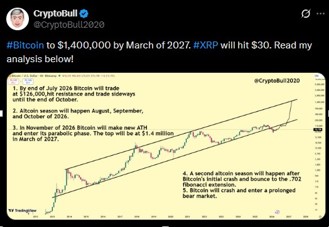
The $XRP halving-cycle correlation also needs clarification. It does not have a Bitcoin-style halving that automatically reduces new supply. Instead, its historical price cycles have generally followed broader crypto market trends, with Bitcoin liquidity and altcoin rotation playing a larger role.
Therefore, the near-term price target depends on reclaiming $1.50, while a $30 valuation would require a sustained crypto bull market and major institutional adoption. The XRP price prediction 2026 remains focused on whether the token can break key resistance and attract stronger institutional demand before the market enters its next major cycle. If momentum continues into 2027, the XRP price prediction 2027 could become the next stage of the longer-term cycle thesis.
This article is published for informational purposes only and does not constitute financial, investment, tax, or legal advice. Cryptocurrency markets are highly volatile and carry significant risk, including total loss of capital. Always conduct independent research and consult a qualified financial advisor before making any investment decision.







.webp)