Layer 1 Blockchains in 2026: Simple Comparison Guide


Layer 1 Blockchains Compared: Speed, Use & Key Differences
You've been hearing words like "Layer 1," "TPS," "consensus mechanism," and "DeFi TVL" thrown around and you're wondering what any of it actually means, and which blockchain is worth paying attention to. You're in the right place.
This guide walks you through the biggest Layer 1 blockchains right now, what makes each one different, and who each one is actually built for. No jargon walls. No hype. Just the honest picture.
What Is a Layer 1 Blockchain?
Think of a Layer 1 blockchain as the foundation of a house.So everything else, like apps and tokens and DeFi protocols and NFT marketplaces are all made on top of the Layer1.
Layer 1 is the layer that takes care of recording all the transactions and setting the rules for the network and keeping it secure. Layer 1 is really the foundation that all these other things are built on.
Bitcoin is a Layer 1. Ethereum is a Layer 1. So are Solana, Avalanche, Cardano, Cosmos, Sui, Aptos, and Hedera. Each one made different trade-offs when they were designed. Some went all-in on speed. Some prioritized decentralization. Some focused on making developers' lives easier. There's no single "best" one, it depends entirely on what you're trying to do.
The Blockchains, One by One
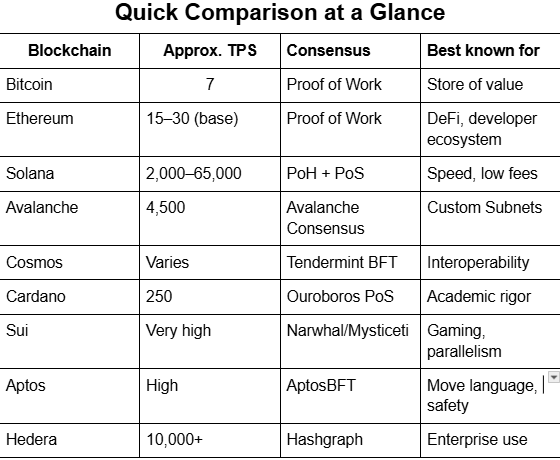
Bitcoin (BTC) — Bitcoin is the original. It was never designed to be fast or host apps. It was designed to be the most secure, most decentralized way to store and transfer value, and it does that job extremely well. At about 7 transactions per second is slow compared to today's standards. That's not what matters.
Bitcoin uses a Proof of Work system which uses a lot of energy but has been tested and proven over 15 years.
If you want a system that's hard to change and has the longest history in cryptocurrency then Bitcoin is still the best choice.
Bitcoin's long history and secure system make it a good option if you want something
It handles 7 transactions per second which might seem slow. Its security and history make up for it.
Bitcoin is still a pick if you want a cryptocurrency with a long track record.
Ethereum (ETH) — Ethereum was the first blockchain to ask, "what if we could run programs on here?" That one idea changed everything. It introduced smart contracts, which opened the door to DeFi, NFTs, DAOs, and most of what we call Web3. It runs at 15–30 TPS on the base layer, though Layer 2 networks push that much higher. It switched to Proof of Stake in 2022, cutting energy use dramatically. Ethereum still holds the largest share of DeFi value locked and has the biggest developer ecosystem in crypto. It's not the cheapest or the fastest, but it's where the most serious money lives.
Solana (SOL) — Solana made a bet on raw speed. Its innovation, called Proof of History, lets the network agree on transaction order without constantly slowing down to verify. The result is a chain handling 2,000 to 65,000 TPS at fractions of a cent per transaction. Solana has had network outages in the past, which shook confidence, but things have been significantly more stable in recent years. It's the go-to chain for high-frequency apps, consumer products, NFT culture, and anyone building something that needs to be cheap and fast.
Avalanche (AVAX) — Avalanche doesn't force you to pick one chain. It lets anyone launch a custom blockchain called a "Subnet" that connects back to the main network. That means enterprises can run their own chains with their own rules while still being part of the broader ecosystem. With around 4,500 TPS and 1–2 second finality, it's fast. Its Avalanche Consensus protocol is energy-efficient and well-designed. If you're a company that wants the benefits of blockchain with control over your own environment, Avalanche's Subnet model is one of the most practical options available.
Cosmos (ATOM) — Cosmos works differently. It does not believe in one chain controlling everything. What if many blockchains could work together?
This is like an internet of blockchains. Each blockchain is independent. Can communicate with others using IBC. The speed of transactions depends on the blockchain. However with Tendermint BFT transactions are usually confirmed quickly.
The Cosmos SDK is a tool that helps you create your blockchain easily. Many big projects such as dYdX and Celestia use it. They chose Cosmos because it is simple to use. The Cosmos network is growing fast. More and more blockchains are joining it.
IBC makes it all possible. It connects the blockchains. Cosmos is changing how blockchains work. It is making them more connected. The future of blockchains is here.
Cardano (ADA) — Cardano is the academic one. It was built by researchers and peer-reviewed at every step. The result is a blockchain that puts correctness and long-term sustainability ahead of speed. It processes around 250 TPS using Ouroboros, a mathematically backed Proof of Stake system. It also has a genuine mission around financial inclusion, especially in Africa. Cardano won't win a speed contest and it wasn't trying to. It's for patient investors and developers who value getting things right over moving fast.
Sui (SUI) — Sui launched in 2023, built by ex-Meta engineers from the Diem project. It introduced an object-centric data model that allows for much higher parallelism — essentially doing many things at once without bottlenecking. Its consensus (Narwhal/Mysticeti) is built for throughput. It's still young, but growing fast and well-funded. Gaming, social apps, and anything needing lots of small simultaneous transactions are where Sui shines.
Aptos (APT) — Aptos came from the same Meta/Diem roots as Sui but went in a different direction. It uses the Move programming language, which was designed with safety in mind from the ground up. Aptos claims up to 160,000 TPS theoretically, real-world numbers are lower, but still fast.
The ecosystem is still finding its footing, but the technical foundation is genuinely solid.
Hedera (HBAR) — Hedera is the odd one out, in a good way. It's not technically a traditional blockchain — it uses a Directed Acyclic Graph and a patented consensus called Hashgraph, which achieves asynchronous Byzantine Fault Tolerance (mathematically the strongest guarantee possible).
It does 10,000+ TPS at very low, predictable fees. It's also governed by a council of major enterprises including Google, IBM, and Boeing. If regulatory compliance, predictable costs, and enterprise-grade governance matter to you, Hedera is in a category of its own.
A Few Honest Things to Keep in Mind Before Investing
Layer 1 tokens are highly volatile. Even the biggest ones can drop 50–80% in a bear market. Never put in more than you can afford to lose entirely.
Network effects matter more than technology. Ethereum isn't the fastest chain, but it has the most developers, most apps, and most liquidity. That's hard to displace, even with technically superior competitors.
The idea that something is going to be the "Ethereum killer" is news. It is probably going to be the case that multiple blockchain chains will exist at the time.
Each Ethereum and other blockchain chains will serve purposes, rather than one blockchain chain being the best, at everything.
The Ethereum blockchain will likely still be used for things and other blockchain chains will be used for other things because the Ethereum blockchain and other blockchain chains are all different.
Token economics matter. Look at total supply, inflation rate, and what the token actually does inside the network. A token with no real utility beyond speculation is a very different kind of bet than one deeply woven into a working ecosystem.
Developer activity is a leading indicator. More builders means more apps, which brings more users, which attracts more capital. Watch GitHub activity and new protocol deployments, they tell you where things are actually heading.
CONCLUSION
There's no one-size-fits-all answer. Bitcoin is for those who want the most battle-tested store of value. Ethereum is for those who want the most mature ecosystem. Solana is for speed and consumer apps. Cosmos is for builders who want their own chain. Hedera is for enterprises that need governance and compliance. Sui and Aptos are bets on next-generation tech still proving itself.
Do your own research, understand what you're buying and why, and don't let the noise of any single market cycle drive your decisions. The projects still standing five years from now will be the ones solving real problems — not the ones with the biggest marketing budgets.
DISLAMIER
This blog is for informational purposes only and is not financial advice. Always research thoroughly before making any investment decisions.
Also read: