CFTC Approves Spot Crypto Trading on U.S. Regulated Exchanges


CFTC Open Path for Spot Crypto Trading Across Regulated U.S. Exchanges
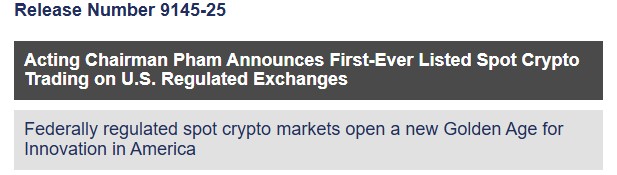
In a landmark move for the digital asset industry, the Commodity Futures Trading Commission (CFTC) has officially approved listed spot crypto trading on U.S. regulated exchanges for the first time.
Source: cftc.gov
This single decision could reshape the entire market – unlocking new capital, accelerating adoption, and helping the United States position itself as the global hub for digital assets.
With this, is the USA finally entering its long-awaited era of fully regulated digital asset markets? Or it's just an add-on of the State’s growth.
A Turning Point for U.S. Digital Asset Markets
Acting Chairman Caroline D. Pham confirmed that spot crypto trading in the USA is now permitted on CFTC-registered platforms. This ends the gap where Americans relied mostly on offshore exchanges lacking strong protections.
Pham emphasized that the CFTC is finally using its long-standing authority to deliver clear rules and protect retail traders. According to her, the approval ends years of “regulation by enforcement” and provides a safe path for USA residents to trade Bitcoin, Ether, and other cryptocurrencies directly on regulated U.S. exchanges.
This shift aligns with the Trump Administration’s broader push to make the U.S. the “crypto capital of the world.”
Major Platforms Preparing to Launch Under the New Rules
With the CFTC greenlighting spot crypto trading:
Coinbase moves from state-level to full federal compliance, a milestone for the largest American exchange.
Bitnomial becomes the first to launch a leveraged retail spot-crypto exchange on December 8 under CFTC regulation.
Kalshi and Polymarket, currently prediction platforms, can now add spot markets.
This creates the first wave of regulated U.S. spot cryptocurrency exchanges, a development analysts expect will attract billions in new capital over the next year.
This marks the beginning of a federally regulated trading ecosystem, a major boost expected to attract billions in new capital and surge in institutional and retail adoption.
America’s Presence Is Growing Faster Than Ever
The regulatory breakthrough comes at a time when crypto activity in the U.S. is already accelerating:

TRM Labs reports 125% growth in global retail cryptocurrency activity from 2024 to 2025 alone.
U.S. crypto transaction volume jumped 50% year-over-year, surpassing $1 trillion between January and July 2025.
Spot Bitcoin ETFs saw nearly $15 billion in inflows in early 2025, showing strong institutional appetite.
If the current pace continues, the estimate transaction volume could jump another 70–90% next year, potentially reaching $1.7–$2 trillion by the end of 2026.
This would mirror previous cycles, such as 2020–2021, when regulatory clarity and institutional entry triggered explosive growth and pushed the markets into a multi-trillion-dollar phase.
Policy Tailwinds Strengthen The Momentum – or Contributing in It?
This rapid expansion isn’t happening in isolation. It follows major political and structural shifts:
Political and regulatory clarity President Trump’s campaign accepted digital coin donations, Congress passed the GENIUS Act, and the administration appointed the nation’s first Crypto Tsar. Together with the CLARITY Act and the White House’s 180-Day Digital Assets Report, fueling the growth.
With the approval of spot crypto trading on CFTC-registered exchanges, the country is achieving one of the most important regulatory milestones in the industry’s history. It provides investor protection, opens the door to institutional capital, and gives USA traders a safe, regulated environment, something that was “unthinkable” just a few years ago.









