What Will Be the Effect of This Weeks Events on Crypto Prices


Major Economic Events Shaping Market Sentiment This Week
Price action over recent sessions has taken on a different tone compared to earlier in the week, as crypto market events impact prices more quickly than before. Movements have become less even, with faster reactions and weaker intraday follow-through.
This shift suggests the market is responding more to positioning and liquidity than to headlines. With several macroeconomic and crypto-specific events approaching, the change in price behavior itself adds quiet attention to what comes next.
FOMC Meeting Minutes Release
The FOMC meeting minutes are still one of the most closely watched events across risk markets. The minutes usually matter less for what they say and more for how they say it. Last time, a subtle shift in tone was enough to unsettle price action briefly, as markets tried to gauge how comfortable policymakers really were with inflation progress.
This time on Tuesday, with the FOMC meeting minutes release, attention is also shaped by growing discussion around when rate cuts might eventually come into view. Minor shifts in language regarding inflation risk, economic strength, or policy patience may affect how quickly prices move after the release even in the absence of a clear signal. In a low-liquidity environment, the minutes are more likely to influence short-term sensitivity across markets than set any clear direction.
U.S. Initial Jobless Claims Data
With U.S. markets closed later in the week, there is not much on the economic calendar, which leaves jobless claims doing more of the work than usual. Lately, markets have shown a habit of reacting quickly to even minor changes in data, especially when liquidity is already thin.
The most recent release was a good example. Prices did move, but it did not stick for long. The reaction faded, with attention drifting back to the bigger policy picture instead of the number on the screen.
That tone had not changed much going into this release. If labor conditions look a little softer or hold steady, it could still affect short-term positioning, though any reaction is more likely to be uneven than directional.
U.S. Market Holiday and Thin Liquidity
Trading conditions are probably going to be lighter than normal because U.S. markets are closed for a holiday. In similar sessions, price action has often become harder to read. Moves show up, but they do not always say much.
Liquidity tends to drop off, and when that happens, prices can swing on relatively small orders. We have seen this before, where a move looks convincing for a moment, then loses momentum as participation fades. In that kind of environment, prices react more to who is trading than to what is happening.
Fed Balance Sheet Statement and Liquidity Signals
Fed balance sheet updates rarely trigger an immediate reaction, and the last one was no different. Although there was little follow-through on either side, the tone was cautious, and prices did not move in a clear manner.
This kind of response fits the current environment with thin liquidity; the balance sheet update is more likely to influence how comfortable traders feel holding positions
Crypto-Specific Events and Coin-Level Market Impact
LIT Token Launch and Early Market Reaction
Pre-market trading showed a quick reaction around December 29, even though the LIT token is still not officially launched. Price picked up from the $3 area as expectations built around a possible launch date, which brought in short-term interest.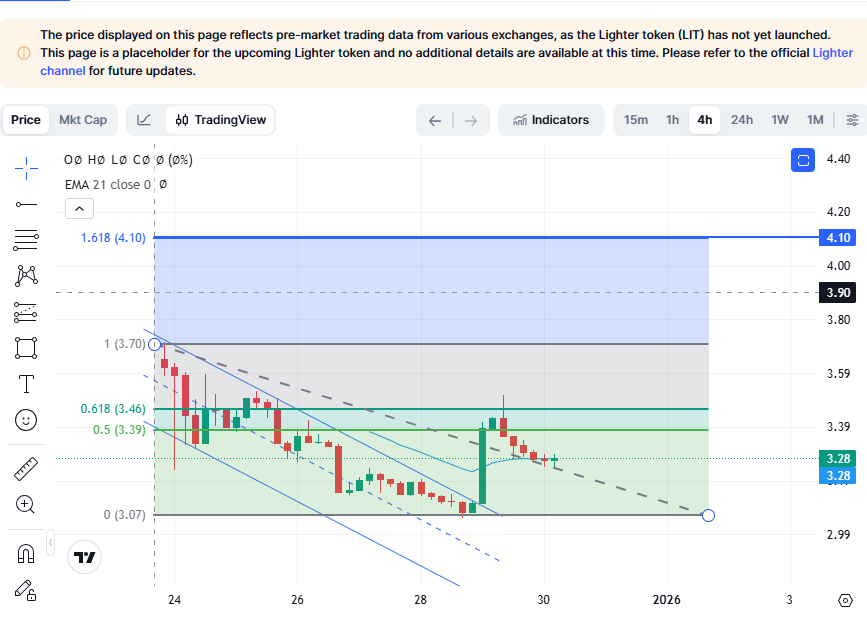
Chart Source: CoinMarketCap
When the launch did not happen as expected, the move lost strength. Follow-through was limited, and price action turned uneven. If the token does launch and the price manages to push past its recent high with real volume behind it, Fibonacci levels place the 4 dollar area as a zone to watch. On the other side, once trading opens, early selling could also weigh on price if participants start exiting positions.
HYPE Token Unlock and Price Structure Around Key Levels
On the 1-hour chart, HYPE is trading inside a rising wedge, and for now, price continues to respect the structure. Also, price is sitting above the 21 EMA, and RSI is hovering near 63. Momentum is there, but it does not feel comfortable anymore.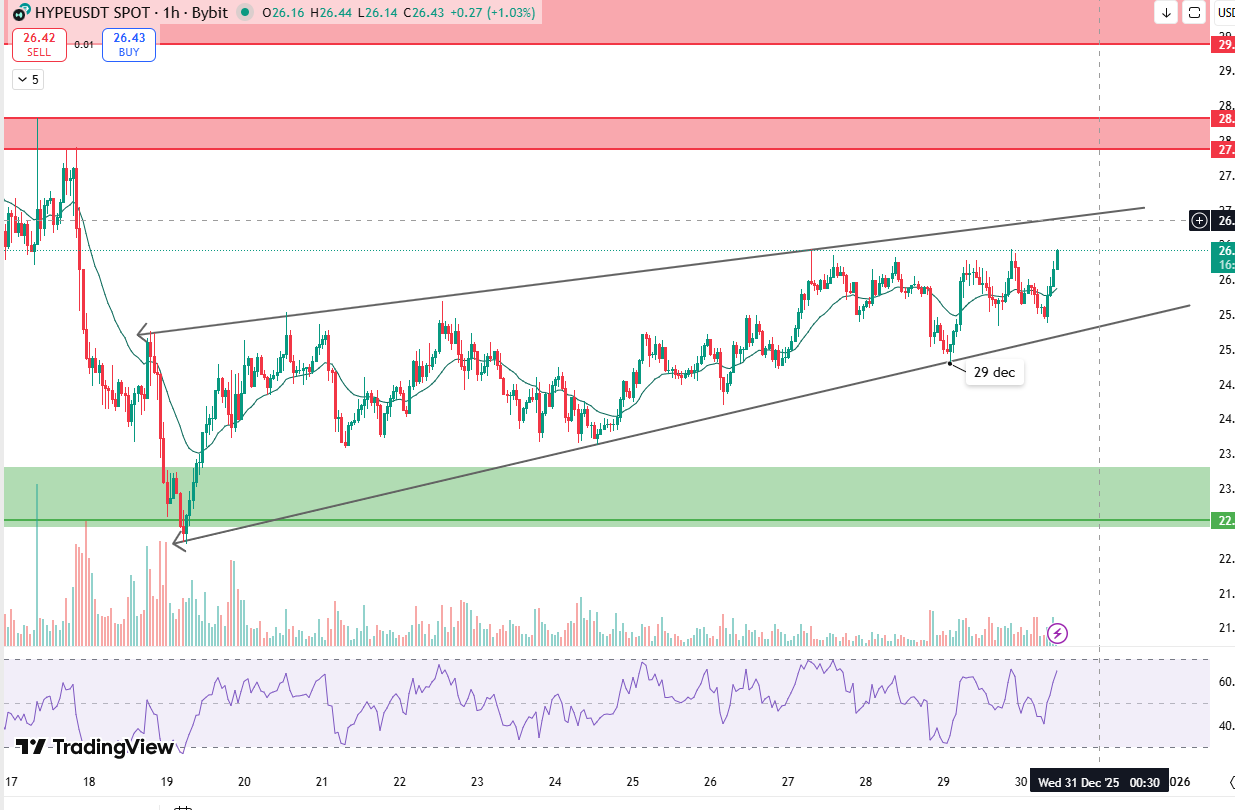
Chart Source: TradingView
If price pushes through the top of the wedge, the area around $28–$29 comes into view. That move would need to hold; otherwise, it risks getting sold into.
On the downside, the upcoming unstaking of 1.2 million HYPE tokens on 6th January 2026, worth roughly $33.05 million, is hard to ignore. If the wedge breaks lower, selling pressure could push the price toward $22.50, and if distribution picks up after the unlock, a move below $20 cannot be ruled out.
AEVO Token Burn and Price Behavior
The news is circulating of Aevo's plans to burn 69M AEVO tokens (7% of its circulating supply) soon, but the price is not really reacting to it. AEVO had been moving inside a rising channel for a while, and that structure finally broke today. Since then, price has been slipping, which looks more like a normal pullback after a decent run than anything else.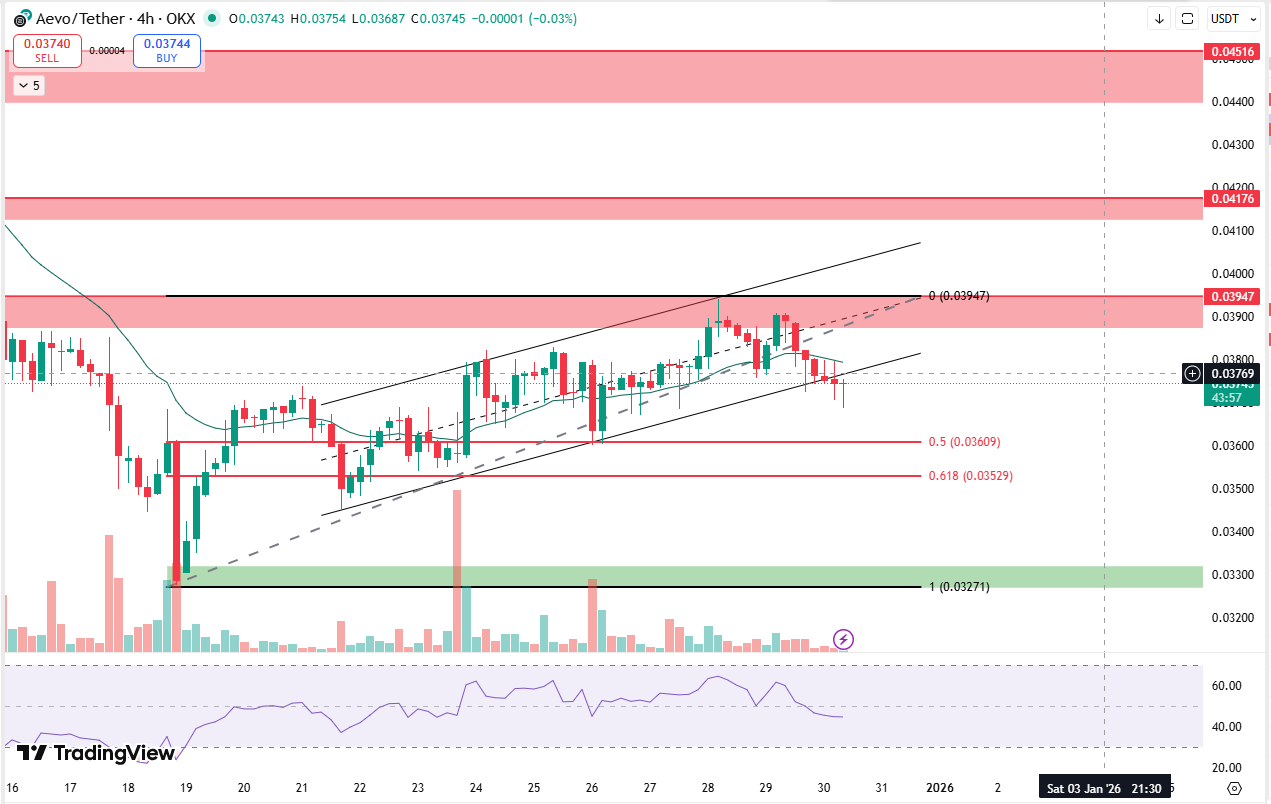
Chart Source: TradingView
If this is just a retracement, price should try to hold near the 0.5–0.618 Fibonacci area and attempt another push higher. If that zone does not hold and the price stays below it, lower support could start coming into play. Volume is thin, RSI is around 46, and momentum feels muted for now.
Conclusion
This week is less about major announcements and more about how prices react to them. Reactions have become quicker, follow-through has weakened, and liquidity has played a bigger role than usual. Macro events are setting the backdrop, while token-specific developments are shaping short-term moves.
So far, the market appears cautious rather than committed. Moves are being made, but conviction remains low. In this kind of setup, how price reacts around key levels matters more than expectations, and those reactions are likely to define the tone going forward.
Disclaimer: This article is for informational purposes only and does not constitute financial advice. Crypto investments involve risk; always do your own research
Also read:










.webp)